On this page
The Museum of American Heritage, known locally as MOAH, is the kind of small museum that surprises people. From the sidewalk on Homer Avenue it looks like a handsome old house with a garden. Inside, it is full of the machines that ran daily life before computers: typewriters, sewing machines, radios, cameras, kitchen gadgets and a print shop that still prints. Admission is free and many of the objects are the kind your grandparents used every day.
In a town famous for digital technology, MOAH tells the story of everything that came before. This guide covers how the museum started, what you will see inside, the history of the Williams House and its garden and the practical details of a weekend visit.
One collector's idea
MOAH grew out of a single private collection. Frank Livermore, a Menlo Park accountant who lived from 1919 to 2000, started collecting in the early 1960s when he bought an old Standard vacuum sweeper from a local junk shop. Over the following decades he gathered hundreds of mechanical and electrical objects. In 1985 he incorporated the museum to share them with the public.
The museum moved several times before settling down. It first opened on September 20, 1990 at 275 Alma Street in Palo Alto. From 1995 to 1998 it used a former BMW dealership on El Camino Real. In 1994 the city chose MOAH to care for the Williams House and after a restoration the museum opened there in 1998. By the time of Livermore's death in 2000, his own collection numbered about 1,000 artifacts.
The collection
Today MOAH holds more than 8,000 accessioned artifacts, which it describes as one of the largest collections of its kind in the country. The focus is mechanical, electrical and technological objects invented or built from the 1750s through the end of the 1950s. The museum's own summary of its mission is "tangibly connecting Bay Area communities to pre-digital-era innovation," covering the span from the telegraph to the moon landing.
Categories include:
- Sewing machines and typewriters
- Cameras, radios and early televisions
- Clocks, calculators and office machines
- Toys and games
- Kitchen appliances and household tools
Most of the collection lives in an off-site warehouse that is rarely open to the public, so only a small share is on display at any time. The full catalog is searchable online. MOAH also lends objects to other institutions, including the San Francisco International Airport museum, History San Jose and the Los Altos History Museum.
What you will see inside
The Williams House has six rooms of permanent exhibits and five rooms of changing shows. The permanent rooms are the heart of a visit:
- The kitchen, furnished as it might have been in the early twentieth century, with the gadgets and appliances a household of that era would have used.
- The general store, a 1920s shop stocked with the original contents of a single store from Chicago.
- The print shop, a working letterpress shop with four letterpress printers and an Intertype typesetting machine.
- The garage and workshop, named for the late board member Marshall Mathews, with a 1915 Ford Model T and a 1939 Ford 9N tractor, a joint project of Henry Ford and Harry Ferguson.
The rotating exhibits change several times a year and draw on the warehouse collection. A recent example was Honoring 35 Years of Collectors, which ran from April to September 2025. Check the museum's visit page for current shows.
The Williams House
The building is a story of its own. Architect Ernest Coxhead designed it in 1907 for Dr. Thomas Marion Williams, his wife Dora Moody Williams and their daughters Betty and Rhona. It cost about $6,000. The exterior is Tudor Revival while the interiors are Craftsman. The plan joins a two-story family home to a one-story medical wing, which had an operating room lit by a large skylight. A detached garage stood out back.
Dr. Williams was one of the town's first doctors and one of its first drivers. Accounts of the house credit his practice with the area's first doctor's office, which later grew into the Palo Alto Medical Clinic. Rhona Williams, the last surviving daughter, died in 1989 and left the house and garden to the City of Palo Alto for park or cultural use in her parents' honor.
The house is listed as a Category II structure on Palo Alto's historic building inventory. MOAH leases it from the city for a nominal fee and pays all upkeep itself, without federal or state funding.

The garden
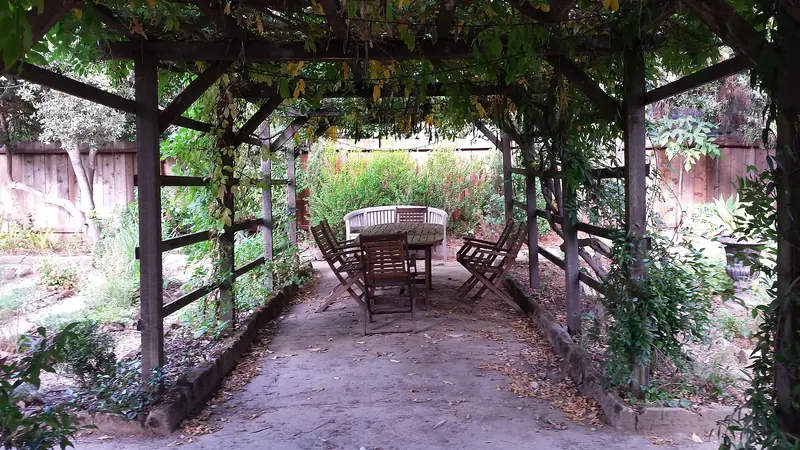
Do not skip the garden. Dora Moody Williams designed it as a series of outdoor rooms set off by rock walls, plantings, paths, fountains and ponds. Some rooms were for lawns and flowers. Others were working spaces for vegetables, medicinal plants and composting. The garden reached its fullest form in the 1920s and 1930s.
In the 1990s a team restored it using Dora's own notes, so it now reflects an early twentieth century working English garden. Volunteers maintain it and donate the food they grow to local food banks. The house and garden together cover about two thirds of an acre, a rare green pocket a few blocks from University Avenue.
Hours, admission and access
MOAH is open on Friday, Saturday and Sunday from 11 a.m. to 4 p.m. Regular admission is free, with a suggested donation of $10 per person. Tours can be arranged and group prices are available through the museum.
Good to know
- Street parking is free on Homer Avenue, though local time limits may apply.
- The back lot is for staff. One accessible space there can be arranged by calling ahead.
- The museum is wheelchair accessible.
- Photography is allowed unless a sign says otherwise.
- No food or drink is allowed in the galleries and none is sold on site.
The museum is a short walk from the downtown Caltrain station and from the restaurants of University Avenue. See our getting to Palo Alto guide for trains and our downtown guide for places to eat before or after.
Events through the year
MOAH runs a few annual events that are worth planning around:
- Vintage Vehicle Family Festival, held during Palo Alto's May Fete weekend, with classic cars on display.
- Winter Lego Show, presented with the Bay Area Lego Users Group.
- Seasonal concerts through the year.
See our events guide for other festivals in town.
Tips for your visit
- Plan for a weekend. With opening hours limited to Friday through Sunday, a weekday trip will find the doors closed.
- Allow an hour. That is enough for the permanent rooms, the changing exhibits and a loop of the garden.
- Bring the kids. Children who have only known touchscreens are often fascinated by typewriters, sewing machines and printing presses.
- Leave a donation. Admission is free, but the museum pays for the house and garden itself, so the suggested $10 helps cover those costs.
- Search the catalog first. If you are curious about a particular object, look it up in the online collection database before you visit.
Pair it with nearby history
MOAH makes a natural pair with the HP Garage at 367 Addison Avenue, a few blocks away, where Bill Hewlett and David Packard started their company. Together they show both sides of the region's story: the analog machines of the past and the birth of the electronics industry. Our Silicon Valley history page fills in what came next.
The streets around the museum also hold the old shingled houses of Professorville and Gamble Garden, another house and garden left to the city by a longtime resident, is a short drive or a longer walk south. If you want stories as you stroll, a self-guided audio tour adds context to a downtown walk.
Frequently asked questions
Is the Museum of American Heritage free?
Yes. The museum says regular admission is free, with a suggested donation of $10 per person. Group visits and tours can be arranged by calling the museum.
When is the Museum of American Heritage open?
The museum lists its hours as Friday, Saturday and Sunday from 11 a.m. to 4 p.m. It is closed Monday through Thursday. Check moah.org before visiting on a holiday weekend.
What is in the Museum of American Heritage?
The museum shows mechanical and electrical technology from before the digital era. Permanent rooms include an early twentieth century kitchen, a 1920s general store, a working letterpress print shop and an early auto garage. Five more rooms hold changing exhibits.
Where do you park for the Museum of American Heritage?
Use free street parking on Homer Avenue, where local time limits may apply. The back lot is for staff, but the museum can arrange the accessible parking space there if you call ahead.
What is the Williams House?
It is the 1907 home and medical office of Dr. Thomas Williams, designed by architect Ernest Coxhead. His daughter Rhona left it to the city in 1989 for cultural use and the museum has occupied it since 1998.