On this page
Visitors who come to Palo Alto in summer see golden hills and assume they always look that way. Come in spring and the same hills are green and spotted with orange, purple, yellow and white. The show depends on the rain. A wet winter followed by mild spring weather can carpet the grassland, while a dry year gives a short and patchy bloom.
This guide picks the best wildflower spots within about half an hour of downtown, from a famous serpentine preserve in Redwood City to the paved Dish loop behind Stanford. Our hiking guide covers the trails themselves. Here we focus on what blooms, where and when.
When to go
Bloom times shift every year, so think in phases rather than dates.
| Phase | Rough timing | What to expect |
|---|---|---|
| Early | Late winter into March | The first poppies, buttercups and blue-eyed grass in sunny low grassland. |
| Peak | Late March into April | Broad color in the foothills and on serpentine soils, with lupine, goldfields and poppies together. |
| Late | May into June | Higher ridges such as Russian Ridge keep blooming, with mule's ears and farewell-to-spring. |
| Over | Summer | Grass turns gold. Look for the occasional late bloomer in shady canyons. |
Sunny south-facing slopes bloom first and shaded or higher ground follows. If you miss the peak in the low hills, drive up to the ridge a few weeks later. Our month guides for March and April cover the weather and events that go with the season.
Edgewood Park and Natural Preserve
Edgewood is the wildflower destination on the Peninsula. The San Mateo County park covers 467 acres just off Interstate 280 near Redwood City, with more than ten miles of trails. The entrance is at 10 Old Stage Coach Road.
Why it is special
About 160 acres of Edgewood sit on serpentine soil, a rock type that is high in heavy metals and low in the nutrients most plants need. Grasses from Europe that crowd out wildflowers elsewhere struggle on serpentine. Native plants adapted to it thrive. The result is some of the densest and most varied spring color in the Bay Area. Friends of Edgewood counts more than 500 plant species in the preserve.
The serpentine grassland is also home to the Bay checkerspot butterfly, a threatened species whose caterpillars depend on specific native plants. Look for goldfields, poppies, owl's clover, tidy tips and lupine in the open grassland in a good year.
A preserve that was almost a golf course
San Mateo County bought the land in the early 1980s and approved an 18-hole golf course there. A coalition of conservationists fought the plan for years. In the summer of 1993 the Board of Supervisors declared the area a Natural Preserve instead.
Docent walks
Friends of Edgewood volunteers lead free docent walks on Fridays, Saturdays and Sundays from March through May, with advance registration. They are the best way to learn the flowers by name and to understand the serpentine story. The Bill and Jean Lane Education Center, also staffed by volunteers, is open on weekend days and on Wednesday mornings. Check Friends of Edgewood for the walk schedule and meeting points.
Russian Ridge
Drive up Page Mill Road to Skyline Boulevard and the main Russian Ridge lot sits right at the intersection. The Midpen preserve covers more than 3,000 acres of open ridgeline and its grassland is one of the best wildflower displays in the Santa Cruz Mountains. Poppies and lupine come first, followed by mule's ears, farewell-to-spring and many others into May and June.
Midpen closes all areas to off-trail use during wildflower season, so stay on the path. The main lot has only 37 spaces and fills on spring weekends. Go on a weekday or early in the morning. Fog can sit on the ridge even when it is sunny below, so bring a layer. Our hiking guide has trail details and Midpen's Russian Ridge page posts current conditions.

Pearson-Arastradero Preserve
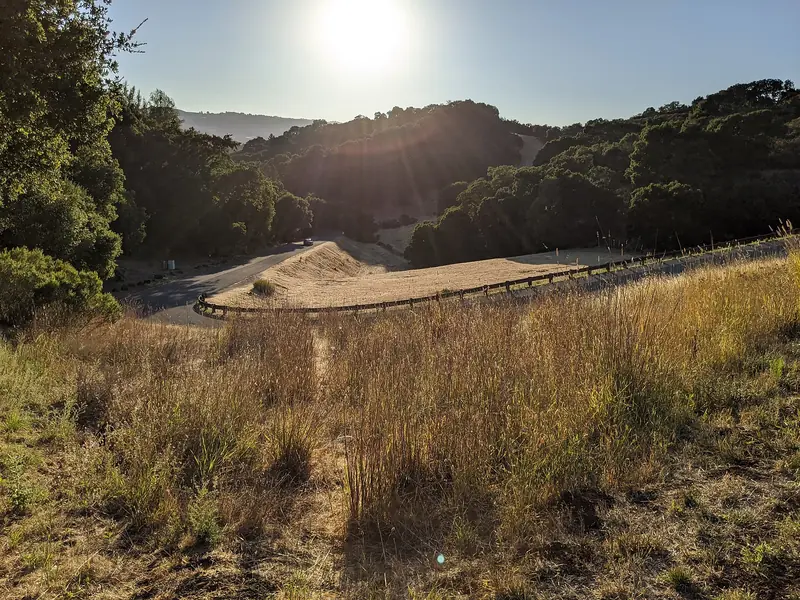
Arastradero is the closest real wildflower walk to downtown. Its 622 acres of rolling grassland and oak woodland green up with the first rains and bloom through spring. Look for poppies and lupine on the open slopes and smaller flowers such as blue-eyed grass along the trail edges. The preserve's grassland also draws western bluebirds, which makes a spring morning here good for both flowers and birds. See our birdwatching guide.
The preserve is open 8 a.m. to sunset and parking is free at 1530 Arastradero Road. Some trails close after heavy rain until the ground firms up, which often happens just as the flowers start. Check the city's trail status before you go.
The Stanford Dish
The Dish is better known as a workout, but in spring the hillsides along the paved loop turn green and then light up with poppies and other flowers. It is an easy way to see spring color without leaving town. The land beside the road is Stanford research and habitat land, so stay on the pavement. Dogs and bikes are not allowed and Stanford sets the hours by month.
More places to look
- Foothills Nature Preserve. Foothills has spring poppies, blue oaks and madrone along its trails. The vehicle fee and visitor cap apply.
- Jasper Ridge. Stanford's biological preserve in the hills is famous among scientists for its serpentine grassland and checkerspot research. It is open only on guided visits. See our Jasper Ridge guide.
- Windy Hill. The grassy summit above Portola Valley greens up in spring and gives wide views with the flowers.
Five flowers to learn first
You do not need a field guide to enjoy the bloom, but knowing a few names makes a walk more fun. These are common in the grassland around Palo Alto in a good year.
- California poppy. The state flower, bright orange and cup shaped. The petals close on cloudy days and in the evening.
- Lupine. Spikes of blue to purple pea-like flowers with leaves shaped like a hand. Often grows in big patches.
- Goldfields. Tiny yellow daisies that can turn a whole slope yellow, especially on serpentine soil at Edgewood.
- Blue-eyed grass. Not a grass at all but a small iris with purple-blue petals and a yellow center.
- Mule's ears. Big yellow sunflower-like blooms with large leaves, common on the higher ridges later in the season.
Docents at Edgewood and Midpen naturalists can add dozens more to your list. A free plant identification app also helps, as long as you photograph from the trail.
Rules and how to protect the bloom
Wildflowers are fragile and a single trampled patch can take years to recover. The rules are simple and they apply in almost every preserve.
Good to know
- Stay on the trail. Some preserves, such as Russian Ridge, close all off-trail areas in spring. Even where they do not, walking into the grass crushes plants.
- Do not pick. Picking or digging plants is not allowed in city, Midpen or county preserves.
- Photograph from the path. A zoom or macro lens gets you close without stepping in.
- Watch for hazards. Spring is tick season and rattlesnakes come out on warm days. Poison oak grows along many trail edges.
- Check closures. Muddy trails close after rain and some ridge areas close during fire weather.
Spring weather changes fast. A warm afternoon in the valley can mean fog and wind on the ridge. Our weather guide explains the patterns.
Frequently asked questions
When is wildflower season near Palo Alto?
Most years the show runs from about March through May. Early bloomers appear in late winter after good rains, the low hills usually peak in spring and the high ridges along Skyline Boulevard keep blooming into late spring. Dry winters shorten the season.
Where is the best wildflower hike near Palo Alto?
Edgewood Park and Natural Preserve in Redwood City is the classic choice, thanks to its rare serpentine grassland. Russian Ridge on Skyline Boulevard is the best ridgetop display. Closer to town, Pearson-Arastradero Preserve and the Stanford Dish have good spring color.
Are there guided wildflower walks near Palo Alto?
Yes. Friends of Edgewood volunteers lead free docent walks at Edgewood on Fridays, Saturdays and Sundays from March through May. Register in advance through the group's Eventbrite listings. Stanford's Jasper Ridge Biological Preserve is also known for spring flowers but is open only on guided visits.
Can I pick wildflowers in the preserves?
No. Picking or removing plants is not allowed in city and Midpen preserves or in county parks. Some wildflower areas also close to off-trail use in spring, so stay on the path and take photos instead.
Is it safe to walk off trail for wildflower photos?
It is not allowed in many preserves and it damages the plants. Off-trail grass also hides ticks and rattlesnakes and poison oak grows along the edges. Use a zoom lens and stay on the trail.