On this page
Palo Alto spent the 2010s as the most famous small city in technology. The companies kept coming, outgrowing their offices and leaving for bigger campuses nearby. Home prices climbed far beyond the reach of most workers. The city's politics turned on a handful of questions that are still open: how much office space to allow, how much housing to build and who gets to stay. Meanwhile a long-promised rebuild of the railroad finally got under way.
This page covers 2010 through 2019, with a few loose ends that ran past the decade. It follows our page on the dot-com era, which ends with Facebook's arrival downtown.
Companies come and go
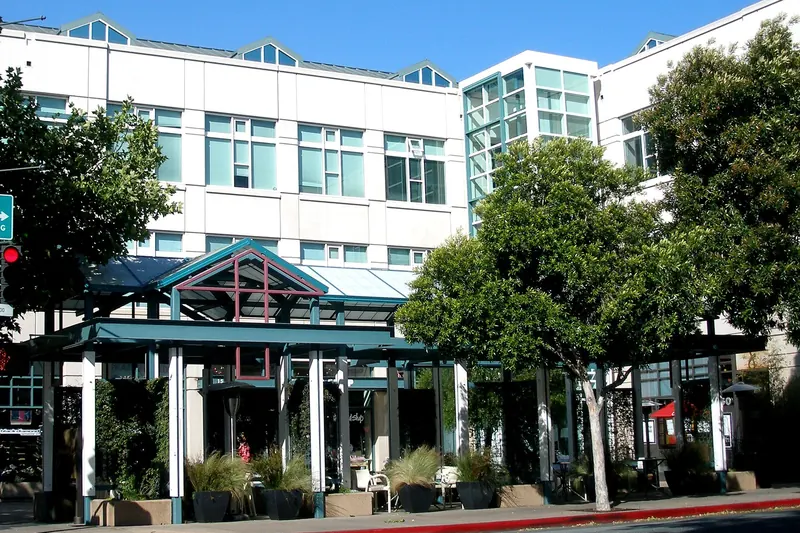
The decade's company stories mostly played out in Stanford Research Park, where the land is Stanford's and the buildings are big:
- Facebook. It had moved nearly 900 local employees from about ten downtown buildings into 1601 California Avenue in May 2009. In early 2011 it announced a move to the former Sun Microsystems campus in Menlo Park and staff began moving that year. Our Facebook page has the details.
- Tesla. Tesla announced its Palo Alto lease on August 17, 2009. It made 3500 Deer Creek Road, a former Hewlett-Packard and Agilent site, its headquarters from 2010. It stayed until the move to Texas announced in December 2021. See our Tesla page.
- Theranos. The blood-testing startup worked from 1601 S. California Avenue from 2012, then from 1701 Page Mill Road from 2015 to 2017, before its collapse.
- Hewlett-Packard. The company born in a Palo Alto garage split in two in 2015, into HP Inc. and Hewlett Packard Enterprise. HP Inc. kept its headquarters on Page Mill Road.
Downtown stayed a startup address, with many firms in the upper floors of University Avenue buildings. Palantir, founded in 2003, spread across offices on Hamilton Avenue. In October 2011 Steve Jobs, who had lived in Palo Alto for two decades, died at his home in the city. Our Steve Jobs page covers his local story.

The shuttle era
As big campuses grew in Menlo Park, Mountain View and beyond, companies ran private buses to bring workers down from San Francisco. Unmarked white coaches on El Camino Real and the freeways became a familiar sight. In late 2013 protesters in San Francisco began blocking these "Google buses" at city bus stops, turning them into a symbol of rising rents and displacement. The protests happened up the Peninsula, not in Palo Alto, but the argument behind them was the same one Palo Alto was having: jobs were growing much faster than homes.
The housing fights
Palo Alto's population rose from 64,403 in 2010 to 68,572 in 2020, slow growth for a city with so many jobs. In 2010, Wikipedia notes, it ranked as the second most expensive city in the United States, with four-bedroom homes averaging about $1.48 million. Two fights defined the decade.
Maybell Avenue and Measure D
The Palo Alto Housing Corporation proposed 60 affordable apartments for seniors and 12 single-family houses on a former orchard site at 567 to 595 Maybell Avenue. The City Council approved the rezoning. Neighbors gathered signatures for a referendum and on November 5, 2013, voters rejected Measure D with 8,476 no votes to 6,538 yes votes, or 56.45 percent against. The project died. For many residents the vote became shorthand for the city's resistance to new housing.
Buena Vista Mobile Home Park
Buena Vista, on El Camino Real, was Palo Alto's last mobile home park. The Law Foundation of Silicon Valley described its roughly 400 residents as mostly Latino and low-income. When the owners sought to close it, residents fought back through hearings and the courts. In 2017 Santa Clara County Superior Court Judge Brian Walsh ruled for the residents' association and ordered the city to revise its relocation assistance plan. The Housing Authority of Santa Clara County then approved a plan to acquire the park, with eminent domain as an option, so residents could stay. Our page on Latino history places the fight in a longer story.
By the end of the decade, Wikipedia reports, the city had built low-income housing to meet only 13 percent of its state-mandated share. Our guide to below market rate housing explains the programs that exist.
Limits on offices
The other side of the housing debate was office growth. The 1986 downtown cap had a review point at 235,000 square feet of new space and a city report in the 2010s found about 251,690 square feet added since 1986. In 2015 the council set an annual cap on new office space downtown, on California Avenue and along El Camino Real. It also moved to protect ground floor shops. Palo Alto Online reported in February 2019 that the city scrapped the old downtown cap in favor of other controls. Our page on University Avenue's tech history covers those rules.
Rebuilding the railroad
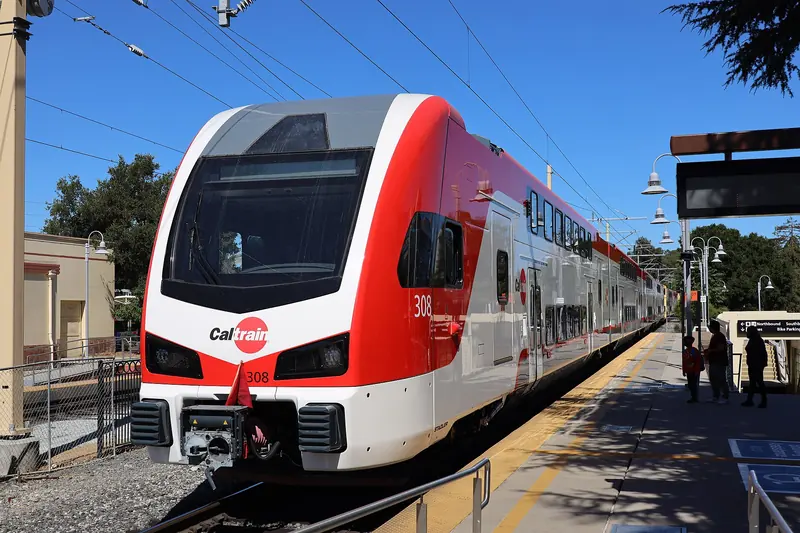
For a century Caltrain's diesel locomotives had rumbled past El Palo Alto and the downtown station. In the 2010s the long-planned Peninsula Corridor Electrification Project moved from paper to poles and wires, with construction under way by the end of the decade. Electric service finally began in 2024. Palo Alto also began studying how to separate road and rail at its street-level crossings, a debate over cost and neighborhood impact that continued into the 2020s. See our Caltrain guide for riding today.

Libraries, schools and names
Several civic projects finished during the decade. The rebuilt Mitchell Park Library and Community Center opened on December 6, 2014, at 56,332 square feet and a cost of $46.3 million. The renovated Rinconada Library reopened on February 14, 2015.
The school district grew again and confronted its own history. In March 2017 the board voted to drop the names of David Starr Jordan and Lewis Terman from two middle schools because of their links to eugenics. A year later it chose Frank S. Greene Jr. and Ellen Fletcher as the new names. Our school district history tells that story.
The city also celebrated itself. In 2018 the City Council named April 9, the anniversary of the 1894 incorporation vote, Palo Alto Day. That August the IEEE dedicated a milestone plaque at the site of Shockley Semiconductor Laboratory in Mountain View.
2010s timeline
- 2010: Tesla moves its headquarters to 3500 Deer Creek Road. The census counts 64,403 residents.
- 2011: Facebook begins moving to Menlo Park. Steve Jobs dies in Palo Alto in October.
- 2013: Voters reject Measure D on Maybell Avenue. Shuttle protests begin in San Francisco.
- 2014: Mitchell Park Library opens on December 6.
- 2015: Rinconada Library reopens. HP splits in two. The city caps annual office growth.
- 2017: A judge rules for Buena Vista residents. The school board votes to drop the Jordan and Terman names.
- 2018: April 9 becomes Palo Alto Day. Greene and Fletcher are chosen as new school names.
- 2019: Palo Alto Online reports the end of the 1986 downtown cap.
Frequently asked questions
When did Facebook leave Palo Alto?
Facebook announced in early 2011 that it would move to the former Sun Microsystems campus in Menlo Park and staff began moving that year. It had been based at 1601 California Avenue in Stanford Research Park since May 2009 and planned to give up its Palo Alto offices by 2013.
Where was Tesla's headquarters in Palo Alto?
From 2010 until 2021 Tesla's headquarters was at 3500 Deer Creek Road in Stanford Research Park, a former Hewlett-Packard and Agilent site on 23 acres. Tesla announced its move to Austin on December 1, 2021. In 2023 it named 3000 Hanover Street its global engineering headquarters.
What was Measure D in Palo Alto?
Measure D was a November 2013 referendum on rezoning land on Maybell Avenue for 60 affordable senior apartments and 12 houses proposed by the Palo Alto Housing Corporation. Voters rejected it with 56.45 percent voting no, which stopped the project.
What happened to the Buena Vista Mobile Home Park?
The owners sought to close Palo Alto's last mobile home park, home to about 400 mostly Latino, low-income residents. Residents fought the closure in court and in 2017 a judge ordered the city to revise its relocation plan. The county housing authority then moved to acquire the park so residents could stay.
When did Caltrain become electric?
Construction on the Peninsula Corridor Electrification Project got under way in the late 2010s and electric service began in 2024. The new trains ended more than a century of locomotive smoke past El Palo Alto and the Palo Alto stations.