On this page
No decade changed Palo Alto more. In 1950 the city had 25,475 people and a good deal of orchard land. By 1960 it had 52,287 people, a research park full of electronics firms, a regional shopping center, a second high school and thousands of new houses with flat roofs and glass walls. A few miles south, a lab opened in 1956 that would give the region its later nickname.
This page summarizes the 1950s theme by theme and links to the longer pages. Our page on postwar growth, 1945 to 1970 covers the same boom with more detail on annexations, traffic and schools.
A new kind of city government
Palo Alto started the decade by changing how it was run. Since 1909 it had been governed under a charter with a 15-member council. In 1950 it adopted the council and city manager system it still uses today. The timing mattered, because the next ten years would bring a flood of decisions about land, roads and schools.
Most of the growth came by annexation. The area of the future Stanford Shopping Center joined in 1953. Ventura, including the old cannery district, came in on December 29, 1954. Land for the research park and areas east of the Bayshore Highway followed during the decade. The foothills came in between 1959 and 1968. In 1958 Dr. Russel V. A. Lee offered the city about 1,294 acres of hill land at $1,000 an acre after turning down developers, the core of what is now Foothills Nature Preserve. See our Russel Lee page.
Stanford leases its land
Stanford had a great deal of land and little cash. Its founding grant barred selling the farm, but nothing stopped the university from leasing it. Frederick Terman, back from wartime radar work as dean of engineering, pushed the idea of putting technology companies next to the campus. In 1951 the university and the City of Palo Alto created the Stanford Industrial Park along Page Mill Road, often described as the first university research park in the world. Our Frederick Terman page explains his thinking.
The tenants came quickly:
- 1953: Varian Associates, the klystron company founded by the Varian brothers in 1948, became the first firm on site. See the Varian brothers.
- 1956: Hewlett-Packard leased 40 acres. It opened its first building there in 1957 and moved its headquarters to 1501 Page Mill Road in 1960.
- 1956: Lockheed opened a Palo Alto research lab while building its missile and space campus in Sunnyvale.
HP sold stock to the public for the first time in 1957. The same year its senior managers wrote down six corporate objectives that became known as the HP Way. Our page on Hewlett and Packard follows the founders through the decade.
Eichler's houses
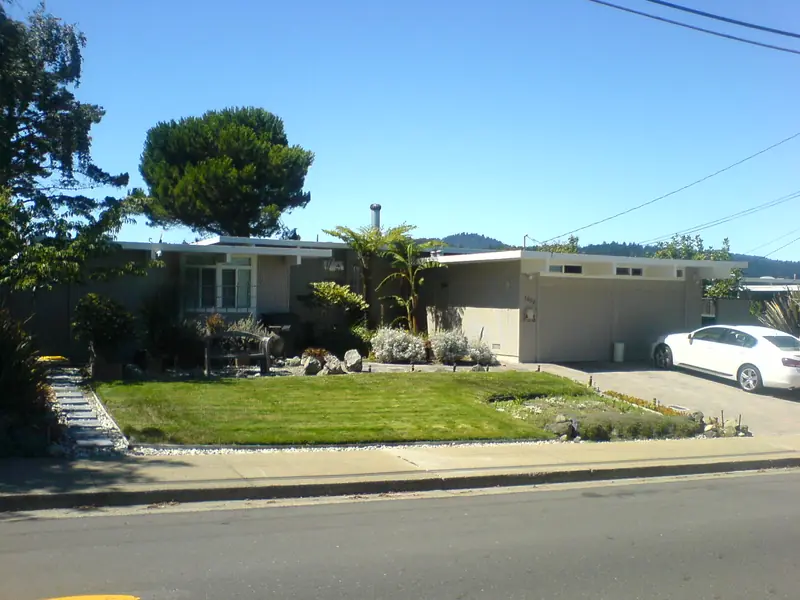
All those engineers needed homes. The builder who defined the look of 1950s Palo Alto was Joseph Eichler, a former butter and egg wholesaler who had fallen for modern design while renting a Frank Lloyd Wright house. His company built its first Palo Alto tract, University Gardens, in 1949 and 1950. More followed fast:
- 1950 and 1951: Charleston Meadows, Green Gables and Greer Park, designed by the San Francisco firm Anshen and Allen.
- 1951 to 1954: Fairmeadow, with its circular streets, credited to Anshen and Allen.
- 1954 and 1955: Greenmeadow, 243 homes designed by A. Quincy Jones and Frederick Emmons, with its own community center and pool.
The houses had post and beam frames, radiant floor heat, atriums and walls of glass facing private yards. The city now counts about 2,700 Eichlers, often rounded to 3,000. Our pages on Eichler homes and Joseph Eichler cover the tracts and the man.

Who could buy
Eichler was unusual in one more way. His company sold to buyers regardless of race or religion, years before fair housing laws required it. In 1958 he resigned from the National Association of Home Builders when it would not back that stand. Most of the market worked differently. According to PaloAltoHistory.org, most subdivisions recorded in the city between 1925 and 1950 carried covenants barring nonwhite occupants. A 1952 Palo Alto Fair Play Council survey found that 68 residents polled would rent to a person of good character regardless of race while 198 would rent to white tenants only.
The Fair Play Council helped build an alternative. In 1950 construction began on the Lawrence Tract, an interracial subdivision near the Palo Alto border, where nine Black families were among the first owners. Our page on covenants and the fair housing fight tells the story in full.
Shockley and the chip
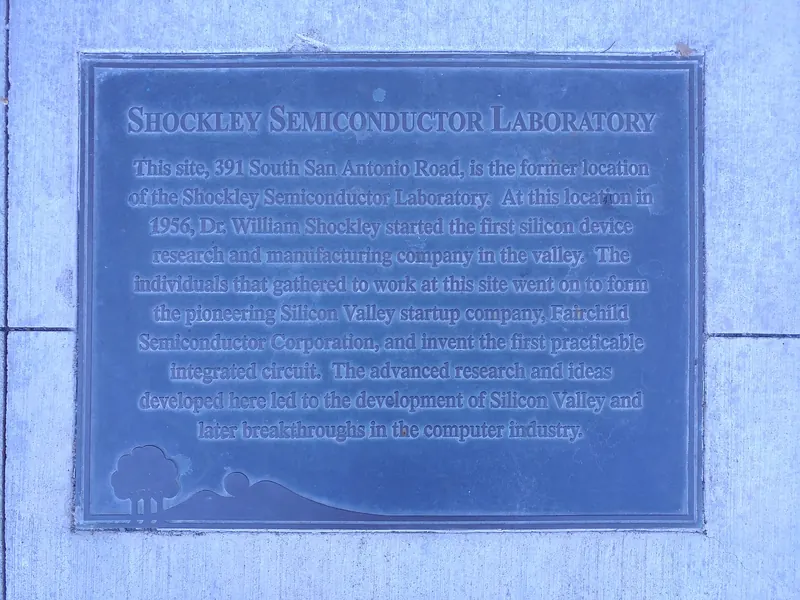
William Shockley grew up in Palo Alto and his mother still lived there. After sharing the invention of the transistor at Bell Labs, he reached an agreement with Arnold Beckman in September 1955 to start a semiconductor lab. In 1956 Shockley Semiconductor Laboratory opened at 391 San Antonio Road in Mountain View, just south of the city line. That December Shockley shared the Nobel Prize in Physics and his team toasted him at Rickey's Studio Inn on El Camino Real in Palo Alto.
He was a difficult boss. On September 18, 1957, eight of his scientists resigned together and founded Fairchild Semiconductor. In November 1957 Fairchild moved into a building at 844 East Charleston Road on the Palo Alto side of the border. There Jean Hoerni developed the planar process and Robert Noyce filed his integrated circuit patent on July 30, 1959. Our page on Shockley, Fairchild and the chip covers the whole sequence and our Silicon Valley history places it in the larger story.

Schools, shopping and the freeway
The baby boom hit the schools hard. Superintendent Henry Gunn, who served from 1950 to 1961, oversaw growth from about 5,500 students to more than 14,000. Cubberley High School opened in 1956 at 4000 Middlefield Road, close to the new Eichler tracts. Our Cubberley High School page covers its short life.
Shopping moved to the edge of town. Construction of Stanford Shopping Center began in 1954 and its first store, Roos Bros., opened in September 1955. Rickey's Studio Inn opened at 4219 El Camino Real in 1954. Edward Durell Stone's Main Library, today's Rinconada Library, opened in 1958. In 1955 Roy Kepler opened his bookstore just over the line in Menlo Park.
Traffic was the other story. The old Bayshore Highway, with only a double yellow line between opposing lanes, earned the name Bloody Bayshore. A campaign led by the Palo Alto Times pushed the state to build a divided freeway, which reached Palo Alto in June 1958 by one account and was finished to San Jose in 1962. See our freeways and expressways page.
1950s timeline
| Year | Event |
|---|---|
| 1950 | Council and city manager system. Green Gables built. Lawrence Tract begins. |
| 1951 | Stanford Industrial Park created. |
| 1953 | Varian moves into the park. Shopping center land annexed. |
| 1954 | Greenmeadow begins. Ventura annexed December 29. |
| 1955 | First store at Stanford Shopping Center. Shockley signs with Beckman. |
| 1956 | Shockley lab opens. Cubberley opens. HP leases land in the park. |
| 1957 | The eight leave Shockley. Fairchild moves to Charleston Road. HP goes public. |
| 1958 | Main Library opens. Lee offers foothill land. Bayshore Freeway arrives. |
| 1959 | Noyce files the integrated circuit patent July 30. |
The 1960s brought the counterculture, a third high school and the first protests at Stanford. That story continues on our page about Palo Alto in the 1960s.
Frequently asked questions
What was the Stanford Industrial Park?
Created by Stanford and the City of Palo Alto in 1951, it leased university land along Page Mill Road to technology firms. It is often called the first university research park in the world. Varian Associates moved in first in 1953 and Hewlett-Packard leased land in 1956. It is now Stanford Research Park.
When were Palo Alto's Eichler homes built?
Joseph Eichler's first Palo Alto tract, University Gardens, went up in 1949 and 1950. Tracts such as Green Gables, Greer Park and Fairmeadow followed in the early 1950s and Greenmeadow in 1954 and 1955. The last Eichler house in the city was built on Guinda Street in 1975. The city counts about 2,700 in all.
Was Shockley Semiconductor in Palo Alto?
No. Shockley Semiconductor Laboratory opened in 1956 at 391 San Antonio Road in Mountain View, just south of the city line. Fairchild Semiconductor, founded by eight scientists who left Shockley in September 1957, moved that November to 844 East Charleston Road on the Palo Alto side of the border.
How fast did Palo Alto grow in the 1950s?
The census counted 25,475 residents in 1950 and 52,287 in 1960, more than double. Annexations added the Stanford Shopping Center area in 1953, Ventura in December 1954 and land for the research park and east of Bayshore during the decade. School enrollment rose from about 5,500 to more than 14,000 between 1950 and 1961.
When did Stanford Shopping Center open?
Construction began in 1954 on Stanford land that Palo Alto had annexed in 1953. The first store, Roos Bros., opened in September 1955.