On this page
The Varian name is on a corporate campus in Stanford Research Park and on radiation therapy machines around the world. The two men behind it were an odd pair. Russell Varian was a slow-reading physicist who took six years to finish college. His younger brother Sigurd never finished college at all and flew airliners over Mexico. Together, in a basement at Stanford, they built the microwave tube that made airborne radar possible. Then they founded a company that opened the research park and they spent their last years trying to protect the Santa Cruz Mountains.
This page covers the brothers' lives. The company's later story, from the 1999 split to Siemens Healthineers, is on our Varian company page.
Growing up in Halcyon
Russell Harrison Varian was born on April 24, 1898. Sigurd Fergus Varian followed on May 4, 1901. Their parents, John and Agnes Varian, had grown up in Ireland and belonged to the Theosophical Society in Dublin. They emigrated in 1894 and settled first in Syracuse, New York. In 1914 they moved to Halcyon, a small utopian Theosophist community near the coast in San Luis Obispo County. John worked as a chiropractor and wrote poetry based on Irish myth. Agnes ran the community store and post office.
The family had little money but plenty of music and ideas. Russell was named for the Irish poet George Russell, a friend of his father. The composer Henry Cowell befriended Russell as a teenager and wrote his famous piece The Tides of Manaunaun for one of John Varian's stage productions. All three Varian boys loved electricity. Family stories describe them wiring bedsprings and doorknobs to give visitors mild shocks.
Russell was dyslexic and was considered slow as a child. Sigurd was the more outgoing of the two older boys. A third brother, Eric, stayed near Halcyon as an electrical contractor.
A physicist and a pilot
Russell went to Stanford. Reading and math came hard, so he took six years to finish his bachelor's degree, switching from social sciences to physics. He completed a master's in physics in 1927. Stanford turned down his application to the doctoral program. He worked briefly for Humble Oil, where he patented a vibrating magnetometer, then took a job in San Francisco with the television pioneer Philo Farnsworth.
Sigurd took a different road. He dropped out of what is now Cal Poly, strung power lines for an electric utility and learned to fly. He barnstormed, then became a pilot for Pan American Airways as it opened routes into Latin America. He lived in Mexico from 1929 to 1934 while flying as an airline captain. He met his wife Winifred there.
Flying showed Sigurd how dangerous the skies were at night and in cloud. Maps were wrong and pilots had no way to see other planes. By the mid-1930s he was also worried about Nazi Germany. He believed enemy bombers could reach the Panama Canal or the United States undetected. He talked Russell into building a radio system that could find aircraft in the dark.
The klystron, 1937
The brothers first set up a lab at Halcyon but made little progress alone. They turned to Russell's old Stanford roommate, William Webster Hansen, then a physics professor. In 1936 physics department head David Webster agreed to take them on. The terms were modest. They got lab space and $100 a year for supplies. Stanford got half of the royalties on any patents.
Working in the basement of the old physics building, Russell came up with a way to bunch electrons and control their speed, a method called velocity modulation. Hansen's cavity resonator supplied the other half of the idea. Russell designed the tube and Sigurd built the first prototype, which was completed in August 1937. They called it the klystron. It was the first practical tube that could generate signals at microwave frequencies.

Sperry Gyroscope signed a contract with the brothers and Hansen in 1938. A paper published in 1939 spread the idea to American and British radar researchers. In 1940 the Varians moved east to work for Sperry, where they appear to have led its tube and radar work through World War II. Klystrons helped make radar small and light enough to fly. The brothers and their associates drifted back to California between 1945 and 1948. In 1950 the Franklin Institute gave the Varians its John Price Wetherill Medal for the invention.
Varian Associates, 1948
The articles of incorporation for Varian Associates were filed on April 20, 1948. The founders included the two brothers, Russell's wife Dorothy, Hansen, Edward Ginzton and Stanford physics chair Leonard Schiff, among others. The company opened in San Carlos with six full-time employees and about $22,000.
Money was tight from the start. Russell insisted that the company belong to its employees and refused outside investors. Hansen mortgaged his house for $17,000. The founders finally raised about $120,000 by offering stock to employees, directors, consultants and a few like-minded local investors. Frederick Terman and David Packard later joined the board. Hansen did not live to see the company grow. He died in 1949.
The firm was ahead of its time in other ways. It offered progressive employee policies and leaned left politically, like its founders. Russell was a lifelong Sierra Club member and backed the American Civil Liberties Union. Sigurd helped start the Ladera housing cooperative near Stanford. Military contracts kept the company alive, including work on a fuse for an atomic bomb. As early as 1958 both brothers said they regretted their part in weapons of mass destruction.
First into the research park
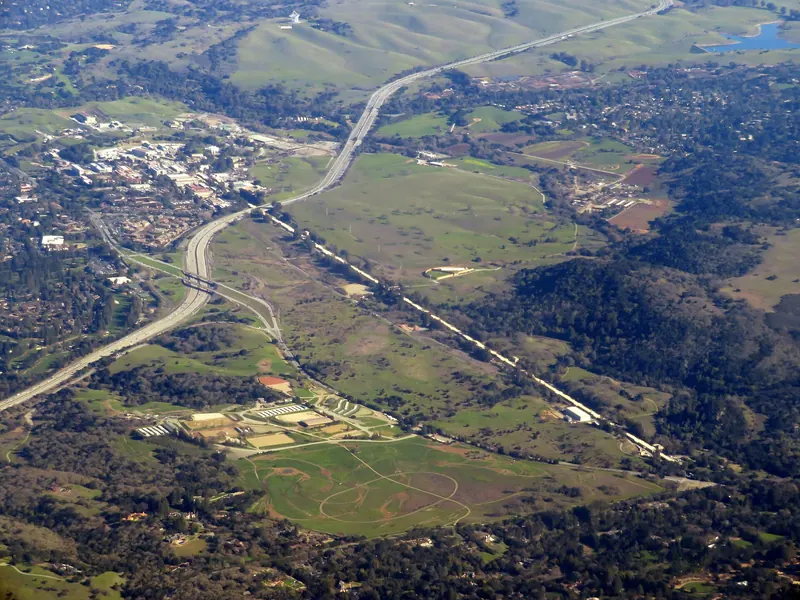
In 1951 Stanford and the City of Palo Alto created the Stanford Industrial Park on university land along Page Mill Road. Terman, who knew the Varians well, wanted companies with Stanford roots there. Varian Associates moved its headquarters from San Carlos to the park in 1953 and became the first company to occupy a site. Hewlett-Packard leased land a few years later. Our Stanford Research Park guide covers what the park became and our Frederick Terman page explains why he pushed so hard for it.
The move tied the company to campus for good. Stanford researchers such as Ginzton and Marvin Chodorow kept building bigger klystrons. Those tubes later powered the two-mile linear accelerator at SLAC, covered on our research labs page. Russell also patented work in nuclear magnetic resonance, the field that led to Varian's NMR instruments and, in time, to medical imaging.
| Year | Milestone |
|---|---|
| 1936 | Stanford physics department takes the brothers on. |
| 1937 | First klystron prototype completed in August. |
| 1940 | The brothers move east to work for Sperry. |
| 1948 | Varian Associates incorporated on April 20 in San Carlos. |
| 1950 | Franklin Institute's Wetherill Medal. |
| 1953 | Company moves to the Stanford Industrial Park. |
| 1959 | Russell dies in Alaska on July 28. |
| 1961 | Sigurd dies off Puerto Vallarta on October 18. |
| 1968 | Castle Rock State Park is established. |
Russell, Dorothy and Castle Rock
Russell married Dorothy Hill in 1947. She had studied economics at UC Berkeley and built a career in marketing. They met on a burro trip. Russell was a close friend and hiking companion of the photographer Ansel Adams, whom the family had known for decades. The two made many trips into the Sierra together.
Russell's favorite local landscape was the sandstone country around Castle Rock on the crest of the Santa Cruz Mountains, which he had explored as a young man. He worked on the Sierra Club's conservation committee to acquire land for protection. In 1959 he secured an option on land at Castle Rock with the goal of giving it to the state.
He did not live to finish the job. In July 1959 Russell died of a heart condition on a trip in Alaska, where he had been scouting places under consideration as national parks. Dorothy carried on. She revived the Sempervirens Club as a fund to buy land for conservation. The Sierra Club and the Sempervirens Fund donated land in Russell's memory and Castle Rock became a state park in July 1968. In 1963 Ansel Adams dedicated his Portfolio Four to Russell's memory and sold it to raise money for the Sierra Club. Dorothy later wrote a biography of the brothers, The Inventor and the Pilot, published in 1983. She died in 1992.
The park is about an hour's drive from Palo Alto up Highway 35. Our guide to Castle Rock State Park covers the trails, the falls overlook and current fees.
Sigurd's last flight
Sigurd served as Varian's vice president for engineering and sat on the board, sometimes as chairman. He spent his last three years living in Puerto Vallarta. On October 18, 1961, he was flying his private plane from Guadalajara to Puerto Vallarta when he lost his way in darkness. The plane crashed about a mile offshore. His passenger, George Applegate, swam to safety. Sigurd was buried in Guadalajara. He left an estate of more than $3 million, a quarter of it to a family charitable foundation whose main beneficiary was a hospital in Puerto Vallarta.
After both brothers were gone, Edward Ginzton became the company's chief executive.
Legacy in Palo Alto
The brothers have no museum or plaque of their own in town. Their legacy is spread out instead. Varian's medical business still lists 3100 Hansen Way in Stanford Research Park, on a street named for their partner. Klystrons still run in accelerators and broadcast transmitters. Castle Rock's sandstone outcrops stay open to hikers because a physicist took out an option on them in his last summer.
Historians usually pair the Varians with Hewlett and Packard as the two founding stories of the research park. Read our page on Bill Hewlett and David Packard for the other half. For the wider sweep, see our Silicon Valley history. Visitors who want to see the research park and Stanford together can join a Silicon Valley tour.
Frequently asked questions
What did the Varian brothers invent?
With Stanford physicist William Hansen they built the klystron, a vacuum tube that generates and amplifies microwaves. Russell worked out the design and Sigurd built the first prototype, which was finished in August 1937. The tube made airborne radar practical in World War II and later powered particle accelerators.
When was Varian Associates founded?
Its articles of incorporation were filed on April 20, 1948. The company started in San Carlos and moved to the Stanford Industrial Park in Palo Alto in 1953, where it was the first company to occupy a site.
How did the Varian brothers die?
Russell died of a heart condition on July 28, 1959, during a trip in Alaska. Sigurd died on October 18, 1961, when his private plane went down in the Pacific off Puerto Vallarta, Mexico. His passenger swam to shore and survived.
What is the Varian connection to Castle Rock State Park?
Russell Varian loved the Castle Rock area and secured an option on the land in 1959, shortly before he died. His widow, Dorothy Varian, revived the Sempervirens group to buy land for conservation and her work helped create Castle Rock State Park in 1968.
Who was William Hansen?
William Webster Hansen was Russell Varian's college roommate and a Stanford physics professor. His cavity resonator was the key to the klystron and he was a founder of Varian Associates. Hansen Way in Stanford Research Park is named for him.