On this page
Walk down the 500 block of Ramona Street and you are walking through Pedro de Lemos's idea of what a California town should look like. White stucco, tile, carved wood and a small courtyard tucked behind an arch. He was not a licensed architect. He was a printmaker, a museum director and the editor of a national art magazine. He designed buildings the way he designed prints: by hand, in detail and often with his family helping.
Our guide to Spanish Colonial Revival in Palo Alto places his buildings beside Birge Clark's. This page is about the man. Sources include Wikipedia's detailed biography, Stanford's 2017 centennial exhibition notes, a gallery biography and the National Register nomination for his house as summarized by the Clio.
Nevada, Oakland and the engraving trade
Pedro Joseph Lemos was born on May 25, 1882, in Austin, Nevada, a silver mining town. His parents had come from the Azores, the Portuguese islands in the Atlantic, in 1872. In 1888 the family settled on Myrtle Street in Oakland.
He went to public schools and then, as a teenager, to the Mark Hopkins Institute of Art in San Francisco, today's San Francisco Art Institute. From 1900 to 1904 he worked for the Pacific Press Publishing Company in Oakland. In 1904 he and his brother John opened an engraving firm in San Francisco. The 1906 earthquake and fire destroyed it. The brothers started again in Oakland and ran the Lemos Illustrating Company, later Lemos Brothers, Artists and Engravers, from 1907 to 1911.
In 1907 he married Reta Bailey of Berkeley. She became a partner in his craft work and later co-wrote one of his books.
Teacher and printmaker in San Francisco
In 1911 de Lemos began teaching decorative design at the San Francisco Art Institute. He kept studying too, with George Bridgman at the Art Students League of New York and Arthur Wesley Dow at Columbia University in 1913. Dow's ideas about design and Japanese woodblock prints shaped his work for the rest of his life.
He was a founder of the California Society of Etchers in late 1912. In 1913 he started the Art Institute's first printmaking classes. At the 1915 Panama-Pacific International Exposition he showed five works and won an honorable mention. A gallery biography says he also organized the California print exhibition there. He became the Institute's director in 1914 or 1915, depending on the source.
His time in charge ended in a fight over modern art. Wikipedia says he resigned in the fall of 1917 after pressure to bring trends like Cubism into the curriculum. He went south to Stanford instead.
Running Stanford's art museum
Stanford had just finished a new art gallery, paid for with $80,000 from Thomas Welton Stanford, Leland Stanford's younger brother. It opened in 1917 with a glass roof and an arcade on the second quad. De Lemos became its first director and curator. He also took charge of the Stanford museum, which the 1906 earthquake had badly damaged. That museum is today's Cantor Arts Center.
Stanford's 2017 centennial notes say he co-hosted major traveling shows from the East Coast and curated more than 190 exhibits of regional artists. About 40 percent of those artists were women. He held his own first solo show there in March 1922, a set of pastels. He retired in 1945 according to Wikipedia. Other accounts run his tenure to 1947. Our page on the Stanford Art Gallery covers the building today.
An art teacher to the whole country
Most Americans who knew his name knew it from a magazine. De Lemos was editor in chief of School Arts, a national magazine for art teachers, from 1919 to 1950. He wrote or co-wrote about 50 books on arts and crafts, a gallery biography says. A few stand out:
- Applied Art (1920), a textbook revised and reprinted more than a dozen times into the 1940s.
- Art Simplified (1920), written with his brother John T. Lemos.
- Color Cement Handicraft (1922), written with Reta and reprinted in 2007 as Arts & Crafts Era Concrete Projects.
Stanford credits him with simplifying printmaking so it could be done with household materials. His methods became standard in classrooms in North America and Britain. He also popularized pastels and promoted Native American arts through schools and exhibits. In 1943 London's Royal Society of Arts elected him a fellow.
Saving oaks on Ramona Street
His building career in Palo Alto began with a tree. Wikipedia says that in 1922, after an old oak was cut down in town, he bought land on Ramona Street to protect the oaks there. In 1925 he built the shop at 520 Ramona, often called the Gotham Shop, around an old oak he wanted to keep. In 1938 he designed 533 to 539 Ramona, across the street, with its arched entry and inner patio. Our heritage trees page notes that the 520 Ramona oak was removed in the 1980s.
Those buildings anchor what is now the Ramona Street Architectural District between University and Hamilton avenues. Birge Clark designed most of the rest. Our page on Birge Clark tells his side.
De Lemos also designed a studio at 460 Churchill Avenue in 1925 and four Medieval Revival houses at 1550 to 1579 Cowper Street in the 1930s. In 1931 to 1933 he changed his name from Lemos to de Lemos, believing he was related to the Count de Lemos, according to Wikipedia.

The Hacienda de Lemos
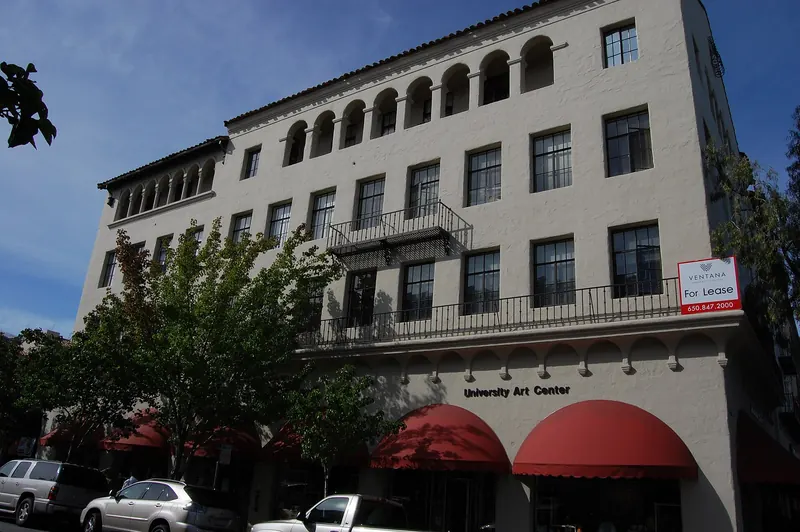
His most personal building was his own house. The Hacienda de Lemos, also called Waverley Oaks, is a Spanish Colonial Revival home of nearly 9,000 square feet. He designed it, made many of its tiles by hand and spent about a decade building it. Wikipedia dates the work to 1931 to 1941. The Clio entry gives two different ranges, so treat the exact years as uncertain.
The house is on the National Register of Historic Places. The nomination form is dated January 10, 1980, the date our landmarks list uses. Wikipedia gives the listing year as 1979. The house is a private home today.
Menlo Park, Carmel and Pebble Beach
His work spread well beyond downtown:
- Allied Arts Guild, Menlo Park. Garfield and Delight Merner founded the guild in 1929. De Lemos worked with architect Gardner Dailey on its Spanish Colonial buildings and designed its logo. Wikipedia goes further and lists Pedro and Reta as co-founders. See our Allied Arts Guild page.
- Carmel-by-the-Sea. In 1927 he bought an art shop there that later became the Tuck Box. He built the Lemos Building in 1929. He was elected the first president of the Carmel Art Association in August 1927, then skipped most meetings during a bitter dispute over juried shows.
- Pebble Beach. From 1944 he began a small house he called Casita de Lemos. He finished only the garage and a poured concrete roof.
Our Monterey and Carmel day trip covers the town where his shop still stands.
Death and how to see his work
De Lemos died at his home in Palo Alto on December 5, 1954, at 72. Stanford's art department marked the gallery's centennial in the fall of 2017 with Lasting Impressions of Pedro de Lemos, a show of more than 70 works on paper and objects from his career.
Good to know
- The 500 block of Ramona Street is closed to cars, which makes it easy to stand back and look at the facades. Our downtown guide shows the way.
- The Hacienda de Lemos and the Cowper Street houses are private. View them from the sidewalk only.
- The Hostess House at 27 University Avenue is a different story. Julia Morgan designed it in 1918 and it is not a de Lemos building. Read about it on our Hostess House page.
- His Carmel building and the Allied Arts Guild make a good pair of side trips for anyone following his work outside Palo Alto.
Frequently asked questions
Who was Pedro de Lemos?
Pedro de Lemos (1882 to 1954) was a California printmaker, painter, designer and art educator. He directed the San Francisco Art Institute, then ran Stanford's art gallery and museum from 1917 into the mid-1940s. He also edited School Arts magazine and designed Spanish style buildings in Palo Alto, Menlo Park and Carmel.
What buildings did Pedro de Lemos design in Palo Alto?
His best-known downtown work is on Ramona Street: 520 to 526 Ramona from 1925 plus 533 to 539 Ramona from 1938. He also designed a studio at 460 Churchill Avenue, four Medieval Revival houses on Cowper Street in the 1930s and his own home, the Hacienda de Lemos on Waverley Oaks.
Did Pedro de Lemos design the Hostess House?
No. The Hostess House at 27 University Avenue was designed by Julia Morgan in 1918 for Camp Fremont and moved to Palo Alto in 1919. We found no source linking de Lemos to it. His Palo Alto buildings date from the 1920s and 1930s.
Is the Pedro de Lemos House open to the public?
No. The Hacienda de Lemos is a private home. It is on the National Register of Historic Places. Please view it only from the street and respect the residents' privacy.
Why did he change his name from Lemos to de Lemos?
According to Wikipedia, he used Pedro Lemos or Pedro J. Lemos until about 1930. Between 1931 and 1933 he switched to de Lemos because he believed he was related to the Count de Lemos.