On this page
Palo Alto is an easy place to make good pictures. The light is clear most of the year and the subjects are close together. Within a short drive you have Romanesque sandstone at Stanford, a Byzantine-style gold mosaic, Spanish Colonial Revival storefronts downtown, an open marsh on the bay and a radio telescope on a golden ridge. Most of it is free and public.
What makes the area tricky is that much of it is private land. Stanford owns the Quad and the Dish and sets its own rules. The city sets separate rules for its parks and preserves. This guide covers the best spots, the light at each and the published rules for tripods, drones and paid shoots, so you know what is allowed before you set up.
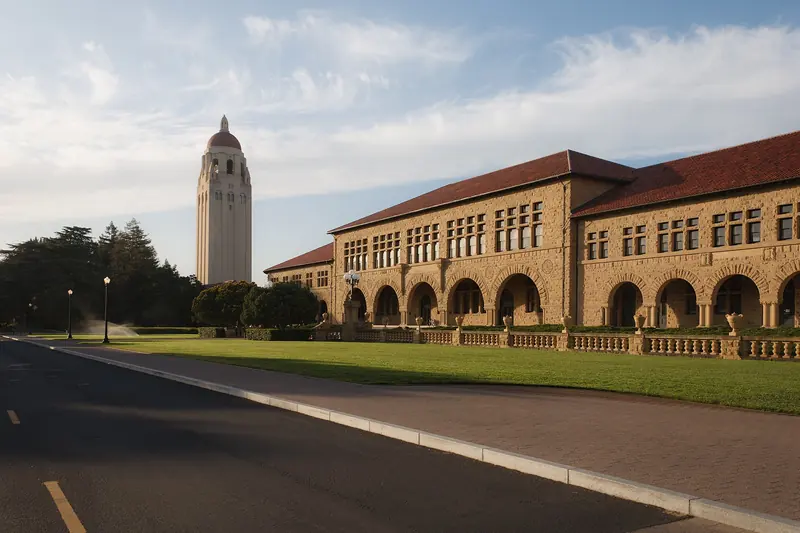

The Main Quad and Memorial Church
The Main Quad is the classic Stanford frame: long arcades of buff sandstone, red tile roofs and repeating arches that pull the eye toward a vanishing point. The Quad faces slightly east of north, up Palm Drive toward the bay. Stand on the Oval lawn and look south: Hoover Tower rises to the left and the church mosaic sits straight ahead.
Light and timing
- Late afternoon is the best time for the arcades. Low sun from the west rakes along the columns and warms the stone.
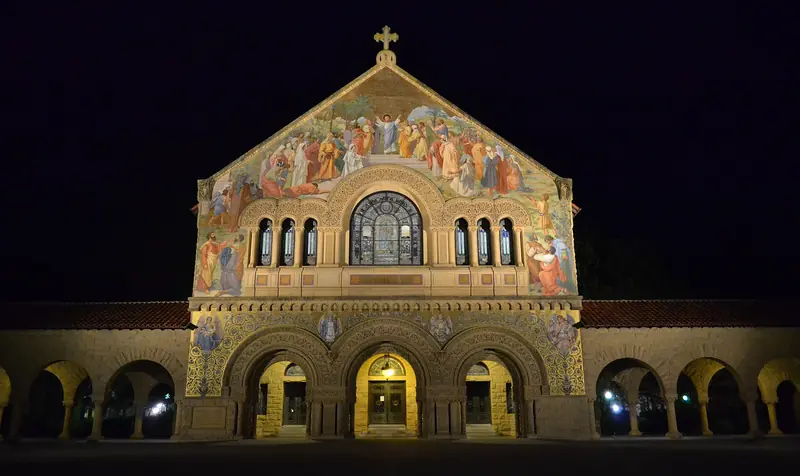
- The church mosaic faces roughly north, so it spends most of the day out of direct sun. A bright overcast day keeps the gold even. After dark the facade glows, as the photo below shows.
- Early morning on a weekend gives you empty arcades. Class days fill the Quad with bikes and students from mid-morning.
- Hoover Tower from the Quad works best in the afternoon, when the sun lights the side of the tower that faces the Quad.
Inside Memorial Church
Stanford's Office for Religious and Spiritual Life lists Memorial Church as closed to visitors for maintenance from June 15 to October 31, 2026. It has not posted a reopening date, so check the visit page before you go. When the church is open, its photography policy allows photos for personal use during open hours and even permits flash. Photography is never allowed during services. Weddings and memorials happen often, so look before you raise a camera.

Hoover Tower's observation platform
The observation deck of Hoover Tower sits about 250 feet above the ground. It is the best high public viewpoint in town, with the Quad roofs below and the bay and the foothills beyond. The bad news for late 2026: the Hoover Institution lists the deck as closed from August 14, 2026 to January 25, 2027, with the whole tower closed on weekends until then.
Once it reopens, tickets are $8, paid by card or contactless only. The deck also closes during carillon performances and on Stanford home football game days. For photos, go on a clear winter morning after rain, when the air is cleanest. Midday haze flattens the long view, so a morning visit soon after opening is the better bet.
The Baylands boardwalk
The boardwalk at the Baylands Nature Preserve runs about a quarter mile from the Lucy Evans nature center across the marsh to open water. Rebuilt and reopened in 2019, it is wide, flat and steady enough for a tripod, as long as you leave room for other visitors to pass.
- Sunset. The marsh looks west toward the Santa Cruz Mountains. The power line towers make strong silhouettes against an orange sky. The city lists the preserve as open from 8 a.m. to sunset, so park close to your car and be ready to leave as the light fades.
- Birds. Winter brings the most shorebirds and ducks. A rising high tide pushes them closer to the boardwalk and levees. Bring a long lens. Our birdwatching guide has more on timing.
- Reflections. Calm mornings give glassy water in the sloughs. Wind usually picks up in the afternoon, especially in summer.
The city's film policy asks that wildlife be photographed from at least 100 feet away without feeding or disturbing animals. That rule is written for permitted shoots, but it is good practice for everyone.
The Dish
The Stanford Dish loop climbs through open grassland to a radio telescope about 150 feet across, built in 1961. It gives you the antenna, rolling hills dotted with oaks and long views over campus to the bay. The grass turns green after the first winter rains and gold by late spring.
Timing is everything here because Stanford sets fixed hours by month. The official Dish site lists 6:30 a.m. to 5 p.m. for November and December and 6 a.m. to 7:30 p.m. from April through August. No visitors are allowed after closing. In late fall and winter, sunrise comes after the gates open, which makes the Dish a sunrise spot in those months. Summer evenings work for golden hour on the hills before the 7:30 p.m. close. The area can also close or restrict access during high fire danger.
The trail is paved and busy with walkers and runners. Shoot from the edge rather than the middle. Stay on the pavement. Stanford's filming policy names the Dish trail as Stanford land, so its rules on drones and commercial work apply here too.
Downtown: Ramona Street and University Avenue
Downtown is the place for street photography, architecture and evening light on storefronts. Our downtown guide covers the area in full.
- Ramona Street. The 500 block between University and Hamilton avenues is the Ramona Street Architectural District, listed on the National Register in 1986. Arches, wrought iron and tile roofs line both sides. The half block nearest University Avenue is car-free, a change the City Council made permanent in March 2025, so you can frame the facades without parked cars. Our Spanish Colonial Revival guide explains what you are looking at.
- University Avenue. The Stanford Theatre marquee at 221 University dates from 1925 and is best after dusk, when it lights up. The Varsity Theatre building at 456 University opened in 1927. Downtown's murals add color on side streets.
- Light. University Avenue runs roughly southwest from the creek toward the train station, so in winter the low late afternoon sun can line up with the street. Blue hour, just after sunset, balances storefront light with the sky.
Photographing people in public places is generally legal, but ask before taking close portraits of strangers and be careful with children. Outdoor diners on Ramona Street did not sign up to be in your shot.
Stanford's rules for tripods, drones and paid shoots
Stanford's filming and photography policy covers all Stanford land, including the Redwood City campus and the Dish. The key points:
- Personal photos are fine as long as they follow university policies and do not disrupt classes, research or student activities.
- Tripods and lights are not allowed if they block movement or create a hazard. Keep any tripod out of walkways and arcades, especially at class change.
- Professional portrait and wedding photography is prohibited in the Main Quadrangle and Memorial Court.
- Current Stanford affiliates may hold wedding and portrait shoots on weekends only, at three spots: the History Corner (Building 200), White Plaza and the courtyard behind Building 200. Groups are capped at six people and the affiliate must carry proof of affiliation.
- Outside crews and businesses need advance written approval, a location agreement and an approved certificate of insurance. Commercial shoots for company channels are barred and the university can refuse any request.
- Drones are prohibited for campus visitors. Stanford's research policy on unmanned flying vehicles, last updated January 28, 2026, bars third party flights from or above university land, including hobby and aerial photography flights.
City rules for parks, the Baylands and drones
The City of Palo Alto treats parks and open space preserves together. Its film policy for parks and open space sets out three tiers.
| Type of shoot | Permit? | What the city says |
|---|---|---|
| Personal, noncommercial | No | Up to 24 people, one hour or less, no exclusive use, no harm to habitat or wildlife |
| Low-impact commercial | Yes | Up to two hours, fees of $344 to $2,667, deposit up to $1,000, apply at least 14 days ahead |
| High-impact | Not allowed | Road closures, traffic control or shoots over two hours |
Permitted shoots cannot run on weekends, city holidays or outside park hours. Groups of 25 or more always need a permit. The policy states plainly that drones are not permitted. The municipal code adds a long-standing ban on radio controlled model aircraft in parks and open space outside areas the director designates.
There is also the airspace. Palo Alto Airport, which has an FAA control tower, sits right beside the Baylands. Federal rules apply on top of city rules anywhere you fly, so check the FAA's B4UFLY tools before flying anywhere in the area. Filming on city streets is handled separately and needs city approval.
Good to know
- Memorial Church's maintenance closure was listed through October 31, 2026. Confirm it has reopened before planning interior shots.
- Daylight saving time ends November 1, 2026. Sunset moves to about 5 p.m., the same time the Dish closes.
- For more evening viewpoints, see our sunset spots guide.
Frequently asked questions
Can I fly a drone at Stanford?
No. Stanford's filming policy says drone use by campus visitors is prohibited. Its research policy on unmanned flying vehicles, updated January 28, 2026, bars all third party flights from or above university land, including hobby and aerial photography flights. Even students and staff need advance committee approval.
Can I fly a drone at the Palo Alto Baylands?
No. The City of Palo Alto's film policy for parks and open space says drones are not permitted. The municipal code also bars radio controlled model aircraft in parks and open space outside designated areas. Palo Alto Airport, with its FAA control tower, sits right next to the preserve.
Do I need a permit for engagement photos in Palo Alto parks?
Usually not for a small personal session. The city says personal shoots need no permit if they are noncommercial, involve 24 or fewer people, last an hour or less and do not take over an area. Commercial shoots need a permit with fees from $344 to $2,667. Allow at least two weeks.
Can photographers do wedding or portrait shoots on the Main Quad?
No. Stanford's filming and photography policy prohibits professional portrait and wedding photography in the Main Quadrangle and Memorial Court. Current Stanford affiliates may hold small weekend shoots of up to six people at the History Corner, White Plaza and the courtyard behind Building 200.
Is the Hoover Tower observation deck open for photos?
Not until early 2027. The Hoover Institution lists the deck as closed from August 14, 2026 to January 25, 2027. When it reopens, tickets are $8 and the deck sits about 250 feet up with views across campus to the bay.