On this page
January in Palo Alto is cool, green and changeable. A storm rolls through, the creeks run high for a day and then the sky clears to a cold blue that shows every ridge from the Santa Cruz Mountains to Mount Hamilton. Afternoons usually reach the upper 50s. Nights after a clear day can fall to the freezing mark. Lawns on the flats turn white by sunrise.
The figures on this page are NOAA's 1991 to 2020 climate normals for the Palo Alto station (USC00046646), which sits on the flats at about 25 feet above sea level. NOAA marks the station's values as "representative" rather than "standard" because its record has gaps, so read the tenths loosely. Sunrise and sunset times are calculated for central Palo Alto for January 2027 and match published tables such as timeanddate.com within a minute. These are averages, not a forecast. For the year at a glance, see our Palo Alto weather guide.
January by the numbers
| Measure | January in Palo Alto |
|---|---|
| Average high | 57.8°F |
| Average low | 39.0°F |
| Average rainfall | 2.95 inches |
| Middle half of years | 1.09 to 4.50 inches |
| Days with 0.01 inch of rain or more | 10.0 |
| Days with 0.10 inch or more | 6.7 |
| Days at 90°F or hotter | 0.0 |
| Nights at 32°F or colder | 4.8 |
| Sunrise | 7:13 to 7:23 a.m. |
| Sunset | 5:01 to 5:32 p.m. |
| Daylight | 9 h 38 min to 10 h 19 min |
| Ocean water, San Francisco buoy | 53.8°F |
The ocean figure comes from NOAA's Coastal Water Temperature Guide. It does not publish a Half Moon Bay reading, so the table uses its nearest open ocean station, a buoy about 18 nautical miles west of San Francisco. More on the coast below.
Rain: storms in clusters
January averages 2.95 inches, which ties December as the second wettest month after February. That average hides a wide spread. In one January out of four the station records less than 1.09 inches. In another one out of four it gets more than 4.50. The median is 2.46 inches, a little below the average, because a few very wet years pull the mean up.
Rain usually arrives with Pacific storms every week or two. A typical front brings a night and a morning of steady rain, gusty south winds and then clearing. The big ones are atmospheric rivers, long plumes of subtropical moisture that can stall over the Santa Cruz Mountains for a day or more. San Francisquito Creek overtopped its banks on December 31, 2022 and in February 1998, which is why the city publishes creek monitors and opens sandbag stations from November. Our rain and storm season guide covers what to do when one hits.
Between storms, January can run dry for a week or more. Those stretches bring the best hiking light of the year. The hills above Interstate 280 are usually bright green by now and the air after a front is scrubbed clean.
Daylight, sunrise and sunset
January starts with the latest sunrises of the year, about 7:23 a.m. in the first week. Sunrise only creeps earlier to about 7:13 a.m. by January 31. Sunsets move faster. They start at about 5:01 p.m. and reach about 5:32 p.m. by the end of the month, so the evenings feel noticeably longer by the time February arrives.
Total daylight grows from about 9 hours 38 minutes to 10 hours 19 minutes. For outdoor plans that means a short window. Start a foothill hike by early afternoon. City open space preserves such as Foothills Nature Preserve and Pearson-Arastradero close at sunset. Stanford posts a 5 p.m. closing time for the Dish in January.
Fog, frost and air quality
Valley fog and frost
January fog in Palo Alto is not the summer ocean fog people picture in San Francisco. It is radiation fog. After a rainy spell, the ground is wet, the night is long and the sky clears. The air near the ground cools to its dew point and a shallow fog forms over the bay flats, the marshes and low spots along Highway 101. It usually burns off by late morning. Drivers on 101 and the Dumbarton Bridge see the thickest patches.
The same clear, still nights bring frost. The Palo Alto station averages 4.8 nights at or below 32°F in January, more than San Jose or Moffett Field. Cold air drains off the foothills and pools on the flat neighborhoods. The station sits in that pool. Scrape the windshield, cover frost tender plants and expect icy wood decks on bridges and boardwalks early in the day.
Wood smoke and Spare the Air days
Wildfire smoke is rarely a January issue. The winter air problem is wood smoke. On cold, calm nights an inversion traps smoke from fireplaces close to the ground. The Bay Area Air District runs its winter Spare the Air season from November through February and calls burn bans when fine particles are forecast to reach unhealthy levels. Check sparetheair.org before lighting a fire. Our air quality guide explains the rules.
Microclimates: the flats, Stanford and the foothills
Palo Alto is small, but its winter weather changes over a few miles. Near the bay, at the Baylands and in East Meadow and Greer Park, nights are damp and fog lingers longest. The bay itself moderates temperatures a little. Moffett Field, on the bay edge in Mountain View, averages a January low of 42.4°F, more than three degrees milder than the Palo Alto station.
The Stanford campus and the neighborhoods west of El Camino Real sit on a gentle slope. They tend to drain cold air away a bit better than the lowest flats, though frost still covers playing fields on clear mornings. In the foothills, Pearson-Arastradero rises from about 275 to 775 feet and the Dish tops out around 526 feet. Those ridges can sit above a shallow morning fog layer in bright sun while downtown stays gray.
Higher still, Skyline Boulevard runs above 2,000 feet. Storms drop far more rain there than on the flats. Redwood City, closer to the hills, already averages 3.81 inches in January. On the coldest storm days the ridge can see a dusting of snow or hail. If you drive up after a cold front, carry a warm jacket and check for road and trail closures.

How January compares with San Francisco and San Jose
| January normal | Avg high | Avg low | Rain (in) | Rainy days |
|---|---|---|---|---|
| Palo Alto | 57.8°F | 39.0°F | 2.95 | 10.0 |
| San Francisco downtown | 57.8°F | 46.6°F | 4.40 | 11.2 |
| San Jose | 59.8°F | 41.8°F | 2.80 | 9.2 |
| Moffett Field | 59.0°F | 42.4°F | 2.49 | 10.8 |
January afternoons are nearly identical around the Bay Area. Palo Alto and downtown San Francisco both average 57.8°F. The difference is the night. San Francisco is surrounded by water and averages a January low of 46.6°F, while Palo Alto drops to 39.0°F. San Jose, at its airport station, runs two degrees warmer by day and nearly three degrees warmer at night than Palo Alto.
Rain follows the hills and the ocean. San Francisco averages 4.40 inches in January, about half again Palo Alto's total, because storms hit the coast first. San Jose, farther into the rain shadow of the Santa Cruz Mountains, averages 2.80 inches. A day trip to the city in January means more rain gear but less frost. See our San Francisco day trip guide for indoor ideas.
The coast and the ocean
NOAA does not publish a long term sea temperature for Half Moon Bay. Its closest open ocean average, from the buoy west of San Francisco, is 53.8°F in January. The Monterey buoy averages 54.7°F. Surf at Half Moon Bay is usually in that range. Swimming without a full wetsuit is cold at any time of year. Inside San Francisco Bay, NOAA's Redwood City reading averages just 51.8°F in January, colder than the open ocean, because shallow bay water loses heat on long winter nights.
January brings big winter swell to the coast. The beaches can be dangerous. Stay well back from the waterline at Half Moon Bay, watch for sneaker waves and check the National Weather Service Bay Area office for beach hazard statements. The upside is clear air between storms and the start of gray whale season offshore.
What to pack for January
- A real rain jacket with a hood. Umbrellas struggle in the gusty south winds ahead of fronts.
- A warm middle layer such as a fleece or down sweater for mornings near 40°F.
- Waterproof shoes or boots with grip. Dirt trails turn to sticky clay after rain.
- A hat and light gloves for early walks and frosty car windows.
- Sunglasses and sunscreen. The low winter sun is bright on clear days.
Dress is casual everywhere. Layers that come off at 2 p.m. and go back on at 4:30 p.m. are the local uniform.
What January weather is good for
Cool, clean air and green hills make January a fine month for walking, birding and photography, as long as you work around the storms. Our January trip guide lists events and dates. A few weather-driven ideas:
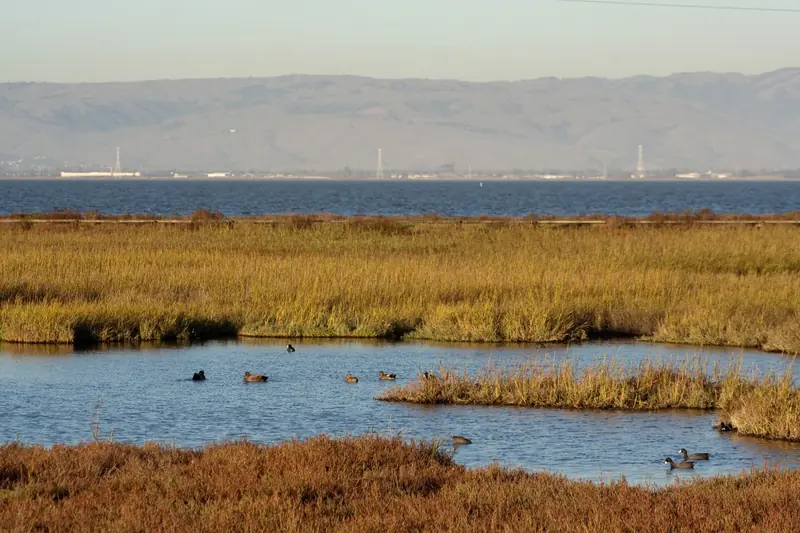
- Winter birds at the bay. Ducks and shorebirds peak in late fall and winter at the Baylands Nature Preserve. Go near high tide, when birds crowd closer to the levees.
- Waterfalls after storms. Seasonal falls run from about December to April. Our waterfalls guide lists the closest ones.
- Outdoor ice skating. The Winter Lodge rink on Middlefield Road is open for its 2026 to 2027 season through April 11, 2027.
- Rainy days indoors. Museums on campus, the libraries and cafes downtown fill a storm day. If you want a guide for a day in the city, you can browse Bay Area tours.
Plan flexible days and move the hike to whichever afternoon the sky clears. In January that usually happens at least once a week.
Frequently asked questions
How cold does Palo Alto get in January?
NOAA's 1991 to 2020 normals give the Palo Alto station an average low of 39.0°F and an average high of 57.8°F in January. Clear, calm nights can drop to freezing, which happens on about 4.8 nights in a typical January. Snow in the city is extremely rare.
How many rainy days does Palo Alto get in January?
About 10 days in a typical January bring at least 0.01 inch of rain and about 6.7 bring a tenth of an inch or more. The monthly average is 2.95 inches. Storms tend to arrive in clusters with dry, bright days between them.
Is January colder in Palo Alto than in San Francisco?
The afternoons are the same, with both cities averaging 57.8°F. Nights are colder in Palo Alto. Its average low is 39.0°F while downtown San Francisco averages 46.6°F, because the ocean keeps the city warmer after dark.
What time is sunset in Palo Alto in January?
Sunset moves from about 5:01 p.m. on January 1 to about 5:32 p.m. on January 31. Sunrise stays late, between about 7:13 and 7:23 a.m. Daylight grows from about 9 hours 38 minutes to 10 hours 19 minutes over the month.
What should I pack for Palo Alto in January?
Bring a waterproof jacket, a warm sweater or fleece and shoes that can handle wet sidewalks and muddy trails. Mornings near 40°F call for a hat and gloves if you plan to walk early. Afternoons in the upper 50s feel comfortable in a light layer when the sun is out.