On this page
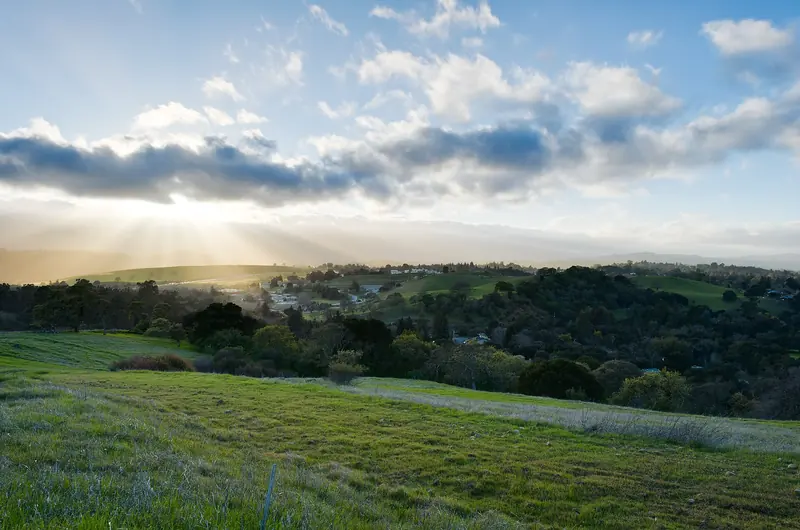
February in Palo Alto is a month of contrasts. It is the wettest month in the long term record, yet a dry February is common and a sunny week in the mid 60s can feel like spring. Plum and magnolia trees bloom along residential streets. The foothills are their deepest green. Then a storm arrives and drops an inch of rain overnight.
All temperature and rain figures here are NOAA's 1991 to 2020 climate normals for the Palo Alto station (USC00046646) on the flats near the bay. NOAA labels the station's values "representative" because the record has gaps over those 30 years, so treat small differences with caution. Sun times are calculated for central Palo Alto for February 2027 and agree with published tables within a minute. Nothing here is a forecast. The weather hub has every month side by side.
February by the numbers
| Measure | February in Palo Alto |
|---|---|
| Average high | 60.7°F |
| Average low | 41.3°F |
| Average rainfall | 3.18 inches |
| Middle half of years | 1.11 to 4.40 inches |
| Days with 0.01 inch of rain or more | 10.1 |
| Days with 0.10 inch or more | 7.0 |
| Days at 90°F or hotter | 0.0 |
| Nights at 32°F or colder | 1.8 |
| Sunrise | 6:41 to 7:12 a.m. |
| Sunset | 5:33 to 6:01 p.m. |
| Daylight | 10 h 21 min to 11 h 20 min |
| Ocean water, San Francisco buoy | 53.3°F |
The ocean temperature is NOAA's long term average for its buoy about 18 nautical miles west of San Francisco. NOAA does not publish a Half Moon Bay figure.
Rain: the wettest month, on paper
February averages 3.18 inches at the Palo Alto station, a quarter inch more than January or December. About 10 days bring at least a hundredth of an inch and about 7 bring a tenth of an inch or more. The median is 3.15 inches, close to the average, which says February rain is a bit more dependable than January's.
Still, the range is huge. In one February out of four the station gets less than 1.11 inches. In one out of four it gets more than 4.40. Some years see one storm after another for two weeks, with soaked ground, swollen creeks and trees down on wet soil. San Francisquito Creek flooded in February 1998, the city's worst flood in modern memory. Others bring a blocking high pressure ridge, offshore breezes and three dry weeks.
When storms do line up, saturated soil makes each new inch run off faster. Creeks rise quickly and trails stay muddy for days. Our storm season guide explains the city's creek monitor and sandbag stations.
Longer evenings
February is when the evenings come back. Sunset moves from about 5:33 p.m. on February 1 to about 6:01 p.m. on February 28. Sunrise moves earlier too, from about 7:12 a.m. to about 6:41 a.m. Daylight grows by an hour, from about 10 hours 21 minutes to 11 hours 20 minutes.
That extra light matters for after-work walks. Stanford posts February hours of 6:30 a.m. to 5:30 p.m. for the Dish. Midpen preserves in the hills stay open until half an hour after sunset. Daylight saving time does not start until March 14, 2027, so evenings are still short by summer standards.
Fog, frost and air quality
Like January, February fog in Palo Alto is mostly valley fog that forms on calm, clear nights after rain. It sits over the bay flats and Highway 101 at dawn and lifts by midmorning. Longer days and a stronger sun clear it faster than in December or January.
Frost is fading. The Palo Alto station averages 1.8 nights at or below 32°F in February, down from 4.8 in January. Sensitive plants can still be nipped in the first half of the month, especially in the lowest neighborhoods near the bay where cold air pools.
Air quality is usually good, because storms keep scrubbing the air. The exception is still nights with a strong inversion. The winter Spare the Air season runs through the end of February. Wood burning is illegal on any day the Air District calls an alert. Check sparetheair.org before you light a fireplace. Wildfire smoke is not a February concern in a normal year.
Microclimates: bay, campus and ridge
The spread between the bay and the hills shows clearly in February. Moffett Field, on the bay edge in Mountain View, averages a February low of 44.5°F, about three degrees milder than Palo Alto's 41.3°F. Its high of 61.8°F is a degree warmer too. Water holds heat, so neighborhoods closest to the marsh stay slightly milder at night but damper and foggier.
Stanford and the neighborhoods around Junipero Serra Boulevard sit just high enough to shed some cold air. The real change starts above Interstate 280. Storms that bring an inch to the flats can bring two or three inches to the ridgetop along Skyline Boulevard, where rain wrings out of air pushed up the mountain slopes. Redwood City, a few miles closer to the hills, averages 3.65 inches in February.
Cold storms sometimes bring snow to the high peaks. In late February 2023 a cold system left snow on Mount Hamilton and other high Bay Area summits, a sight Palo Alto residents could see from the flats. Snow in town is extremely rare.

How February compares with San Francisco and San Jose
| February normal | Avg high | Avg low | Rain (in) | Rainy days |
|---|---|---|---|---|
| Palo Alto | 60.7°F | 41.3°F | 3.18 | 10.1 |
| San Francisco downtown | 60.4°F | 47.9°F | 4.37 | 10.8 |
| San Jose | 62.4°F | 43.9°F | 2.69 | 10.0 |
| Moffett Field | 61.8°F | 44.5°F | 2.90 | 11.3 |
February afternoons are within two degrees across the region. Palo Alto averages 60.7°F, downtown San Francisco 60.4°F and San Jose 62.4°F. The nights split. San Francisco's average low is 47.9°F, more than six degrees warmer than Palo Alto, while San Jose sits in between at 43.9°F.
Rain shows the rain shadow clearly. San Francisco averages 4.37 inches in February. Palo Alto gets 3.18 and San Jose 2.69. If you are choosing where to stay for a rainy week, the South Bay is a little drier. If you are heading to the city, our San Jose and San Francisco guides both have indoor fallbacks.
The coast in February
The open ocean off San Francisco averages 53.3°F in February per NOAA. The Monterey buoy averages 54.2°F. Half Moon Bay has no published long term figure, but surf there is usually in the low to mid 50s. Inside the bay, NOAA's Redwood City reading averages 54.2°F, warming from January as days lengthen.
Winter swell is still running. Beaches can be beautiful on a clear day and dangerous at the same time, so keep children back from the surf line. February is a strong month for wildlife on the coast: gray whales are migrating and the elephant seal colony at Año Nuevo is busy, with guided walks normally running from December 15 to March 31.
What to pack for February
- A hooded rain shell. Plan on at least a few wet days.
- A sweater or fleece for mornings in the low 40s.
- Shoes that can get muddy. Dirt trails stay slick for days after storms.
- A light layer for afternoons. Sunny days in the 60s feel warm out of the wind.
- Sunscreen. The sun is climbing fast and the air is very clear after storms.
What February weather is good for
Green hills, blossoms and long views make February a rewarding month to be outside between storms. Our February trip guide covers events and holidays. Weather-driven ideas:
- Early blossoms. Plums, magnolias and early camellias bloom across town. Gamble Garden on Waverley Street is a free place to see them.
- First wildflowers. Early bloomers appear in the low hills after good rains. Our wildflower guide tracks the season into May.
- Clear-air hikes. The morning after a storm brings the sharpest views of the year from the Stanford Dish.
- Storm days indoors. Plan a museum day, then book somewhere central so you can walk to dinner. You can compare Palo Alto hotels near downtown and Caltrain.
Keep one flexible day in your plans. February storms are often well forecast a few days out, so check the National Weather Service Bay Area office before you go and swap outdoor and indoor days as needed.
Frequently asked questions
Is February the rainiest month in Palo Alto?
Yes, on average. NOAA's 1991 to 2020 normals give the Palo Alto station 3.18 inches in February, slightly more than January and December at 2.95 inches each. Individual years vary a lot. In one February out of four the total is under 1.11 inches.
How warm is Palo Alto in February?
The average high is 60.7°F and the average low is 41.3°F. Sunny afternoons often reach the low or mid 60s. Frost is less common than in January, with about 1.8 nights at or below freezing in a typical February.
Does it rain more in San Francisco than Palo Alto in February?
Yes. Downtown San Francisco averages 4.37 inches in February against 3.18 in Palo Alto. San Jose, deeper in the rain shadow of the Santa Cruz Mountains, averages 2.69 inches.
When does the sun set in Palo Alto in February?
Sunset moves from about 5:33 p.m. on February 1 to about 6:01 p.m. on February 28. Sunrise moves from about 7:12 a.m. to about 6:41 a.m. Daylight grows by about an hour over the month.
Is February a good time to visit Palo Alto?
It can be, if you pack for rain and keep plans flexible. The hills are at their greenest, early fruit trees bloom and winter birds are still at the bay. Expect a few storm days and plan indoor options for them.