On this page
Palo Alto is a college town with a twist. The town was laid out in the 1880s to serve a university that did not yet exist. More than a century later, that university's campus still is not inside the city. Stanford sits next door on unincorporated county land, while Palo Alto handles much of the traffic, housing demand and emergency calls that the campus generates. The result is a long, mostly friendly, sometimes tense relationship that shapes nearly every big decision in town.
This page follows that relationship from the founding grant to the permit application Stanford filed in September 2026. For the university's own story, see our history of Stanford.
A town for a university
Leland and Jane Stanford signed the founding grant of their university on November 11, 1885, after the death of their son. The grant set rules that still matter to Palo Alto. Most important, the university could not sell its land. It could lease it, which is why the research park, the shopping center and faculty homes on campus all sit on long ground leases.
The Stanfords wanted a sober town beside the campus. In 1886 the existing town of Mayfield, south of the farm, refused Leland Stanford's demand that it ban alcohol. So in 1887 Timothy Hopkins bought land north of the campus and laid out University Park. Alexander Gordon's tract to the south, which had briefly used the Palo Alto name, became College Terrace. University Park took the Palo Alto name in 1892 and incorporated in 1894. The university opened to students on October 1, 1891. Our page on the founding of Palo Alto tells the full story.
Dry-town rules
The liquor rules are a good example of how town and gown blurred. Despite a popular belief, the founding grant has no liquor clause. The restrictions came instead from several layers:
- Timothy Hopkins wrote liquor clauses into University Park deeds in 1889.
- The new town adopted its own rule in 1894.
- A 1909 state law banned liquor sales within a mile and a half of the campus.
- Stanford banned drinking on campus from 1908 until its trustees relaxed the rule in 1966.
A judge ruled the Hopkins clauses unenforceable in 1970. Downtown marked its first legal public drink in May 1971. Our dry-town page covers the details.
Annexations and the Stanford Avenue line
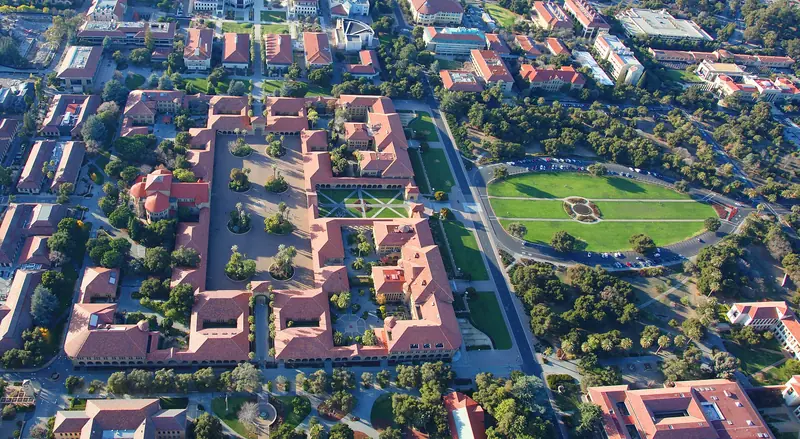
The map of who governs Stanford land is a patchwork. The main campus has never been annexed to Palo Alto. It remains unincorporated Santa Clara County land with a Stanford, California mailing address. According to Santa Clara County planners, nearly half of all Stanford land falls in the unincorporated county. More Stanford land reaches into San Mateo County, including SLAC and the Jasper Ridge preserve.
The clearest place to see the line is Stanford Avenue. On its south side lies College Terrace, a city neighborhood that joined Palo Alto when Mayfield was annexed in 1925. On the north side is Escondido Village, a large Stanford housing area on county land. Nixon Elementary, a Palo Alto public school, stands at 1711 Stanford Avenue on Stanford land. Students and families cross between two governments every day without noticing.
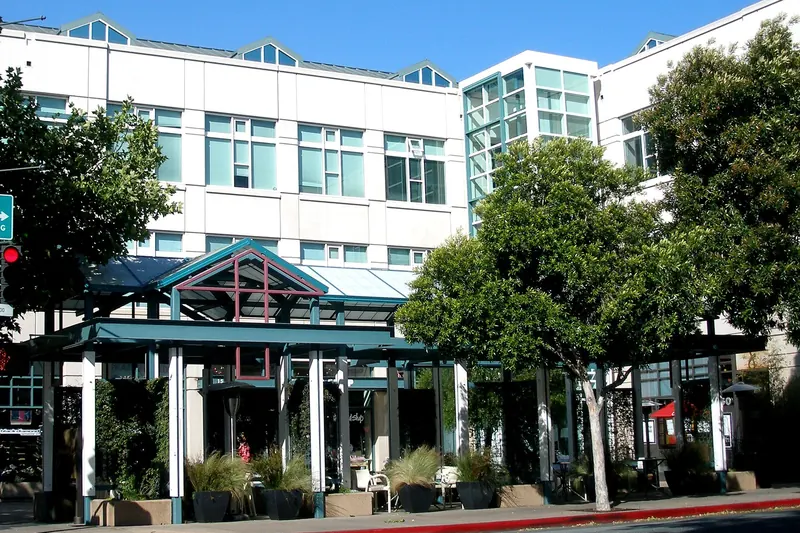
Palo Alto did annex the Stanford lands that mattered most to its tax base. The city annexed land for the Stanford Industrial Park beginning in 1951, about 700 acres in all, which brought tax revenue to the city, the county and the school district. The area of the future Stanford Shopping Center joined in 1953 and the first store opened in September 1955. The Stanford medical center, which moved from San Francisco in 1959, also lies inside the city. Gunn High School opened in 1964 on land the school district bought from Stanford.

The research park bargain
The research park is the clearest case of shared interest. Stanford had land but little cash after World War II. Engineering dean Frederick Terman saw a way to lease it to technology firms. In 1951 the university and the city created the Stanford Industrial Park along Page Mill Road. Varian Associates moved in first in 1953 and Hewlett-Packard leased land in 1956. Stanford earned rent. Palo Alto gained jobs and property tax. The schools gained revenue. Our Stanford Research Park guide covers what is there now.
The bargain had costs. Jobs grew far faster than housing. Traffic on Oregon Avenue grew so bad that the city fought a bitter battle over turning it into an expressway in 1962. That imbalance between jobs and homes is still the core of most Stanford debates.
Flashpoints in the 1960s and 1970s
Campus protest brought town and gown into conflict. In April 1969 students occupied the Applied Electronics Laboratory for nine days in protest against classified war research. The faculty banned classified research and Stanford separated from the Stanford Research Institute, which became independent on March 31, 1970.
In 1971 Palo Alto police searched the offices of the Stanford Daily for photographs of a violent clash at Stanford Hospital. The paper sued. In Zurcher v. Stanford Daily, decided in 1978, the U.S. Supreme Court upheld the search. Congress answered with the Privacy Protection Act of 1980, which limits searches of newsrooms. Our page on Palo Alto in the 1960s covers the protest era.
Other ties were practical. In 1976 Palo Alto took over fire and paramedic service on campus under a contract with Stanford. That contract went through a five-year fee dispute before a new deal in 2018. See our fire department history.
The 2000 general use permit
Because the main campus is county land, Santa Clara County regulates its growth. In 2000 the county adopted the Stanford Community Plan and approved a general use permit that has governed campus building ever since. It allowed about 2,035,000 square feet of new academic space plus new housing. It also set two rules that still frame every debate:
- No net new commute trips. Stanford must add no new car trips in the peak commute direction at peak hours, a rule it meets with transit passes, shuttles and parking limits.
- An academic growth boundary. Urban development stays inside a line around the central campus, keeping the foothills open.
By 2025 Stanford was nearing the permit's limit on academic space.
The 2011 hospital deal
The medical center is on Stanford land inside Palo Alto, so the city had the final say over its rebuilding. After four years and nearly 100 public meetings, the Palo Alto City Council on June 6, 2011, approved the expansion of Stanford Hospital and Lucile Packard Children's Hospital. The project was valued at $3.5 billion and added about 1.3 million square feet. Its development agreement included a community benefits package that the hospitals valued at $175 million. That package included $12 million for climate and sustainability programs, $23.2 million for infrastructure and neighborhoods and $91 million in Caltrain passes for medical center workers over 51 years. The new Stanford Hospital opened in 2019.
From the withdrawn 2016 plan to StanfordNext
Stanford applied for a new county permit in 2016. It asked for about 2.275 million square feet of academic space and about 3,150 housing units, commonly described as 2,600 student beds and 550 faculty and staff homes. Palo Alto residents and the school district pressed for more housing, better traffic controls and money for schools. Talks with the county stalled and Stanford withdrew the application in 2019.
The county then rewrote its rules. Revisions to the Stanford Community Plan in 2023 require Stanford to build 75 percent of new housing on its own land rather than pay fees. They also kept the academic growth boundary for another 99 years.
| Permit | Academic space | Housing | Outcome |
|---|---|---|---|
| 2000 permit | About 2,035,000 sq ft | New campus housing | Approved by the county |
| 2016 application | About 2.275 million sq ft | About 3,150 units | Withdrawn in 2019 |
| 2026 application | 1.8 million sq ft over time | 500 affordable worker units and 2,500 student beds | Under county review |
The new effort, called StanfordNext, began with an advisory council of 22 community leaders that included Palo Alto Mayor Ed Lauing. Palo Alto Online reported that Stanford received more than 1,600 pieces of feedback during outreach and that affordable housing dominated the sessions. According to the Stanford Daily, the university filed its application in early September 2026. It proposes 500 affordable units for workers at Quarry Road and El Camino Real, across from the Palo Alto Transit Center, plus 2,500 student beds and 1.8 million square feet of academic space over time. It keeps the no-new-commute-trips rule and includes upgrades to Frost Amphitheater and Stanford Stadium. County review and an environmental impact report are expected to take about two years, with a Board of Supervisors vote aimed for 2028.

The relationship today
For Palo Alto residents, Stanford is employer, landlord, neighbor and sometimes adversary. The university leases the land under the research park, the shopping center and thousands of jobs. Its students and staff fill downtown and Caltrain. Its growth drives the city's housing targets and traffic counts. The next county decision on StanfordNext will set the terms of that partnership for decades. To follow the housing side, see our page on below market rate housing.
Frequently asked questions
Is Stanford University in Palo Alto?
Not officially. The main campus is in unincorporated Santa Clara County and uses a Stanford, California mailing address. Some Stanford land, including the research park, the shopping center and the medical center, lies inside Palo Alto city limits. Other Stanford land reaches into San Mateo County.
Who approves new buildings on the Stanford campus?
Santa Clara County, through a general use permit. The last one was approved in 2000 and allowed about 2,035,000 square feet of new academic space. Palo Alto comments on campus plans but does not approve them. Stanford land inside the city, such as the hospital, goes through Palo Alto.
What is StanfordNext?
It is Stanford's planning and outreach effort for a new general use permit. The application, filed with Santa Clara County in September 2026, proposes 500 affordable housing units for workers, 2,500 student beds and 1.8 million square feet of academic space over time. Stanford expects a county vote around 2028.
Did Stanford make Palo Alto a dry town?
Not through the founding grant, which has no liquor clause. The dry rules came from Timothy Hopkins's deeds in University Park, an 1894 town rule, a 1909 state law and university rules. Downtown's first legal public drink came in May 1971.
What happened to Stanford's 2016 growth plan?
Stanford applied in 2016 for about 2.275 million square feet of academic space and about 3,150 housing units. Talks with the county stalled over housing, traffic and community benefits and Stanford withdrew the application in 2019.