On this page
Google's time in Palo Alto lasted only a few months. Even so, the company's story runs straight through the city. It began as a research project at Stanford, on Palo Alto's western edge. Its first real office after the garage was a small space at 165 University Avenue in downtown Palo Alto. And when it outgrew that office in 1999, it moved only a few miles south to Mountain View, where it has stayed.
This profile covers that early stretch, from the Stanford lab to the move down Highway 101. For the downtown building and its other famous tenants, see also our famous tech addresses tour.
A Stanford research project
Larry Page and Sergey Brin met at Stanford in 1995, when both were computer science graduate students. Page was studying the structure of links between web pages. He reasoned that a page linked to by many important pages was probably important itself. That idea became PageRank, the ranking method behind a search engine the two called BackRub.
BackRub ran on computers inside Stanford's computer science department and used the university's network. As it grew, it put a heavy load on the university's network. Page and Brin renamed the project Google, a play on the number googol. Then they looked for a way to turn it into a business.
Stanford patented PageRank and licensed it to the new company. That arrangement, with a university owning the patent and a student startup licensing it, is one of the best known examples of Stanford research turning into a company. Our Stanford visitor guide covers the campus where it started.
The Menlo Park garage, 1998
Page and Brin incorporated Google in 1998. Before the company even existed on paper, Sun Microsystems co-founder Andy Bechtolsheim wrote them a check for $100,000 made out to Google Inc.
They needed somewhere to work. Susan Wojcicki, who owned a house in Menlo Park and wanted help with her mortgage, rented them her garage for $1,700 a month. Google worked there for about five months. Wojcicki later joined the company and became one of its senior executives. In 2006 Google bought the house and garage from her.
The garage is in a residential neighborhood in Menlo Park, not Palo Alto. It is a private property with no public access. We do not publish the address.
165 University Avenue, 1999
In February 1999 Google moved into an office at 165 University Avenue in downtown Palo Alto. It had eight employees and was handling about 500,000 searches a day. The building is a modest office block near the Caltrain end of University Avenue. At the time a bookstore filled its ground floor. Our page on downtown Palo Alto describes the street today.
Growth was fast. In June 1999 Sequoia Capital and Kleiner Perkins invested $25 million together and partners from both firms joined Google's board. That gave Google the money to hire and buy servers. It quickly ran out of room downtown. A news feature later described Google as a victim of its own success in the office.
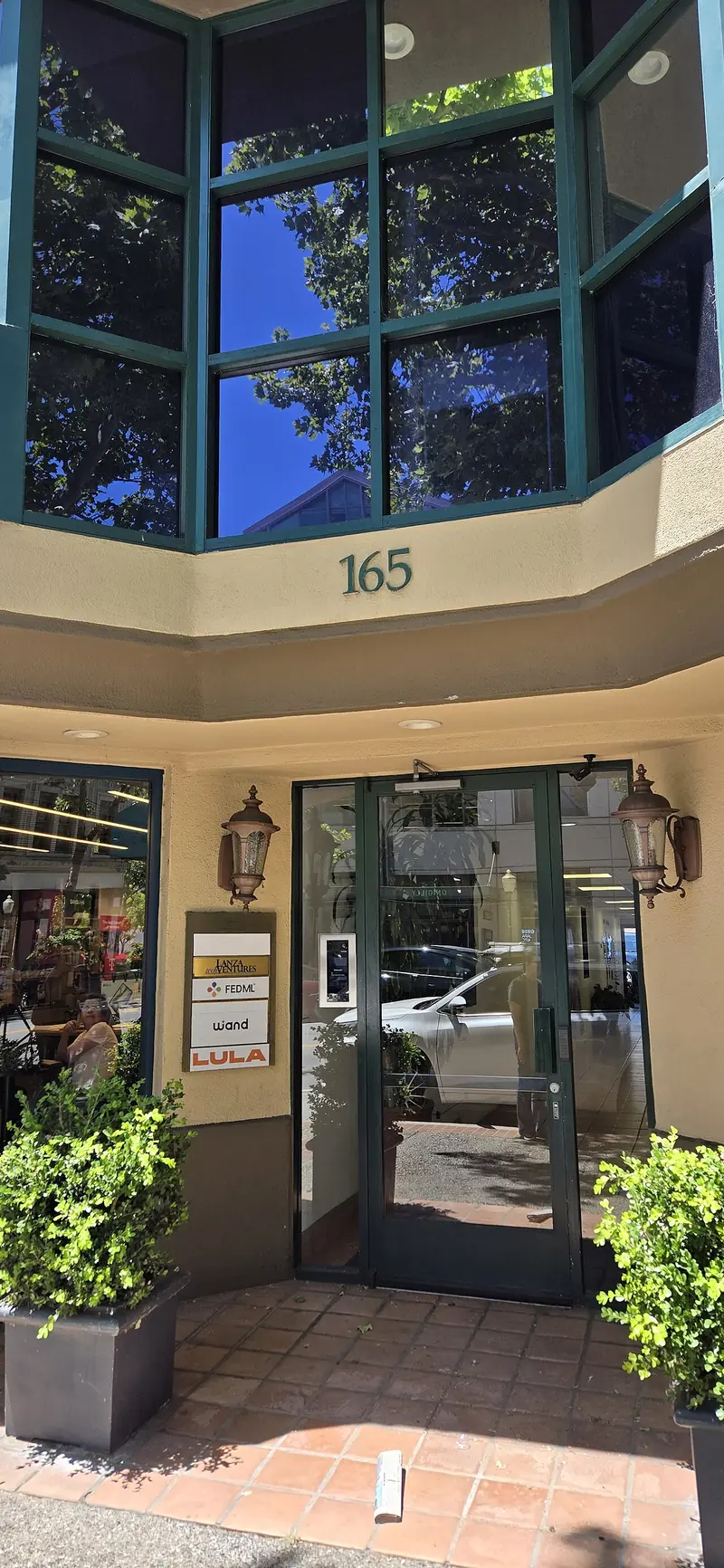

The lucky building
Google is the most famous tenant of 165 University Avenue but far from the only one. The building is run by Rahim and Saeed Amidi, whose family business later grew into the Plug and Play Tech Center. Over the years it has housed or helped start:
- Logitech, the computer accessories company, early in its history.
- Confinity, the startup that launched PayPal. Our PayPal profile covers its Palo Alto years.
- Danger, the mobile phone maker that Microsoft bought in 2008.
- Later startups including Milo.com, WePay, Yummly, BetterWorks and BridgeBio.
That record earned it the nicknames lucky building and karma building. The ground floor was home to Chimaera Books and Music until 2000. There is no plaque or marker today, so look for the street number above the door.
The move to Mountain View
Later in 1999 Google left Palo Alto for its first Mountain View office, on Bayshore Parkway. It moved into the larger Googleplex campus on Amphitheatre Parkway in the early 2000s and later bought it. Google has been headquartered in Mountain View ever since. It went public in 2004 and reorganized under a new parent company, Alphabet, in 2015.
The move fit a pattern. Downtown Palo Alto offices are small and expensive. Fast growing companies tend to leave for bigger floor plates in Mountain View, Menlo Park or Sunnyvale. Facebook followed a similar path a decade later, as our Facebook profile explains.
Why the Palo Alto months mattered
Google's stay downtown was short, but it came at a turning point. When the company arrived it was a promising search tool run by two graduate students and a few early hires. By the time it left it had major venture backing, a board with experienced investors and a growing team of engineers. Those steps happened while the company worked out of a few rooms on University Avenue.
The location helped. The office was a short walk from the Palo Alto Caltrain station and a short ride from Stanford, where Google kept recruiting. Investors on Sand Hill Road were a few miles away. That mix of university, transit and capital is the same one that drew Hewlett-Packard, Facebook and many others to Palo Alto. Our guide to Sand Hill Road explains the investor side.
The building also earned Google a small place in local folklore. Tour guides and founders still point out 165 University Avenue as the place where Google worked before it became a giant.
Timeline
| Date | Event |
|---|---|
| 1995 | Page and Brin meet at Stanford. |
| 1996 to 1997 | BackRub search engine runs at Stanford. |
| 1998 | Google incorporates and rents a Menlo Park garage. |
| February 1999 | Move to 165 University Avenue with eight employees. |
| June 1999 | Sequoia Capital and Kleiner Perkins invest. |
| Later 1999 | Move to Mountain View. |
| 2006 | Google buys the Menlo Park garage house. |
Seeing Google's Palo Alto past
165 University Avenue is easy to find. Walk up University Avenue from the Palo Alto Caltrain station and you will reach it within a couple of blocks. It is a working office building, so look from the sidewalk and do not go upstairs.
Good to know
- There is no Google marker or museum in Palo Alto. The Googleplex visitor experience is in Mountain View.
- The Menlo Park garage is a private property. Do not look for it.
- Combine 165 University Avenue with the Facebook marker at 471 Emerson Street, a few minutes away on foot.
- A self-guided audio tour adds background as you walk.
For the investors who funded Google, see our pages on Sequoia Capital and Kleiner Perkins. For the other companies with a Palo Alto chapter, see the companies guide.
Frequently asked questions
Was Google founded in Palo Alto?
Not exactly. Google began as a research project at Stanford, which sits next to Palo Alto. Its first office was a rented garage in Menlo Park. In February 1999 it moved into 165 University Avenue in downtown Palo Alto, then left for Mountain View later that year.
What is at 165 University Avenue?
It is a small downtown office building with shops on the ground floor. Besides Google it housed Logitech, PayPal's predecessor Confinity, Danger and many later startups, which is why locals call it the lucky building. There is no plaque.
How long was Google in Palo Alto?
Only a few months. Google moved into 165 University Avenue in February 1999 with eight employees and moved to Mountain View later in 1999 after outgrowing the space.
Where was Google's garage?
Google's first office was a rented garage at Susan Wojcicki's house in Menlo Park. She later became a senior Google executive. Google bought the house in 2006. It is a private property and not open to visitors.
Did Stanford own part of Google's technology?
Yes. The PageRank method that Larry Page developed as a graduate student was patented by Stanford, which licensed it to Google. That arrangement is a classic example of Stanford research turning into a company.