On this page
Palo Alto's Chinese American history starts before the town did. In the early 1880s Chinese men were already living and working on Leland Stanford's farm along San Francisquito Creek. They tended his horses and vines, planted his trees and later helped shape the campus. Then the long shadow of the Chinese Exclusion Act kept the community small for decades. After World War II it grew again, slowly at first and then quickly, until Chinese became the second most spoken language in the city.
This page collects the documented history, drawing on Stanford's archaeology program, Palo Alto Online, the Palo Alto History Museum and published accounts. It links to our longer pages on Thomas Foon Chew and on the Japanese American community, whose story overlaps with this one.
The railroad and the Stanford fortune
The money that built Stanford came from railroads and the railroads were built in large part by Chinese workers. Leland Stanford was one of the Big Four behind the Central Pacific Railroad, incorporated in 1861. Stanford's Arboretum project timeline says that between 10,000 and 12,000 Chinese workers were employed on the line at any given time during construction, which ended at Promontory Summit on May 10, 1869.
Stanford researchers are careful about one point. They have found no archival evidence so far that the Chinese men who later worked on Stanford's Palo Alto farm had worked on the railroad. The connection between the two workforces is likely but not proven.
Workers on the Stanford farm
When Stanford began buying land for his Palo Alto Stock Farm in 1876, he hired Chinese workers for many jobs. A 2019 Stanford News report on the university's archaeology work lists them:
- Tending horses on the stock farm.
- Working the vineyards and the winery.
- Maintaining the orchards and gardens.
- Helping build the Oval and Lake Lagunita once the university was under way.
- Planting every palm tree on Palm Drive.
Documents show that the Chinese workers held varied jobs, had room to move up and were paid the same as white workers, according to the same report. Thomas Douglas, hired in 1889 as the first university gardener, worked closely with Chinese gardeners. Our page on orchards and agriculture covers the wider farm economy they worked in.

The Arboretum Chinese Labor Quarters
Anti-Chinese hostility spread across the West from the 1870s. After the Chinese Exclusion Act of 1882, many employers housed Chinese workers on their own property and Stanford did too. Archaeologists estimate there were four to six such residences on the farm and later the university grounds.
One of them stood near the vineyard inside what is now the Stanford Arboretum. Stanford's project dates its occupation from the early 1880s to 1925. In 2017 Stanford Heritage Services archaeologists confirmed the site with test excavations, using old maps fitted to the modern landscape and a grid of 5 meter squares.
What they found was the stuff of daily life. A kitchen midden held broken cups and plates and bones from cooked meals. Other finds include a whiteware teacup fragment, a piece of a Chinese brown-glazed stoneware storage jar and a reconstructed wine bottle. Students have continued the work in a spring field methods course taught by university archaeologist Laura Jones and Megan Victor. The researchers hope to learn about meals, leisure and sleeping arrangements and whether any women lived at the site. Most residents are thought to have been young men.
Good to know
- The quarters site is an active archaeological area. There is nothing built to see and visitors should stay on Arboretum paths.
- Palm Drive itself is the most visible legacy. Walk or drive it from El Camino Real to the Oval.
Exclusion years in a new town
Palo Alto was founded in the 1890s, in the middle of the exclusion era. The 1882 law barred most Chinese laborers from entering the country and stayed in force until Congress repealed it in 1943. Merchants were one of the few groups still admitted, which is how the family of Thomas Foon Chew came to California in 1897.
Local rules added more barriers. In 1920 the Palo Alto Chamber of Commerce passed a resolution calling for a "segregated district for the Oriental and colored people of the city." Henry Dodson of the Colored Citizens Club spoke out against it and the plan died. Restrictive deeds did the work instead. When Southgate was subdivided in 1923, its deeds excluded people of African, Japanese or Chinese descent, according to the city's centennial history. Our page on covenants and the fair housing fight explains how those rules worked and how they ended.
Before World War II, Palo Alto Online notes, the region's Chinese community was made up mainly of Cantonese immigrants who ran restaurants and laundries.
Thomas Foon Chew and the Mayfield cannery
The most successful Chinese American business figure in local history built his plant in Mayfield. Thomas Foon Chew, born in 1889 in Heshan, Guangdong, ran the Bayside Canning Company, which grew into the third-largest canner in the United States in the 1920s. In 1918 he bought about four acres in Mayfield and built a cannery at what is now 340 Portage Avenue. It specialized in apricots, pears and peaches. Chew sold it in 1928 and died in 1931 at about 42.
After decades of near silence his name came back in 2026. The renovated cannery reopened on May 12, 2026, with a glass mosaic by Kyungmi Shin at the entrance. The City Council voted in 2025 to rename Portage Avenue as Thomas Foon Chew Avenue. His granddaughter Gloria Hom, an advisory board member of the Palo Alto History Museum, has helped keep his story alive.
After the war: a community grows
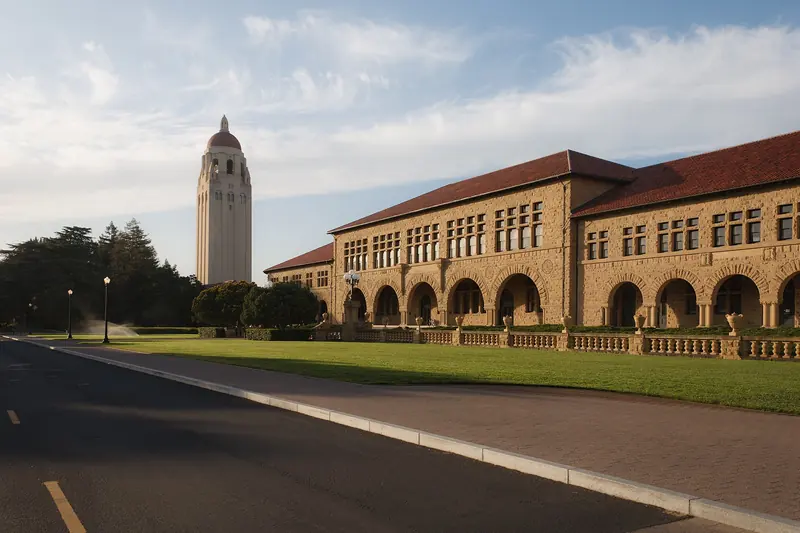
The 1950 census counted just 167 Chinese residents in Palo Alto, about 0.7 percent of the city, according to Palo Alto Online. Eugene Wu was one of them. Born in Chengdu, he came to Palo Alto in 1951 to organize the Hoover Institution's newly acquired Chinese collection, working in the basement of Hoover Tower. He recalled that there was "almost no Chinese community" and no Chinese grocery store. Stanford had only two Chinese faculty members. When he and his wife Nadine went apartment hunting, landlords told them the place had just been rented. Our Hoover Institution Library page covers the archive he helped build.
Some newcomers found a way around the barriers. The Lawrence Tract, an interracial subdivision begun in 1950 near Greer Road, opened as home to Black, Japanese American, Chinese American and white families.
The makeup of the community changed in waves. Palo Alto Online describes three:
- Before World War II: mostly Cantonese immigrants in restaurants and laundries.
- After the war: mostly non-Cantonese academics and engineers drawn by Stanford and the electronics industry.
- After 1980: students from mainland China, many of whom stayed to become professors, doctors and engineers.
The community today
Growth since then has been dramatic. A 2017 census estimate put Palo Alto's Chinese population at 17.5 percent. In the 2020 census about 35 percent of residents identified as Asian alone and not Hispanic. In 2018 Stanford historian Gordon Chang noted that Chinese had become the second most spoken language in the city.
That presence shows up across town. Lunar New Year is one of the city's big community celebrations, covered on our Lunar New Year page. A Stanford-sponsored traveling exhibit on Chinese railroad workers was shown at a Mitchell Park New Year event. Our guide to Chinese food covers the restaurants.
Researching this history
Much of this story is still being recovered. Good places to start:
- Stanford Archaeology Center. Its Arboretum Chinese Labor Quarters project publishes reports and a timeline.
- The Palo Alto Historical Association. It keeps the city archives and clippings from the Palo Alto Times. It will move into the planned Palo Alto History Museum, whose opening was postponed in January 2026.
- Books. Robin Chapman's research on Thomas Foon Chew and Gordon H. Chang's work on Chinese railroad workers.
Frequently asked questions
Did Chinese workers build Stanford?
Chinese workers were an essential part of the labor force. Stanford archaeologists say they tended horses on the Palo Alto Stock Farm, worked its vineyards and winery and kept its orchards and gardens. They also helped build the Oval and Lake Lagunita and planted every palm tree on Palm Drive.
What is the Arboretum Chinese Labor Quarters?
It is an archaeological site in the Stanford Arboretum where Chinese workers lived from the early 1880s until 1925. Stanford archaeologists confirmed it with test excavations in 2017 and students have dug there in a field methods course. Finds include a kitchen midden, a Chinese brown-glazed stoneware jar fragment and teacup sherds.
Did Stanford's Chinese farm workers build the transcontinental railroad?
Leland Stanford's Central Pacific employed about 10,000 to 12,000 Chinese workers at a time during construction. Stanford researchers say they have not yet found archival evidence that the men on his Palo Alto farm had worked on the railroad, so the link is plausible but unproven.
How large was Palo Alto's Chinese community in the past?
It was small for a long time. The 1950 census counted 167 Chinese residents, about 0.7 percent of the city, according to Palo Alto Online. A 2017 census estimate put the share at 17.5 percent and the 2020 census counted about 35 percent of residents as Asian.
Who was Thomas Foon Chew?
Thomas Foon Chew (1889 to 1931) ran the Bayside Canning Company, the third-largest canning business in the country in the 1920s. In 1918 he built a cannery in Mayfield, now Palo Alto's Ventura neighborhood. The renovated building reopened in 2026 with a mosaic in his honor.