On this page
Foundation Capital is one of the venture firms that never moved to Sand Hill Road. It lists its main office at 550 High Street in downtown Palo Alto, a short walk from the Caltrain station and the cafes where founders meet. Its pitch to founders is simple: it wants to be the first money in. The firm says it is a company's first investor four times out of five.
This profile is a neutral explainer for visitors and founders. It is based on Foundation Capital's website and published profiles. For the basics of how venture funds work, see our venture capital guide.
Founding in 1995
Foundation Capital was founded in 1995, as the commercial internet was taking off. Published profiles name Bill Elmore, Kathryn Gould and Jim Anderson among its founding partners. The firm's own credo looks back on the cycles it has lived through since then: the dot-com bubble, the mobile era, the move to cloud software, blockchain and now AI.
The firm's identity leans on resilience. Its credo says the mark in its logo "isn't an F, it's the Kryptonian symbol for 'resilience,'" a nod to the many rejections founders face. It describes the founders it backs as people who believe "the purpose of life is to be briefly extraordinary."
The office at 550 High Street
The firm's website lists two offices: 550 High Street, 3rd Floor, Palo Alto, plus 2 Shaw Alley, 4th Floor, in San Francisco's South of Market area. High Street runs parallel to Alma Street, one block east of the Caltrain tracks. That makes the Palo Alto office one of the easiest venture addresses to reach without a car.
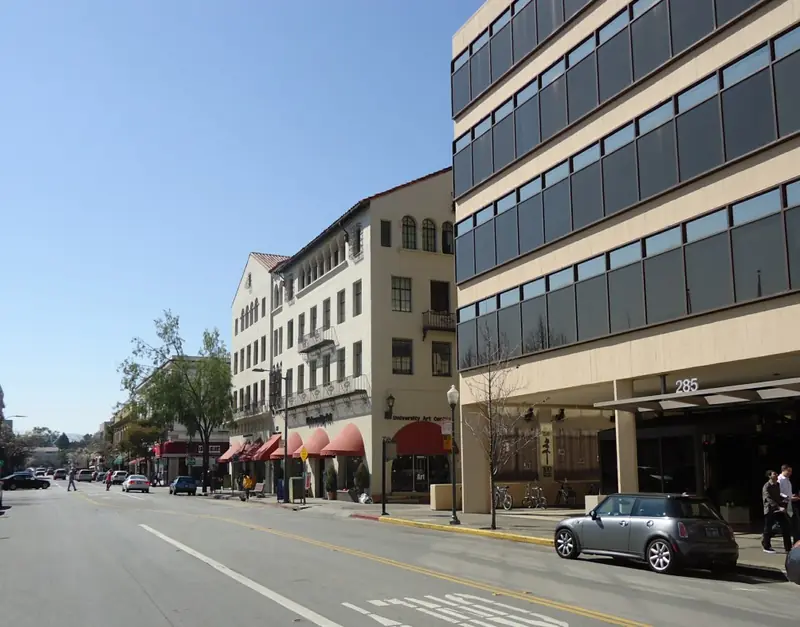

The office is private and meetings are by appointment. The value of the location for visitors is the neighborhood around it. Our guide to downtown and University Avenue covers places to eat and walk. The Palo Alto Caltrain station guide explains trains from San Francisco and San Jose.
Stage and focus
Foundation Capital calls itself an early-stage firm and says there is "no such thing as 'too early.'" Its website makes three specific claims:
- First money in. It is a company's first investor four out of five times.
- Before revenue. 77 percent of its investments are pre-revenue.
- Outcomes. Its portfolio has produced 37 IPOs and many more acquisitions.
The firm's credo names enterprise software, crypto and fintech as areas where its investments have "reinvented industries." Its recent writing and podcast series, called AI in the Real World, focus heavily on AI applications, AI agents and enterprise software. The firm says it commits "when it's an idea and a founder determined to make it real."
Notable investments
Foundation Capital's own pages tell the story of several of its bets:
| Company | What the firm says |
|---|---|
| Netflix | Backed the DVD-by-mail service in 1999. |
| Atheros | Led the investment in the wireless chip company, later acquired by Qualcomm. |
| Uber | Invested about a decade after Atheros. |
| Cerebras | Wrote the AI chip maker's first term sheet in 2016. The firm's homepage congratulated Cerebras on its IPO in 2026. |
| Solana, Sunrun, Lending Club, TubeMogul | Named in the firm's credo among companies that reinvented their industries. |
| Eightfold, Turing, Tennr | Featured with founder quotes on the firm's homepage. |
The Cerebras story shows the firm's patience. The company set out to build a chip the size of a whole silicon wafer, an approach that had no commercial track record when the firm wrote its first check. The firm's news page links coverage in the Wall Street Journal and CNBC about early Cerebras investors and the returns they earned a decade later. CNBC's piece names partner Steve Vassallo as the early Cerebras investor.
The list is a highlight reel. Most early-stage investments do not succeed. A firm's results depend on a few very large outcomes.
The Netflix bet in context
Netflix is the investment Foundation Capital mentions most often. In 1999 the company rented DVDs by mail from its base in the South Bay. Streaming was years away and video rental meant a trip to a store. The firm's credo admits that nobody could have predicted the company would become what it calls "the world's first global television network." Netflix went public in 2002.
The firm uses the story to make a broader point about early investing. At the first check, the product a company sells is often not the one that makes it famous. Atheros is a similar case in the firm's telling: an investment in wireless chips that ended up inside the phones and laptops most people now carry.
Staying power
Foundation Capital puts weight on having lasted. Its credo states that two-thirds of venture firms never get past their first fund and that only 10 percent survive beyond their fourth. Those are the firm's figures, not an independent count. The firm says it has raised more than a dozen funds since 1995 and that lessons from each era are "transmitted to each successive generation of partners." For how the older Peninsula firms built that kind of continuity, see our history of venture capital.
Why downtown Palo Alto
Downtown Palo Alto has a long history as a place where companies start. Google, PayPal's predecessor Confinity and Facebook all had early offices within a few blocks of the Caltrain station. Our page on University Avenue's tech history traces that story.
For an early-stage firm, being downtown has practical value. Founders often work from coworking spaces or small offices in the area. A partner can walk to a coffee meeting rather than drive. Our guide to where founders meet lists the cafes and venues where that happens. Many of the larger firms sit on Sand Hill Road in Menlo Park, about 10 to 15 minutes away by car.
How founders reach Foundation Capital
The firm's website lists its partners and their practice areas but does not offer an open pitch form on the pages we checked. Founders usually take these steps:
- Pick the partner. Read the team and practice pages and find the partner whose area matches your company.
- Read their writing. Partners publish essays and podcasts. Referring to a specific piece shows you have done your homework.
- Get a short introduction. A founder in the portfolio or another investor who knows the partner is the usual route.
- Come early. The firm says it is comfortable investing before revenue, so you do not need traction to start the conversation.
Our guides to seed and pre-seed funds and pitching investors go deeper on first meetings and decks.
Visiting the area
Good to know
- The office at 550 High Street is private. Visit only for a confirmed meeting.
- Downtown parking is tight. Take Caltrain or use a public garage.
- For a place to work between meetings, see our list of cafes for working.
Frequently asked questions
Where is Foundation Capital's office?
Foundation Capital lists its Palo Alto office at 550 High Street, 3rd Floor, in downtown Palo Alto. It also lists a San Francisco office at 2 Shaw Alley. The Palo Alto office is a short walk from the Palo Alto Caltrain station.
When was Foundation Capital founded?
Foundation Capital was founded in 1995. Published profiles name Bill Elmore, Kathryn Gould and Jim Anderson among its founding partners. The firm describes itself as early stage and has stayed with that approach since.
Did Foundation Capital invest in Netflix?
Yes. The firm says it backed Netflix in 1999, when Netflix was a DVD-by-mail service. It lists Netflix among its best known investments alongside Solana, Sunrun, Lending Club and TubeMogul.
What stage does Foundation Capital invest in?
The firm says it invests from day zero. Its website states that it is a company's first investor four out of five times and that 77 percent of its investments are pre-revenue.
What does Foundation Capital's logo mean?
According to the firm's credo, the mark in its logo is not an F. It is the Kryptonian symbol for resilience, a nod to the grit the firm says founders need.