On this page
San Mateo is the largest city on the Peninsula between Palo Alto and San Francisco, with about 106,000 residents. It is old by California standards, incorporated in 1894 and it has the deepest downtown on this stretch of the Caltrain line: blocks of restaurants, a long-standing Japanese community and a central park with a formal Japanese garden. South of downtown, Hillsdale Shopping Center is the Peninsula's main mall.
From Palo Alto it is about 15 miles north, which puts it within easy reach for dinner, a shopping trip or an afternoon in the garden. This guide covers distances and transit, the main areas, attractions, events and why you might choose San Mateo over a closer town.
Where San Mateo is and how far
San Mateo sits in the middle of San Mateo County. Burlingame lies to the north, Belmont and Foster City to the south and east and the hills of the San Mateo Highlands to the west. Highway 92 crosses the city and continues east over the San Mateo Bridge to Hayward.
Downtown San Mateo is about 15 miles north of University Avenue. Outside rush hour the drive takes about 25 minutes on Highway 101. San Francisco International Airport is about 10 miles farther north.
Getting there from Palo Alto
Caltrain
San Mateo has three stations. The San Mateo station serves downtown and Central Park. Hayward Park is near Highway 92. Hillsdale serves the mall and the Bay Meadows district. All three are in zone 2, so the fare from Palo Alto is a two-zone fare: $6.25 in October 2026, rising to $6.50 on January 1, 2027. Express trains often stop at Hillsdale and San Mateo, which makes the ride quick. Check the timetable and our Caltrain guide.
Car
Highway 101 is the fastest route. Exit at Third Avenue for downtown or Hillsdale Boulevard for the mall. El Camino Real runs through the whole city and passes Central Park. Downtown has public garages. Hillsdale has free parking.
Bus
SamTrans buses run up El Camino Real from the Palo Alto Transit Center to San Mateo. The trip is much slower than the train but stops along the way.
What San Mateo is known for
The Ramaytush Ohlone were the earliest known people here. Under Spain and Mexico the land was part of Rancho de las Pulgas and Rancho San Mateo. In the 1850s wealthy San Franciscans began building summer estates in the oak woodlands west of the railroad and the town grew around the station.
In the early 20th century, Japanese immigrants came to work in the bayside salt ponds and the flower industry. Their community shaped downtown, which still has many Japanese restaurants and shops. The city's Japanese Garden in Central Park honors its sister city, Toyonaka, Japan.
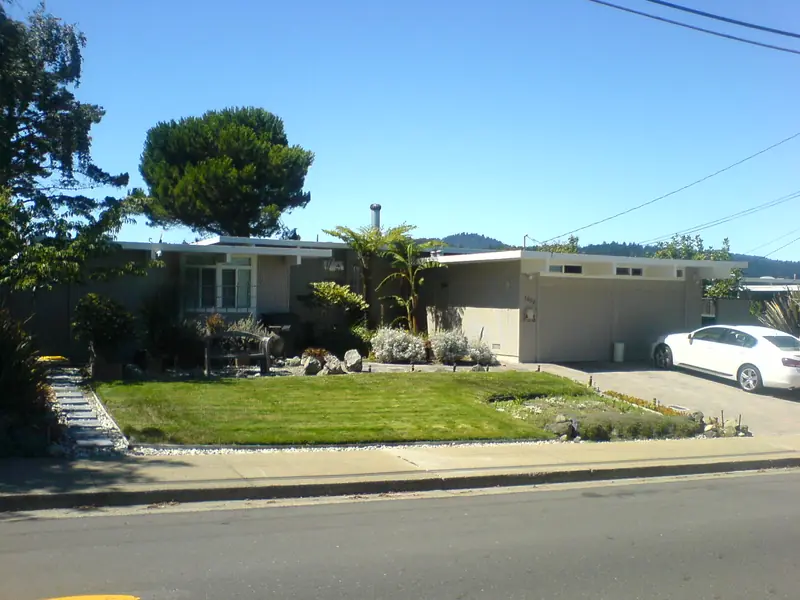
San Mateo was long known for horse racing. The Bay Meadows racetrack closed in 2008 and the 83-acre site was rebuilt as a mixed-use neighborhood of homes, offices, shops and parks. In the hills, the San Mateo Highlands hold one of the Peninsula's best-known groups of Eichler homes. That area is unincorporated county land rather than part of the city. Our Eichler homes history covers the Palo Alto tracts.

The main areas
Downtown
Downtown is roughly bounded by Tilton Avenue, Ninth Avenue, Delaware Street and El Camino Real, with the San Mateo station near its center. Wikipedia counts more than 800 shops and restaurants. The density of Japanese, Chinese, Thai, Vietnamese, Indian, Mexican and Italian restaurants rivals anything near Palo Alto. In 2021 the city voted to create a permanent pedestrian area downtown between First and Third Avenues.
Central Park
Just west of downtown along El Camino Real, Central Park is the city's signature park. San Mateo bought the Kohl Mansion property in 1922 and turned it into a 16.3-acre park. It has tennis courts, a baseball diamond, a rose garden, a miniature train and the Japanese Garden.
Hillsdale and Bay Meadows
Hillsdale Shopping Center opened in December 1954 as an open-air center built by developer David D. Bohannon. Today its own site lists more than 130 stores, a Cinépolis Luxury Cinemas and free parking. Nordstrom and Macy's are the anchors. Across the tracks, Bay Meadows has new apartments, offices and parks around a town square.
Coyote Point and the bayfront
Coyote Point is a large county park on the bay, popular for windsurfing and sailing. It is home to CuriOdyssey, a small science museum and wildlife center for children. The Bay Trail runs along much of the city's shoreline.
The Japanese Garden in Central Park
The Central Park Japanese Garden at 50 East Fifth Avenue is San Mateo's best-loved attraction. The city credits its design to Nagao Sakurai, a landscape architect of the Imperial Palace in Tokyo. It has a koi pond, a granite pagoda, a tea house and a bamboo grove, all arranged for a slow walk around the water.
- Hours: 10 a.m. to 4 p.m. Monday to Friday and 11 a.m. to 4 p.m. on Saturday and Sunday. Open on holidays except December 25.
- Koi feedings: At 11 a.m. and 3 p.m. on weekdays in spring and summer. The fish are not fed from November through March.
- Dogs: Not allowed in the garden.
- Construction: The city says the park's playground and picnic areas are closed during a construction project expected to last 18 to 24 months. Check the city page before planning a family picnic.
Do not confuse it with the Eugene J. de Sabla Japanese Teahouse and Garden on De Sabla Road. That 1894 garden is a separate site listed on the National Register of Historic Places and is not part of Central Park.
Food and shopping
Downtown is the place to eat. Walk the blocks around B Street, Third Avenue and Fourth Avenue and you will find ramen, sushi, izakaya, dumplings, Thai, Indian, tacos and more. It is one of the best Japanese food areas on the Peninsula. Our Japanese food guide covers the Palo Alto side.
For shopping, Hillsdale is the obvious choice when you need department stores or national brands. Downtown has independent shops and services. Our shopping guide covers what Palo Alto has for comparison.
San Mateo also has many hotels, especially near Highway 101 and Highway 92 and is a reasonable base between Palo Alto and SFO. You can compare San Mateo hotels for your dates.
Events
San Mateo's event calendar changes from year to year, so rely on the official listings:
- Central Park: The Japanese Garden is open daily on the schedule above and the city posts any closures on the park page.
- Downtown: Downtown merchants and the city post street events and seasonal celebrations on their calendars.
- Hillsdale: The mall lists holiday events and store openings on its site.
Check the City of San Mateo website for current dates.
Why a Palo Alto visitor might go
- Dinner with more choice. Downtown San Mateo has more restaurants in a few blocks than any Peninsula city south of it.
- The Japanese Garden. A calm hour in one of the region's classic gardens, a short walk from the train.
- Mall shopping by train. Hillsdale is next to its own Caltrain station.
- Bayfront time. Coyote Point is good for windsurf watching and a museum visit with kids.
- A base near the airport. San Mateo splits the difference between SFO and Palo Alto. See our SFO guide.
Good to know
- San Mateo is a two-zone Caltrain fare from Palo Alto.
- The Japanese Garden closes at 4 p.m. every day. Arrive by early afternoon in winter.
- Central Park's playground and picnic areas are closed for construction. The garden stays open.
- Highway 101 through San Mateo is often slow on weekday evenings. The train is usually faster.
Frequently asked questions
What are the San Mateo Japanese Garden hours?
The city lists the Japanese Garden in Central Park as open 10 a.m. to 4 p.m. Monday to Friday and 11 a.m. to 4 p.m. on Saturday and Sunday. It is open on holidays except December 25. Dogs are not allowed in the garden.
How far is San Mateo from Palo Alto?
Downtown San Mateo is about 15 miles north of downtown Palo Alto. The drive takes about 25 minutes outside rush hour on Highway 101. Caltrain connects the two downtowns and San Mateo is a two-zone fare from Palo Alto.
Which Caltrain station is closest to Hillsdale Shopping Center?
The Hillsdale station. Wikipedia describes the mall as adjacent to it and the mall's own site calls it Caltrain accessible. The San Mateo station is the stop for downtown and Central Park.
Can you feed the koi at the San Mateo Japanese Garden?
Visitors do not feed the fish. Staff hold koi feedings in spring and summer at 11 a.m. and 3 p.m. on weekdays during public hours. The fish are not fed from November through March, so there are no feedings in winter.
Is San Mateo a good base near SFO?
It can be. San Mateo is about 10 miles south of San Francisco International Airport and has three Caltrain stations, so you can reach both San Francisco and Palo Alto by train. Burlingame and Millbrae are closer to the airport.