On this page
Most redwood groves near Palo Alto mean a drive up into the Santa Cruz Mountains. Redwood Grove Nature Preserve is the exception. It sits on a quiet stretch of University Avenue in Los Altos, a short walk from downtown, where a stand of coast redwoods shades a bend of Adobe Creek. The trees were planted by hand about a century ago. Today the grove is a small city nature preserve with a boardwalk, a hillside trail and a shuttered Spanish Colonial Revival house at its center.
Our Los Altos guide mentions the grove in passing. This page tells the story of the Halsey family who created it, explains what is happening to their house and covers the practical details of a visit.
The preserve today
The City of Los Altos runs Redwood Grove as part of its parks system. Its preserve page describes a 6.12-acre site with picnic tables, a boardwalk along Adobe Creek and a Hillside Trail that follows the creek. A few rules apply:
- The preserve is closed from 9 p.m. to 6 a.m. daily.
- No motor vehicles are allowed inside.
- Visitor parking is on University Avenue.
The city's recreation department runs its Redwood Grove Summer Camp here each year, so expect groups of children on summer weekdays. The city also partners with Grassroots Ecology, which leads volunteers in restoring native habitat in the preserve. Our nature programs guide explains how families can join those workdays.
The Halsey family and the planted grove
The fullest account of the property's history comes from a historic resource evaluation prepared for the city as part of its environmental review. According to that report:
- Emma Wright Halsey's parents bought the property in 1912 as a summer retreat.
- They gave it to Emma and her husband, Theodore Vail Halsey, as a wedding gift in 1915.
- The Halseys moved there permanently in 1923, the year their house was built.
- In the early 1920s Emma and her gardener, Mori, transplanted redwood saplings from her grandfather's property along Summit Road in the Santa Cruz Mountains.
Theodore Vail Halsey, who lived from 1873 to 1943, was a telephone company executive. Emma, who lived from 1880 to 1975, was a keen gardener and led the landscaping. Her mother, Myra Wright, joined the household in 1928. The couple had two children, Theodore Jr. and Myra.
After the Halseys, Edward and Rachel Bessey owned the property from 1945 to 1970, followed by Meredith Pearson until 1974. That year the City of Los Altos bought it and turned it into a park and nature center. The city listed the Halsey House and Redwood Grove together as a local historic landmark in May 1981.
Why redwoods grow here
Coast redwoods do not grow wild on the flat valley floor around Los Altos. They need cool, moist conditions and in this area are native to the canyons of the Santa Cruz Mountains to the west. Emma Halsey's trees have done well because they stand in the shaded creek corridor, with Adobe Creek keeping the ground damp. A century on, they make a convincing small forest.
The same species gave Palo Alto its name. The lone redwood called El Palo Alto still stands beside San Francisquito Creek on the other side of town. For full-scale old-growth forest, see our guide to redwood forests near Palo Alto.
The Halsey House and its future
The house at the center of the grove is a single-story building of about 3,400 square feet with a concrete foundation, wood framing and a clay tile roof, according to the city. The historic resource evaluation calls it a modest example of Spanish Colonial Revival style and says the architect is unknown. A northwest addition followed in 1928 and the east wing was extended in the 1930s. The plan centers on a main house with two bedroom wings around a courtyard.
After 1974 the city used the house as a nature center for groups of 25 to 30, mostly children. It has been closed since 2008 because of health and safety code concerns. Since then the city has studied what to do with it:
| When | What happened |
|---|---|
| 2015 | Assessment findings go to City Council, which asks for more study |
| August 2021 | Consultants Page and Turnbull find the house and the grove each eligible for the California Register of Historical Resources |
| September 2021 | Council reviews four options with estimates: full rehabilitation about $4.67 million, partial rehabilitation about $3.26 million, demolition about $289,000, mothballing about $247,000 |
| February 2025 | City files a notice that it will prepare an environmental impact report for a Halsey House project |
| June 2026 | Environmental impact report filed with the state; the project it studies is demolition of the house |
The June 2026 filing describes demolishing the building over about three months, then clearing the site and replanting it with native landscaping to match the surrounding vegetation. Because the house is a city landmark, the report treats it as a historic resource. We could not confirm whether the City Council has made a final decision. If demolition goes ahead, crews would use the preserve's University Avenue entrance, so parts of the preserve could close during the work. Check the city's website before a visit.
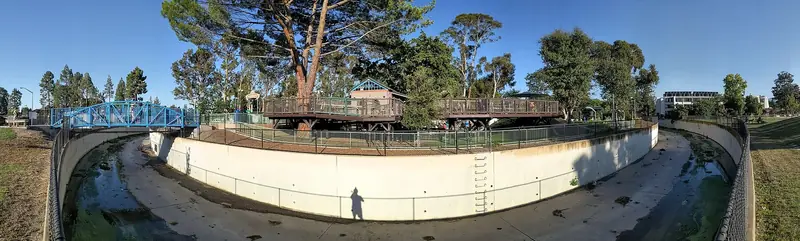
Adobe Creek
Adobe Creek starts in the foothills, runs through Los Altos Hills and Los Altos, then crosses south Palo Alto on its way to the bay. In the Mexican era it formed the boundary between two land grants, Rancho La Purísima Concepción and Rancho San Antonio. At Redwood Grove the creek runs under the shade of the planted redwoods and native trees, a different scene from its suburban stretches downstream in Palo Alto.
Walk the boardwalk slowly and you may see birds working the creek banks. Our birdwatching guide covers what to look for around Palo Alto.

Visiting and Shoup Park next door
Redwood Grove is small, so a visit is short. A loop on the boardwalk and the Hillside Trail takes well under an hour. It works best as part of a longer outing:
- With lunch downtown. Downtown Los Altos is a short walk north along University Avenue.
- With the history museum. The Los Altos History Museum tells the orchard story that the Halseys lived through, from Thursday to Sunday afternoons.
- With Shoup Park. Shoup Park, next door at 400 University Avenue, was dedicated on June 18, 1955, as the city's first park.
There is no admission fee. Wear shoes with grip, since the trail and boardwalk can be damp under the trees even in dry months. Bring a picnic for the tables, but pack out your trash.
Good to know
- Park on University Avenue. There is no parking lot inside the preserve.
- The Halsey House is closed to the public. View it from outside only.
- Summer weekdays are busy with the city's day camp. Mornings and weekends are quieter.
- Want bigger trees? You can book a Muir Woods or redwood tour from the Bay Area.
Frequently asked questions
Who planted the redwoods at Redwood Grove in Los Altos?
Emma Wright Halsey and her gardener, recorded only as Mori, transplanted redwood saplings to the property in the early 1920s. According to a historic resource evaluation prepared for the city, the seedlings came from her grandfather's land along Summit Road in the Santa Cruz Mountains.
Is the Halsey House open?
No. The Halsey House was used as a nature center after the city bought the property in 1974 but has been closed since 2008 over health and safety code concerns. A draft environmental impact report filed in June 2026 studies a proposal to demolish it. We could not confirm a final decision.
Where do you park for Redwood Grove in Los Altos?
The city says visitor parking is on University Avenue. No motor vehicles are allowed inside the preserve. Shoup Park, next door at 400 University Avenue, is also reached from the same street.
What are Redwood Grove's hours?
The city says the preserve is closed from 9 p.m. to 6 a.m. daily, so it is open from early morning into the evening. There is no admission fee.
How long does it take to walk Redwood Grove?
It is small, about six acres. A loop on the boardwalk along Adobe Creek and the Hillside Trail takes well under an hour at an easy pace, which makes it a good add-on to lunch in downtown Los Altos.