On this page
Before orchards and suburbs, the Palo Alto flatlands were oak savanna and grassland cut by creeks, with chaparral and woodland in the hills. The plants that grew there are adapted to exactly what local gardens face now: wet, mild winters and long, dry summers. Planted in the right spot, many natives need no summer water at all once established. They also support the insects that birds feed their young, which is why the bluebirds at Arastradero and the hummingbirds in Midtown yards depend on them.
Buying natives takes a little more planning than a trip to a big-box store. The best local sources are small, sell out of popular species and run sales on set dates. This page lists where to buy, the 2026 sale calendar as published and a starter list. For general shopping, our garden centers guide covers every nursery near town.
Grassroots Ecology nursery
Grassroots Ecology is a local nonprofit that restores habitat in preserves around Palo Alto. It grows native plants at a nursery inside Palo Alto's Foothills Nature Preserve and sells them to the public as well as using them in its own projects.
Its nursery sales page explains how buying works:
- Download the current inventory list from the website.
- Email [email protected] with each plant's name, size and quantity.
- Wait for a reply, which the group says comes within 1 to 3 business days.
- Pick up at the nursery. Directions come after you order.
The minimum online order is $50. The nursery is not open for in-person shopping; it lists pickup as 7 days a week from 8 a.m. to sunset, subject to the preserve's hours. Grassroots Ecology also sells at CNPS chapter sales and offers the book San Francisco Bay Area Native Plants for the Garden for $30. If you would rather plant on public land, the group runs volunteer workdays; see our volunteering guide.
CNPS Santa Clara Valley chapter
The Santa Clara Valley chapter of the California Native Plant Society runs a volunteer nursery at Hidden Villa, 26870 Moody Road in Los Altos Hills, just past the Dana Center. Its nursery page says volunteers propagate natives all year, mostly straight species rather than cultivars. Open work sessions at the nursery have been canceled indefinitely, so buy through the chapter's sales and online store.
The chapter's 2026 sales, as announced in its newsletter and event listings:
| Sale | Dates | Pickup |
|---|---|---|
| Winter online sale | January 19 and 20, 2026 | January 23 at Hidden Villa or January 24 at the Peninsula Conservation Center |
| Spring online sale | May 25 and 26, 2026 | May 29 at Hidden Villa or May 30 at the Peninsula Conservation Center |
| Fall sale, in person | October 24, 2026 | At Hidden Villa |
The Peninsula Conservation Center is in Palo Alto at 3921 East Bayshore Road. The chapter also holds a Seed and Cutting Exchange there, with the January 2026 session on a Saturday afternoon. Dates for 2027 had not been posted when we checked in early November 2026. Sign up for the chapter's newsletter to hear first; popular plants go in the first hours of online sales.
Canopy and free trees
Canopy is a Palo Alto nonprofit focused on the urban forest, based at the same 3921 East Bayshore Road address. Its website has a free tree sign-up, a Tree Library with more than 600 species and guides to caring for young trees. Canopy also runs volunteer planting days. Its fall 2026 calendar included:
- A Palo Alto neighborhood planting at Palo Verde on Saturday, November 7, from 9 a.m. to noon, part of the South Palo Alto Tree Initiative. No experience needed.
- Weekday plantings on Friday afternoons in November in Mountain View or Palo Alto.
Native oaks are the backbone of Palo Alto's canopy. Coast live oak and valley oak are both protected once they reach 11.5 inches in diameter, so plant with long-term space in mind. Our tree permits guide explains the rules and our urban forest guide covers the bigger picture.

Garden centers
SummerWinds Nursery at 725 San Antonio Road is Palo Alto's full-service garden center and keeps a native plant section. Because it is open every day, it is handy for filling gaps between the nonprofit sale dates. Hours and other options, including specialist native growers farther away, are in our garden centers guide.
Easy natives for Palo Alto yards
These are widely grown in local gardens and tolerate clay soil once established. Check sun and size before buying.
| Plant | Type | Why grow it |
|---|---|---|
| California fuchsia | Perennial | Red tubular flowers in late summer and fall for hummingbirds |
| Hummingbird sage and Cleveland sage | Perennial or shrub | Fragrant, early nectar, shade-tolerant (hummingbird sage) |
| Ceanothus (California lilac) | Shrub | Blue flowers in late winter, fast growth, bee magnet |
| Manzanita | Shrub | Red bark, winter flowers, needs good drainage |
| Coffeeberry | Shrub | Evergreen screen, berries for birds |
| Toyon | Large shrub | Winter red berries, very tough |
| California poppy | Annual | Sow seed in fall for spring color |
| Deer grass and other bunchgrasses | Grass | Structure without lawn watering |
| Coast live oak | Tree | Evergreen, long-lived, supports hundreds of insect species |
CNPS's Calscape website lets you search by address for plants native to your exact area. Valley Water's qualified plants list matters if you want a lawn conversion rebate; see our lawn replacement rebates guide.
See native gardens first
It helps to see mature native gardens before you design your own. Spring is the season for that. The CNPS chapter's January 2026 newsletter mentioned a 2026 garden tour, with volunteers preparing a San Jose park for it. Check the chapter's site for 2027 tour dates. Our garden tours guide collects the spring tour dates near Palo Alto as they are announced.
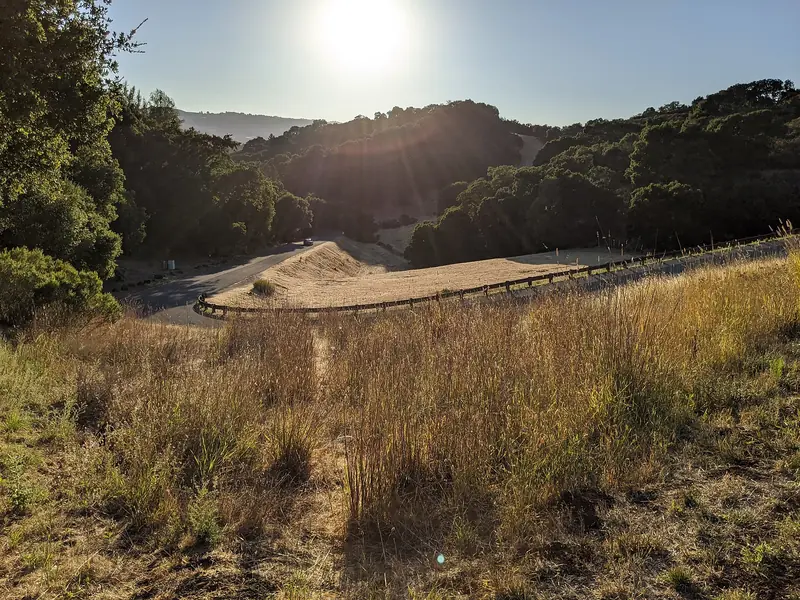
Public places work too. Gamble Garden in Old Palo Alto mixes natives with traditional borders. The trails at Pearson-Arastradero show how sages, coyote brush and bunchgrasses look in late summer without any irrigation, which is a useful reality check: many natives go partly dormant and turn gray-green in August. Plan a few summer-blooming plants such as California fuchsia so the garden still has color.
Planting and care
- Plant in fall. October to early December gives roots the whole wet season.
- Go small. One-gallon plants usually catch up with larger sizes within a couple of years and cost far less.
- Skip the compost. Most natives prefer unamended native soil. Amend only vegetable beds.
- Water the first summer. Deep watering every week or two through the first dry season, then taper.
- Mulch, but not too close. Keep wood chips a few inches from stems. Manzanitas and some sages prefer gravel mulch.
- Prune lightly after flowering, not in summer heat.
Our water-wise gardening guide covers drip irrigation and the city's watering hours. To see natives in the wild before you plant, walk Pearson-Arastradero or the Foothills in spring; our wildflowers guide says where and when.
Good to know
- Grassroots Ecology sells by email order only, $50 minimum.
- CNPS chapter sales sell out fast; join the newsletter.
- Canopy offers free trees and planting days in Palo Alto.
- Plant natives in fall and water them through the first summer.
- Coast live and valley oaks become protected trees at 11.5 inches.
Frequently asked questions
Where can I buy California native plants in Palo Alto?
Grassroots Ecology grows local natives at its nursery in Foothills Nature Preserve and sells them by email order with a $50 minimum and pickup at the nursery. SummerWinds Nursery on San Antonio Road also carries natives. The California Native Plant Society's Santa Clara Valley chapter sells plants from its nursery at Hidden Villa in Los Altos Hills.
When is the native plant sale near Palo Alto?
The CNPS Santa Clara Valley chapter held online sales in January and May 2026 and an in-person fall sale at Hidden Villa on October 24, 2026. The fall sale is usually in October, but check the chapter's website for 2027 dates.
Can I get a free tree in Palo Alto?
Canopy, the Palo Alto urban forestry nonprofit, runs a free tree sign-up on its website and organizes neighborhood plantings. Its fall 2026 calendar included a Palo Alto planting at Palo Verde on November 7 for the South Palo Alto Tree Initiative. Eligibility and species vary, so read the sign-up page.
When should I plant native plants in Palo Alto?
Fall is best, from October through early December. Winter rain settles the roots and plants are established before the long dry season. Water new natives through their first summer, then most need little or no irrigation.
Do native plants qualify for Valley Water's lawn rebate?
Many do. The Landscape Conversion Rebate requires plants from Valley Water's qualified plants list with enough coverage at maturity. Most low-water California natives are on it, but check the list for each species before you buy.