On this page
Menlo Ventures has carried its hometown's name for 50 years. The firm says it was established in 1976, which makes it one of the older venture firms on the Peninsula. Today it works from an office on El Camino Real in downtown Menlo Park and a second office in San Francisco. Its recent investing has leaned heavily into AI, including an early stake in Anthropic and a dedicated fund built with that company.
This page is a neutral explainer for founders and readers interested in local venture firms. It draws on Menlo's own website, with the firm's figures marked as such. For background on how venture funds work, see our venture capital guide.
Founding in 1976
Menlo's website describes H. DuBose Montgomery as a founder of the firm in 1976. His bio, now listed as founder and partner emeritus, says he led many of Menlo's investments in the medical and information technology sectors for almost 40 years. The prior investments it names include Asthmatx, later acquired by Boston Scientific. They also include EndoVascular Technologies, later acquired by Johnson and Johnson.
The mid 1970s were the early years of organized venture capital in the region. Kleiner Perkins and Sequoia had started in 1972 and many of the first firms were small partnerships of a few people. Menlo grew from that period into a firm that now describes itself with large numbers. Its about page lists 50 years of experience, more than 85 public companies, more than 170 mergers and acquisitions and more than $7.6 billion under management.
The office on El Camino Real
Menlo's contact page lists its Menlo Park office at 1300 El Camino Real, Suite 150, Menlo Park, CA 94025. Norwest Venture Partners lists Suite 200 at the same address. Menlo's San Francisco office is at 524 2nd Street.
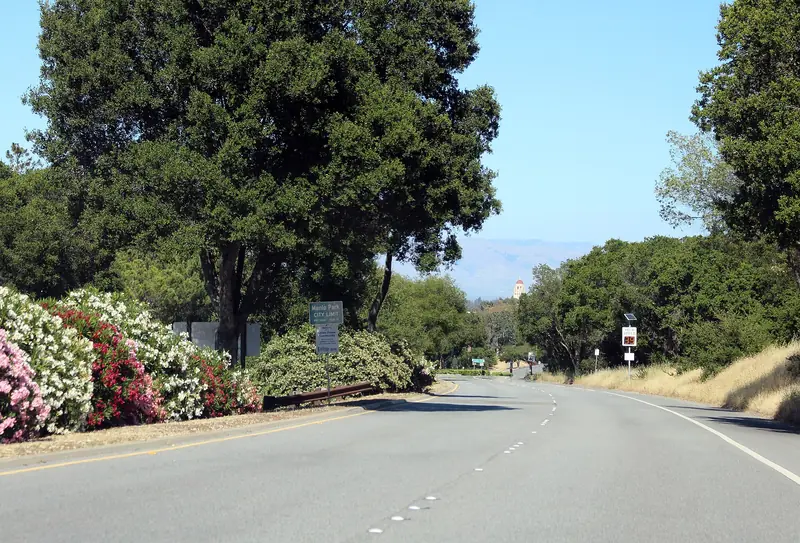

The El Camino Real address puts the firm a few blocks from the Menlo Park Caltrain station and a short walk from the shops and cafes of Santa Cruz Avenue. For visiting founders that is handier than the Sand Hill Road corridor, which has no train stop. The office is private and visits are by appointment.
Three stages of early
Menlo describes its strategy as the "Three Stages of Early." Each stage has its own team:
- Inception. The Inception Fund team helps founders validate early ideas and build their first foundations.
- Venture. The venture team backs Series A and Series B companies as they build teams and products.
- Inflection. The inflection team supports early growth-stage companies preparing to scale.
The firm lists ten focus areas: AI, bio and healthcare, consumer, cybersecurity, defense, fintech, infrastructure, robotics and hardware, SaaS and supply chain and automation. Our seed and pre-seed funds page explains how firms that invest across several stages differ from dedicated seed funds, including the signaling questions founders sometimes worry about.
Notable investments
Menlo's portfolio page lists each featured company with the year Menlo first invested and the round. A selection:
| Company | Menlo's first round | Outcome noted by Menlo |
|---|---|---|
| Uber | Series B, 2011 | IPO on the NYSE, 2019 |
| Chime | Series C, 2018 | IPO on Nasdaq, 2025 |
| Abnormal AI | Series B, 2020 | Private |
| Anthropic | Series C, 2023 | Private |
| Suno | Series C, 2025 | Private |
| Lovable | Series B, 2025 | Private |
| OpenEvidence | Series D, 2026 | Private |
| Fireworks AI | Series D, 2026 | Private |
The list shows how the firm's emphasis has moved. Uber and Chime were consumer bets of the 2010s. Most of the newer names are AI companies, from music generation at Suno to clinical decision support at OpenEvidence. Menlo says it first invested in Anthropic in early 2023 and led a significant follow-on round in 2024.
These are featured companies. A firm of Menlo's age has backed hundreds of companies. Many earlier investments never became household names.
The Menlo Anthology Fund
In 2024 Menlo announced the Menlo Anthology Fund, a $100 million fund created in partnership with Anthropic. The firm says the fund backs AI startups from seed to expansion stages, with investments starting at $100,000. It names five areas of interest:
- AI infrastructure, including developer tools and middleware.
- Frontier applications of AI in fields such as biology, healthcare, law and finance.
- Consumer AI products built around large language models.
- Trust and safety tools for responsible AI deployment.
- AI applications with broad social benefits, such as education and accessibility tools.
Menlo says it will also back strong ideas outside those areas. The fund page has an online application, which makes it one of the few direct entry points the firm publishes. The Stanford side of this story goes back decades. Our page on Stanford and the history of AI traces the research that helped put AI companies on the Peninsula in the first place.
Funds and size
Menlo's website gives its assets under management as more than $7.6 billion. It does not list individual fund sizes on the pages we read. We have not repeated secondhand figures. The Anthology Fund's $100 million size comes from the firm. As with any firm, the amount managed says nothing about returns.
Menlo in the local ecosystem
Menlo Ventures sits in a part of Menlo Park that has quietly filled with investors. Norwest shares its building. Floodgate and Sapphire Ventures list offices on Santa Cruz Avenue a few minutes away on foot. Together they make downtown Menlo Park a second venture district alongside the older offices on Sand Hill Road.
For a founder the practical effect is simple. A day of meetings in Menlo Park can be done on foot from the train, with lunch on Santa Cruz Avenue in between. Downtown Palo Alto, with its own cluster of firms around University Avenue, is a short drive or one Caltrain stop south. Menlo's AI focus also ties it closely to the research labs and startups around Stanford, a mile or two away.
How founders reach Menlo
Menlo is more open than many firms about how to reach it. Its contact page lists separate addresses for general inquiries, the investment team and media. The Anthology Fund has its own application. Practical steps:
- Decide which stage fits. A pre-product team belongs with the Inception Fund. A company raising a Series A or B belongs with the venture team.
- Check the ten focus areas and the portfolio to see which investors cover your space.
- If you build on Anthropic's models, consider the Anthology Fund application.
- Otherwise use the investment team contact on the firm's site or a warm introduction from a founder Menlo has backed.
Our pitching guide covers first meetings and our glossary explains terms such as lead investor and pro rata.
Good to know
- The El Camino Real office is private. Visit only for a confirmed meeting.
- Downtown Menlo Park has plenty of places for a coffee before a meeting. See our Menlo Park food guide.
- Menlo also has a San Francisco office. Confirm the meeting location in advance.
- This page is not investment advice and makes no claims about returns.
Frequently asked questions
Where is Menlo Ventures located?
Menlo Ventures lists its Menlo Park office at 1300 El Camino Real, Suite 150, Menlo Park, CA 94025 and its San Francisco office at 524 2nd Street. The Menlo Park office is a few blocks from the Menlo Park Caltrain station. Norwest Venture Partners lists an office in the same building.
When was Menlo Ventures founded?
The firm says it was established in 1976 and marks 50 years in 2026. Its website describes H. DuBose Montgomery as a founder who led many of its medical and information technology investments for almost 40 years.
What stages does Menlo Ventures invest in?
Menlo describes three stages of early investing. Its Inception Fund works with founders validating early ideas, its venture team backs Series A and B companies and its inflection team supports early growth-stage companies.
What is the Menlo Anthology Fund?
It is a $100 million fund created by Menlo Ventures in partnership with Anthropic to back AI startups. Menlo says it invests from seed to expansion stages, with checks starting at $100,000. Founders apply through the fund's page on the Menlo website.
Did Menlo Ventures invest in Uber?
Yes. Menlo's portfolio page says it partnered with Uber at the Series B in 2011. Uber went public on the NYSE in 2019. The same page lists Chime, which Menlo backed at the Series C in 2018 and which went public on Nasdaq in 2025.