On this page
Yahoo was one of the first companies to make the World Wide Web feel navigable. In early 1994 there was no good way to find anything online. Two Stanford graduate students began keeping a list of sites they liked, sorted by topic. Within months thousands of strangers were using it. By 1996 it was a public company. By the end of the decade it was the front page of the internet for millions of people.
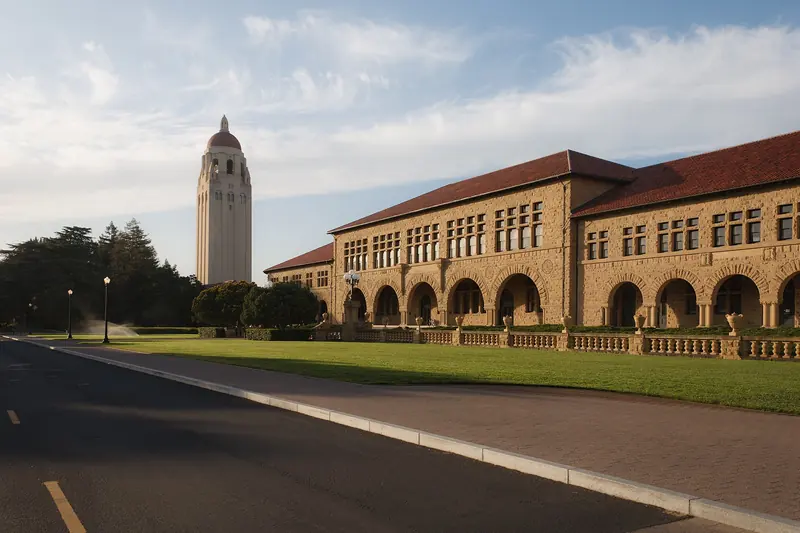
Unlike most companies on this site, Yahoo never had a Palo Alto office we could confirm. Its Palo Alto connection is Stanford itself, where the idea was born and where you can still see the computers that ran the first version.
Two students and a list of links
Jerry Yang and David Filo were electrical engineering graduate students at Stanford. Yang had already earned both his bachelor's and master's degrees in electrical engineering there in 1990, according to Stanford. Filo earned his master's in electrical engineering at Stanford.
Their side project began as "Jerry and David's Guide to the World Wide Web." Wikipedia dates it to January 1994 and says it took the name Yahoo in March 1994. Stanford Engineering's profile of Filo dates the guide to April 1994. Either way, it was a hand-built directory. Instead of searching the text of pages, users clicked down through categories and subcategories that the founders and early staff picked by hand.
The name, Yahoo says, stands for Yet Another Hierarchical Officious Oracle. The founders have also said they liked the plain meaning of the word: Jonathan Swift's crude, unsophisticated Yahoos from Gulliver's Travels. Because "Yahoo" was already trademarked for other products, they added the exclamation point.
The trailer and the servers
Stanford Engineering's own account is short and specific. Yang and Filo used two computers named Konishiki and Akebono in 1994 to find and categorize pages on the early web. The site ran from a campus trailer. By autumn 1994 it handled a million hits a day. The guide's first web address was akebono.stanford.edu.
The two machines are now on display on the first floor of the Jen-Hsun Huang Engineering Center, part of a set of exhibits Stanford calls Engineering Touchstones. The Akebono motherboard is shown separately. The same building holds the storage cabinet Larry Page and Sergey Brin built for Google's early search experiments. Our guide to the Science and Engineering Quad explains how to find the displays.

From project to company
The traffic made it obvious the guide could be a business. The yahoo.com domain was created on January 18, 1995. Yahoo was incorporated on March 2, 1995. Stanford Engineering dates the founding of Yahoo Inc. to April 1995, the month the money arrived.
That money came from Michael Moritz of Sequoia Capital on Sand Hill Road. Entrepreneur Randy Adams introduced the founders to Moritz. On April 5, 1995, Sequoia provided about $3 million across two rounds. In August 1995 the commercial site launched with advertising and news feeds from Reuters. Tim Koogle became chief executive the same month. Later that year SoftBank's Masayoshi Son invested, a stake he expanded sharply in 1996.
Early hires also came from Stanford. Srinija Srinivasan, a Stanford alumna, joined as the fifth employee with the title "Ontological Yahoo." Her job was to organize the directory as it grew.
The IPO and the portal years
Yahoo went public on Nasdaq on April 12, 1996, selling 2.6 million shares at $13. They closed the first day at $33. Excite and Lycos, two rival directories, also listed that month. Excite had its own Stanford founders, as our Excite profile explains.
Through the late 1990s Yahoo added email, news, finance, sports and shopping and became a full web portal. By 1998 it was the most popular starting point for web users. In 2000 it began using Google for search results, then built its own search technology and switched to it in 2004. The dot-com era page covers the boom that carried Yahoo and dozens of smaller Peninsula startups.
Later years and owners
Yahoo's later history is a long story of chief executives and owners. The key dates:
- February 2008. Microsoft made an unsolicited offer of $44.6 billion. Yahoo's board rejected it.
- January 2009. Carol Bartz replaced Jerry Yang, who had been chief executive since 2007.
- July 2012. Marissa Mayer became president and chief executive.
- 2013. Yahoo agreed to buy the blogging site Tumblr for $1.1 billion.
- 2017. Verizon bought Yahoo's operating business and later combined it with AOL.
- September 2021. Apollo Global Management completed its purchase of Yahoo and AOL from Verizon, which kept a minority stake. Jim Lanzone became chief executive.
For most of the 2000s and 2010s Yahoo's headquarters was a large campus in Sunnyvale, about nine miles southeast of Palo Alto. Wikipedia still describes Yahoo as based there.
The founders and Stanford today
Yang has stayed close to the university. Stanford says he served on its Board of Trustees from 2005 to 2015, rejoined in October 2017 and began a two-year term as board chair on July 1, 2021. He and his wife, Akiko Yamazaki, have given to many parts of the campus. The Jerry Yang and Akiko Yamazaki Environment and Energy Building, known as Y2E2, carries their names. Stanford also lists their support for the Li Ka Shing Center, Bing Concert Hall and Stanford Stadium.
That makes Yahoo one of the clearest examples of money from a student startup flowing back into the campus where it began. The pattern repeats across this section, from Hewlett and Packard to the founders of Google. Our page on Stanford entrepreneurship programs covers the classes and offices that support student founders today.
Yahoo's place in the local story
Yahoo sits between two eras of Peninsula technology. Before it, Stanford's best known spinouts mostly made hardware: instruments, chips and workstations. After it, the most famous ones made web services. Yahoo showed investors that a free website built by students could become a public company in about two years. That lesson shaped how Sand Hill Road funded Google, Facebook and many others.
Yahoo also arrived at a moment when the web was tiny. Stanford Engineering quotes Filo on why the job grew so fast: "Thousands of people were producing new websites every day." A hand-sorted directory could not keep up forever, which is why search engines that indexed every page, including the one Page and Brin built in Stanford's Gates Computer Science Building, eventually won.
It also shows how Stanford's network does the work. The founders were students. Their first servers were university machines. Their first investor sat a few miles away. Their early staff came from the same campus. Palo Alto's role was as the town at the edge of it all, where many of those people lived, ate and met. For the wider picture, see our guide to Palo Alto companies.
Visiting notes
Good to know
- The Akebono and Konishiki servers are on the first floor of the Huang Engineering Center, 475 Via Ortega, Stanford. Visit on a weekday during business hours.
- Stanford has not published where the trailer stood, so there is no site to look for.
- Yahoo's offices are private, with no visitor center or tours.
- The Computer History Museum in Mountain View covers the early web era in its exhibits.
Frequently asked questions
Was Yahoo founded at Stanford?
Yes. Jerry Yang and David Filo were electrical engineering graduate students at Stanford when they started their web guide in early 1994. Stanford Engineering says the site ran from a campus trailer and handled a million hits a day by autumn 1994.
What were Akebono and Konishiki?
They were the two Stanford computers Yang and Filo used in 1994 to find and sort pages on the early web. The first address of the guide was akebono.stanford.edu. Both machines are displayed on the first floor of the Huang Engineering Center.
When did Yahoo become a company?
Yahoo was incorporated on March 2, 1995. Sequoia Capital's Michael Moritz backed it in April 1995 and Tim Koogle became chief executive that summer. It went public on Nasdaq on April 12, 1996.
What does Yahoo stand for?
Yahoo says the name stands for Yet Another Hierarchical Officious Oracle. The founders have also said they simply liked the word, which Jonathan Swift used for a race of crude beings in Gulliver's Travels.
Who owns Yahoo today?
Apollo Global Management bought Yahoo and AOL from Verizon in a deal completed in September 2021, with Verizon keeping a minority stake. Jim Lanzone became chief executive that month.