On this page
Long before Palo Alto was known for software, one of its biggest employers made hormones. Syntex began in Mexico City in 1944, extracting steroids from wild yams. Its chemists made one of the key compounds behind the birth control pill. In 1959 the company moved its operating headquarters to Palo Alto. For the next five decades a large lab and production complex on Hillview Avenue turned out drugs, research papers and a stream of scientists who started companies of their own.
This profile follows Syntex from its Mexican roots to Stanford Research Park, through the Roche years and the 2008 closure. It ends with what stands on the land today. For the park itself, see our Stanford Research Park guide.
Steroids from Mexican yams
Syntex was formed in Mexico City in January 1944 by the American chemist Russell Marker and two partners, Emeric Somlo and Federico Lehmann. The name combined "synthesis" and "Mexico." The plan was to make steroid hormones from Mexican wild yams, which held a plant compound that chemists could convert into progesterone. Marker left the company in 1945. George Rosenkranz, a chemist trained in Switzerland, replaced him and built up the research team.
In 1949 Rosenkranz hired Carl Djerassi as associate director of chemical research. Rosenkranz and Djerassi worked out a way to make cortisone from the same yam compound, cheaper than the method then used by Merck. Then came the result that made the company famous.
Norethindrone and the pill
On October 15, 1951, a young chemist named Luis Miramontes completed the last step in making norethindrone, also called norethisterone, working under Djerassi and Rosenkranz. It was the first orally active progestin strong enough to be useful as a medicine. Syntex filed for a patent in November 1951.
A rival, G.D. Searle, got a related compound to market first. By 1964, though, Syntex, Searle and Johnson & Johnson's Ortho brand were all selling pills based on Syntex's norethindrone. Oral contraceptives became the core of the business. According to company histories, they produced 47 percent of Syntex profits in 1966.
Good to know
- Syntex did not invent the pill alone. Several companies and researchers contributed. Its role was making a potent progestin that worked by mouth.
- Djerassi later wrote several books about the period, including "This Man's Pill."
Moving to Palo Alto in 1959
By the late 1950s Syntex's foreign scientists were frustrated with delays in getting Mexican work visas and import approvals for lab supplies. In 1959 the company moved its operating headquarters to Palo Alto. It was incorporated in Panama. Administration, research and marketing ran from Palo Alto. Bulk steroid production stayed in Mexico. Finished drugs were made in Puerto Rico and the Bahamas.
Two people tied the move to Stanford. Djerassi had returned to Syntex in 1957 and was involved in the relocation. He became a professor of chemistry at Stanford in 1960 while keeping his company role for years. Alejandro Zaffaroni, a Uruguayan biochemist who had joined Syntex in 1951, helped steer the company north. In 1962 he became president of Syntex's US subsidiary in Palo Alto. Our Stanford visitor guide covers the campus that sat a few minutes away.
The Hillview Avenue complex
Syntex grew into a large campus in Stanford Research Park, then still called Stanford Industrial Park. Its later address, as listed for Roche Bioscience, was 3401 Hillview Avenue. A record kept by the Syntex Syva Alumni Association dates the main buildings that were later torn down:
| Building | Completed |
|---|---|
| P-1, the first production building | September 1966 |
| P-2 | September 1971 |
| Production administration and quality control expansion | February 1982 |
| Labs administration building | February 1982 |
| Labs administration expansion | November 1987 |
| P-3 | November 1988 |
We could not confirm exactly where Syntex first worked in Palo Alto in 1959, so we do not name an earlier address. The research center near Stanford became the focus of the company's growth in the 1970s, according to company histories.
Naproxen and the big years
Birth control alone could not carry the company forever. The pill's share of profits fell from 47 percent in 1966 to 35 percent in 1972. Syntex's next big drug was naproxen, an anti-inflammatory sold by prescription as Naprosyn and Anaprox. It became one of the company's best sellers. An over-the-counter version, Aleve, was approved in January 1994.
The company's other products included Toradol, Cardene, Ticlid and Cytovene. Albert Bowers, a chemist who had joined in 1956, became president in 1976 and served as chief executive from 1980 to 1989. A 2008 San Francisco Business Times report said the Palo Alto operations had employed about 3,000 people before Roche took control.
A launch pad for Palo Alto biotech
Syntex also seeded new companies. In 1968 Zaffaroni left to found ALZA, a drug delivery company whose name came from his own. ALZA's technology went into skin patches and controlled release pills. Zaffaroni went on to found other biotech companies in the area. Our page on research labs around Palo Alto covers the wider science scene.
The Roche years
In May 1994 Syntex agreed to be bought by the Swiss drug maker Roche. The deal closed later that year at $5.3 billion. In 1995 Roche formed Roche Bioscience, based in Syntex's Palo Alto offices at 3401 Hillview Avenue. Syntex U.S.A. survived as a legal entity to hold existing contracts and patents.
The Palo Alto site stayed large for another decade, focused on research in inflammation and virology. Then on September 2, 2008, the San Francisco Business Times reported that Roche would move jobs out of Palo Alto. The site covered about 1 million square feet, more than three quarters of it labs. It employed about 1,000 people. The Associated Press confirmed on September 5 that Roche planned to close it. Inflammation research was headed to Nutley, New Jersey. Virology was expected to move to Genentech's South San Francisco campus. The plan was tied to Roche's bid for the part of Genentech it did not already own.
From Syntex labs to the VMware campus
The land did not stay empty. Photos kept by former employees show Syntex production and lab buildings, about 323,600 square feet in all, being demolished between September 2005 and April 2006. They were cleared for a new campus of about 460,000 square feet planned by EMC for its subsidiary VMware. A building permit for new offices at 3401 Hillview Avenue followed. The VMware profile covers how that campus grew to nearly 70 acres.
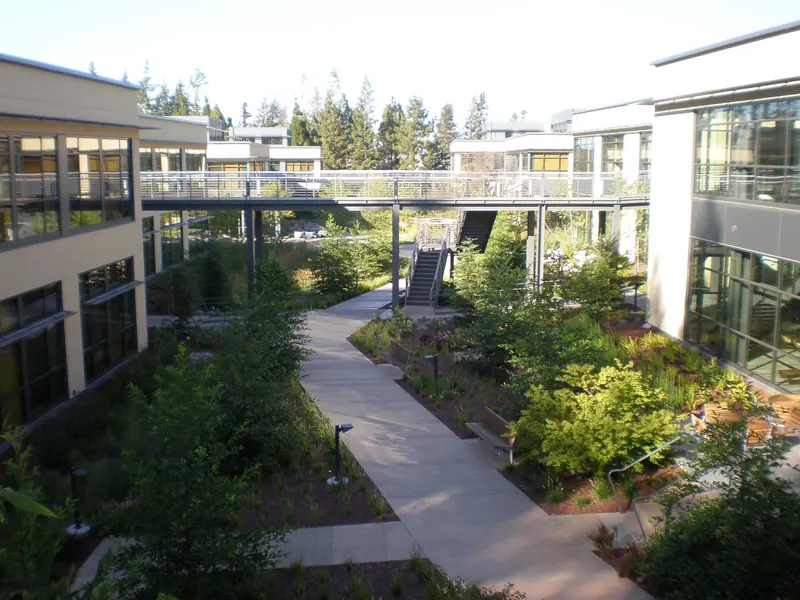

In November 2023 Broadcom bought VMware and moved its own headquarters to the same campus, which its filings list as 3421 Hillview Avenue. So the address where Syntex scientists once worked on steroids and anti-inflammatories now houses a chip company's head office. Neighbors on Hillview Avenue include SAP Labs at 3410 and the TIBCO campus at 3301 to 3307.
Timeline
| Date | Event |
|---|---|
| January 1944 | Syntex founded in Mexico City. |
| October 15, 1951 | Norethindrone made at Syntex. |
| 1959 | Operating headquarters moves to Palo Alto. |
| 1962 | Zaffaroni becomes president of the US subsidiary. |
| September 1966 | First production building completed on the research park site. |
| 1968 | Zaffaroni leaves to found ALZA. |
| 1994 | Roche buys Syntex for $5.3 billion. |
| 1995 | Roche Bioscience formed at 3401 Hillview Avenue. |
| 2005 to 2006 | Syntex buildings demolished for VMware's campus. |
| September 2008 | Roche announces plans to close the Palo Alto site. |
| November 2023 | Broadcom makes the former VMware campus its headquarters (3421 Hillview Avenue in its filings). |
Seeing the site
There is no marker for Syntex on Hillview Avenue. The campus is a working corporate site with badge access, so view it from the street. Hillview Avenue is an easy bike ride from the California Avenue Caltrain station. Former employees keep the memory alive through the Syntex Syva Alumni Association, which still holds an annual reunion. For more companies that shaped the research park, see our companies guide and the famous tech addresses tour.
Frequently asked questions
When did Syntex move to Palo Alto?
Syntex moved its operating headquarters from Mexico City to Palo Alto in 1959. After that its administration, research and marketing were run from Palo Alto, while bulk steroid production stayed in Mexico. Chemist Carl Djerassi helped with the move and joined Stanford's chemistry faculty in 1960.
What did Syntex invent?
Syntex chemists made norethindrone in 1951, one of the first highly active oral progestins and a building block of early birth control pills. The company also made cortisone from Mexican yams and later developed the anti-inflammatory drug naproxen, sold as Naprosyn and Anaprox.
What happened to Syntex?
Roche bought Syntex in 1994 for $5.3 billion and renamed the Palo Alto operation Roche Bioscience in 1995. In September 2008 Roche announced plans to close the roughly 1 million square foot Palo Alto site, which then employed about 1,000 people.
What is on the old Syntex site now?
Syntex's address, 3401 Hillview Avenue in Stanford Research Park, became the address of VMware's campus. Syntex production and lab buildings were demolished around 2005 and 2006 to make room for VMware offices. Broadcom has used the campus as its headquarters since November 2023, listing it as 3421 Hillview Avenue.
Who was Alejandro Zaffaroni?
Zaffaroni was a Uruguayan biochemist who joined Syntex in 1951 and helped move it to Palo Alto. He became president of its US subsidiary in 1962. In 1968 he left to found ALZA, a drug delivery company named after him. He later started other biotech companies.