On this page
In 1980 the business of biology was brand new. Genentech had been founded only four years earlier. Universities were still arguing about whether professors should work with companies at all. That year Alejandro Zaffaroni, already famous in Palo Alto for ALZA, persuaded three of Stanford's most respected biochemists to help him start a research company. They called it DNAX.
DNAX spent its whole life in Palo Alto. It was bought by Schering-Plough after two years, became part of Merck in 2009 and closed its Palo Alto doors in 2019. Along the way its scientists published some of the most cited papers in immunology. This profile covers what DNAX was, who built it and where it went.
Founding in 1980
According to the National Library of Medicine's profile of Arthur Kornberg, Zaffaroni approached Kornberg and colleagues in 1980 about starting a research institute. DNAX was founded later that year. Kornberg, Paul Berg and the Stanford biologist Charles Yanofsky became founding partners. The full name used in the company's own advertising was the DNAX Research Institute of Molecular and Cellular Biology.
The founding team carried unusual weight:
- Arthur Kornberg shared the 1959 Nobel Prize in Physiology or Medicine for work on how DNA is copied. He had moved his department to Stanford's new medical school in 1959.
- Paul Berg won a share of the Nobel Prize in Chemistry in 1980, the same year DNAX began, for his work on recombinant DNA.
- Charles Yanofsky was a Stanford geneticist known for his work on how bacteria switch genes on and off.
- Alejandro Zaffaroni brought the business experience. He had helped move Syntex to Palo Alto and had founded ALZA in 1968.
Our page on Stanford's Nobel laureates covers Kornberg and Berg in more detail.
A company that published
The stated goal was to support the development of new medicines based on recombinant DNA technology. The method was what made DNAX different. It gave scientists strong resources in an open setting and let them publish their findings freely, much as they would in a university lab. The NLM profile calls that a wise strategy and credits it for the institute's success.
That openness helped DNAX recruit. Young scientists could do company funded research without giving up an academic career path. A November 1989 article in The Scientist described DNAX, which it said was pronounced like "Deen-x," as a hybrid biomedical research company from the start. The same article noted that the labs of immunologists Robert Coffman and Tim Mosmann sat side by side on the second floor. They had been placed next to each other by chance about seven years earlier and had stayed neighbors through later moves.
Schering-Plough buys in, 1982
DNAX did not stay independent for long. Schering-Plough, the New Jersey drug company, acquired it in 1982. Kornberg stayed on the board of directors after the sale and kept helping with recruitment. DNAX became the core of Schering-Plough's biopharmaceutical research, focused on immune system and cancer drugs.
The arrangement suited both sides. Schering-Plough got a research group in the middle of the Stanford biology network. DNAX scientists kept their publishing culture, now backed by a large company's budget.
The science: helper T cells and cytokines
DNAX's reputation came from immunology. Its scientists studied cytokines, the small proteins that immune cells use to signal one another. Two results stand out.
- Th1 and Th2 cells. In 1986 Mosmann, Coffman and colleagues reported that helper T cells come in two types that make different sets of cytokines. The Th1 and Th2 model became one of the main frameworks in immunology for explaining why some immune responses fight infection and others drive allergy.
- Interleukin 10. In 1989 DNAX researchers described a factor that shut down cytokine production by Th1 cells. It became known as interleukin 10, a key brake on inflammation.
By 1989 Coffman and Mosmann had four papers that The Scientist named "Hot Papers" in a single year. DNAX researchers also cloned and studied several other interleukins in the 1980s and 1990s. The work fed into Schering-Plough's research on antibody and protein drugs.
Good to know
- DNAX was a company lab, not a Stanford lab, though its founders and many collaborators were Stanford faculty.
- For the medical school side of the story, see our history of Stanford Medicine.
Schering-Plough Biopharma, 2005
In May 2005 Schering-Plough announced it would consolidate its biopharmaceutical research in Palo Alto. Its subsidiary Canji Inc. was relocated to combine with DNAX, forming Schering-Plough Biopharma. A trade report at the time described the DNAX site as 68,000 square feet and said the combined group would focus mainly on biologics, including monoclonal antibodies and therapeutic proteins. The facility was expected to be fully operational by the third quarter of 2005.
Four years later the parent company changed again. Merck completed its merger with Schering-Plough in November 2009. The Palo Alto group became part of Merck Research Laboratories.
Merck and the 2019 move
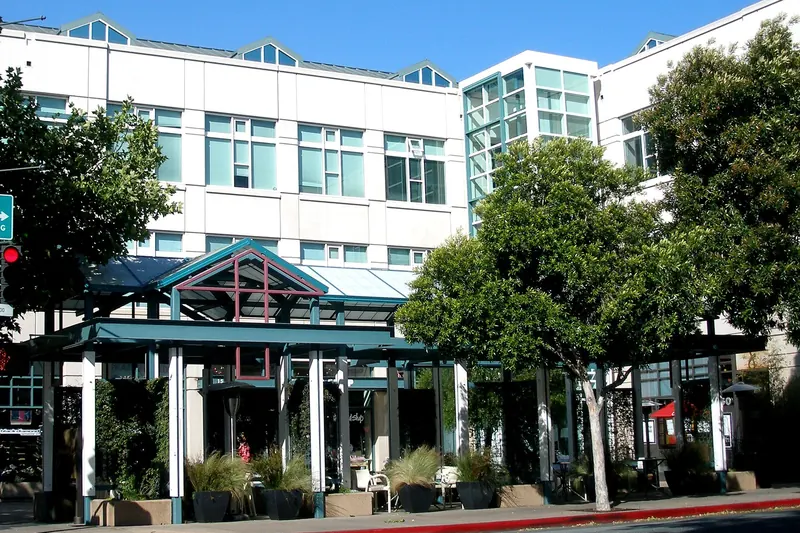
Merck kept the Palo Alto site for another decade. In April 2019 Fierce Biotech reported that Merck Research Laboratories was leaving its Palo Alto site at 901 California Avenue and that the site would be vacated permanently. Most of the 186 employees there moved to a new nine story Merck research building on East Grand Avenue in South San Francisco, designed to hold more than 300 scientists. Twenty employees did not transfer and received severance.
That move ended almost 39 years of the DNAX line in Palo Alto. It also reflected a wider shift. South San Francisco, home of Genentech, had become the Bay Area's main biotech cluster, while Palo Alto's research park filled with electric car, robotics and software companies. Our Stanford Research Park guide covers who is there now.

Timeline
| Date | Event |
|---|---|
| 1980 | DNAX founded by Zaffaroni, Kornberg, Berg and Yanofsky. |
| 1982 | Schering-Plough acquires DNAX. |
| 1986 | Mosmann, Coffman and colleagues describe Th1 and Th2 helper T cells. |
| 1989 | Interleukin 10 described at DNAX; The Scientist profiles the institute. |
| May 2005 | Canji merged with DNAX as Schering-Plough Biopharma. |
| November 2009 | Merck completes its merger with Schering-Plough. |
| April 2019 | Merck vacates 901 California Avenue for South San Francisco. |
Legacy and the site today
DNAX showed that a company lab could do basic science at a university level and still serve a drug company. Many of its alumni went on to faculty posts and to biotech companies around the Bay Area. Its founders' later careers are part of the same story: Zaffaroni went on to cofound Affymax and Affymetrix. Kornberg and Berg remained Stanford fixtures for decades.
We could not confirm who occupies 901 California Avenue in 2026. The address is on the research park side of El Camino Real, a short ride from the California Avenue Caltrain station. There is no marker. The shops and cafes of California Avenue are a few minutes away for anyone tracing the area's science history on foot.
Frequently asked questions
Who founded DNAX?
Alejandro Zaffaroni, the founder of ALZA, started DNAX in 1980 with three Stanford scientists: Arthur Kornberg, Paul Berg and Charles Yanofsky. Kornberg had won the Nobel Prize in 1959 and Berg won his that same year, 1980.
What did DNAX research?
DNAX was set up to develop medicines based on recombinant DNA technology. It became best known for immunology, especially cytokines, the signaling proteins that immune cells use to talk to each other. Its scientists described the Th1 and Th2 types of helper T cells in 1986.
Who owned DNAX?
Schering-Plough bought DNAX in 1982. In 2005 Schering-Plough combined DNAX with its Canji unit as Schering-Plough Biopharma in Palo Alto. After Merck merged with Schering-Plough in 2009, the site became part of Merck Research Laboratories.
Is DNAX still in Palo Alto?
No. In 2019 Merck moved its Palo Alto research staff from 901 California Avenue to a new building in South San Francisco and vacated the Palo Alto site permanently. Of 186 employees, most transferred and 20 left with severance.
How do you pronounce DNAX?
A 1989 profile in The Scientist said the name is pronounced like "Deen-x."