On this page
Cross the San Mateo Bridge from Foster City and the long flat road ends in Hayward. With about 163,000 residents it is the sixth-largest city in the Bay Area and the third-largest in Alameda County. Many Peninsula residents know it only as a place to pass through on the way to the East Bay hills or Interstate 880.
Hayward rewards a closer look. It has a beautiful small Japanese garden, a long bay shoreline of marshes and salt ponds, grassy hill parks and a downtown where the Hayward Fault visibly bends the curbs. In 2026 the city marks 150 years since its incorporation. This guide covers the trip, the history, the sights and why a Palo Alto resident might go.
Where Hayward is and how far
Hayward lies on the east shore of the bay between San Leandro and Castro Valley to the north and Union City to the south. The city stretches from the salt ponds on the bay, across the flatlands and Interstate 880, to the hills where California State University, East Bay looks down on the valley. The Hayward Fault runs along the foot of those hills.
From downtown Palo Alto, western Hayward is about 25 miles by the San Mateo Bridge. Outside rush hour the drive takes 30 to 35 minutes.
Getting there from Palo Alto
By car
Take Highway 101 north to Highway 92 and cross the San Mateo-Hayward Bridge. The first bridge here opened in 1929 and the present span in 1967. Highway 92 becomes Jackson Street and leads toward downtown. From south Palo Alto, the Dumbarton Bridge and Interstate 880 north are about as quick. Both bridges charge tolls only westbound: $8.50 for a car in 2026, rising to $9.00 with FasTrak on January 1, 2027. Our guide to bridges and tolls covers payment.
By bus and BART
On weekdays, the Dumbarton Express runs from downtown Palo Alto and Stanford to Union City BART. From there BART goes north one stop to South Hayward and two stops to downtown Hayward. Both stations opened in 1972. On weekends, ride Caltrain to Mountain View, VTA light rail to Milpitas and BART north.
By Amtrak
Hayward's Amtrak station, opened in 1997, is served by seven daily round trips of the Capitol Corridor between San Jose and Sacramento. It does not serve Palo Alto, but you can board in San Jose or Santa Clara. See our East Bay travel guide for schedules.
History: Rancho San Lorenzo to 150 years
Ohlone people lived in this part of the East Bay for thousands of years. In 1841 the Mexican government granted Rancho San Lorenzo, covering today's Hayward, Castro Valley and San Lorenzo, to the Californio ranchero Guillermo Castro. His house stood on the old road now called Mission Boulevard, between C and D streets.
The Hayward Fault ran right under it. The 1868 Hayward earthquake, the last major quake on the fault, badly damaged Castro's house and destroyed most buildings in the young town. A post office had opened in 1860 and the town incorporated on March 11, 1876. Farms grew tomatoes, potatoes, peaches, cherries and apricots. The Hunt Brothers Cannery opened in 1895 and ran until 1981. Chicken and pigeon ranches were big business. The bay shore became one of the most productive salt evaporation areas in the world.
Before World War II, Hayward had a large Japanese American population. Those families were forced into camps in 1942. The war brought factories and new workers. Postwar tract builders filled the flatlands with houses. The Hayward Area Recreation and Park District formed in 1944. California State University, Hayward, now Cal State East Bay, opened in the hills in 1957. BART arrived in 1972.
Not all of the story is happy. Russell City, an unincorporated community near the shoreline from 1853 to 1964, was cleared for an industrial park. The Russell City Energy Center, a gas-fired power plant, now stands there.
Walking the Hayward Fault
The Hayward Fault creeps a little every year. In older parts of downtown and along Mission Boulevard you can spot curbs, sidewalks and walls bent or offset where the ground is slowly moving. The 1969 City Center Building sat almost on the fault. After the 1989 Loma Prieta earthquake damaged it, the city moved out, opened a new City Hall in 1998 and demolished the old tower in 2013. The 21st Century Library and Community Learning Center, opened downtown on September 14, 2019, was built as a net-zero energy building.
Things to see and do
Japanese Gardens
The Hayward Japanese Gardens cover 3.5 acres near downtown on land once used by Hayward High School's agriculture program. Designed by Kimio Kimura and dedicated in 1980, they are described as the oldest traditional-style Japanese garden in California. The designer used California stone and plants. Nails were hidden and the wood was notched and aged to look traditional. Black pines, junipers and rhododendrons line the paths. Admission is free. Check the Hayward Area Recreation and Park District for hours.
Museum of History and Culture
The Hayward Area Historical Society runs its museum on the second floor at 22380 Foothill Boulevard downtown. The History Gallery and an art gallery are open Thursday to Saturday from 11 a.m. to 3 p.m., with a suggested donation of $5. The society and HARD also manage the historic Meek Mansion, just outside the city limits.
Murals
Since 2008 the Hayward Public Art Program has commissioned murals on walls and utility boxes across the city, partly to fight graffiti. Downtown makes a good walking loop. Our murals guide covers Palo Alto's own.

The shoreline and the hills
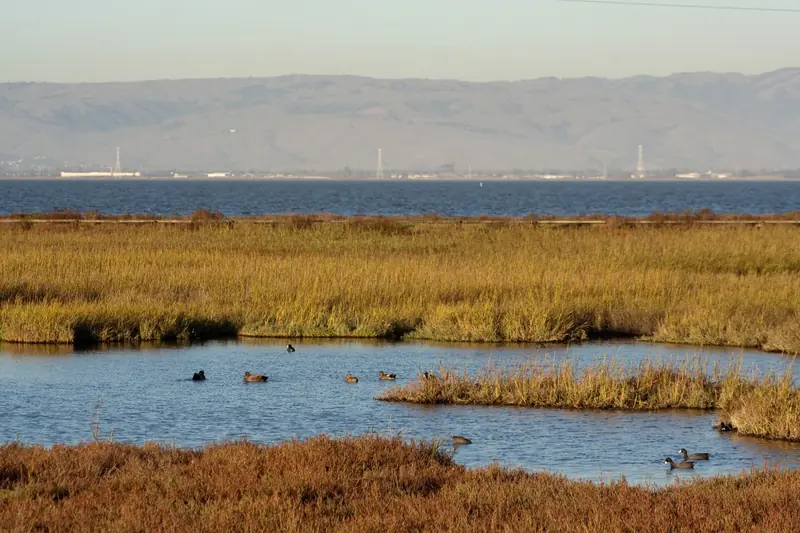
Hayward has four East Bay Regional Park District parks. Hayward Regional Shoreline protects restored marshes and old salt ponds along the bay, with long flat stretches of the Bay Trail. It is a fine place for winter birds. Next door, the state's Eden Landing Ecological Reserve includes about 600 acres of salt ponds being returned to tidal marsh. The Hayward Area Recreation and Park District also runs the small Hayward Shoreline Interpretive Center on the water and the Sulphur Creek Nature Center, a wildlife rehabilitation center with resident animals; both keep limited weekly hours. See our Bay Trail guide and birdwatching guide.
In the hills, Garin Regional Park occupies the old Garin Ranch, sold to the park district in 1966. It has an heirloom apple orchard, a late-summer apple festival and the homestead site of Agapius Honcharenko, a Ukrainian political exile, which is the city's only California Historical Landmark. Garin joins Dry Creek Pioneer Regional Park; the pair cover about 5,857 acres with more than 20 miles of trail. Don Castro Regional Recreation Area, set around a small lake, completes the list.
Food in Hayward
Hayward is one of the most diverse cities in the Bay Area and its food shows it. Downtown and Mission Boulevard hold taquerias, Salvadoran and Central American places, Filipino bakeries, Chinese and Vietnamese restaurants, Afghan and Indian kitchens and Pacific Islander food. Southland Mall, dedicated in 1964, anchors shopping on the north side.
Why a Palo Alto resident might go
- A quiet garden. The Japanese Gardens are a calm, free hour, rarely crowded on weekdays.
- Flat shoreline miles. Hayward's Bay Trail segments are long and level, good for a bike ride or winter birding.
- Geology you can see. Few places show an active fault as plainly as downtown Hayward.
- A bridge loop. Cross the San Mateo Bridge out and the Dumbarton Bridge back, with lunch in between. If you need wheels, you can compare rental cars for the day. Continue north to San Leandro for more history.
Good to know
- Interstate 880 is badly congested at weekday rush hours.
- Hours at the HARD nature centers change often; check before driving over.
- The hill parks are exposed and hot in summer.
- Bridge tolls are collected electronically only; there are no cash lanes.
Frequently asked questions
How long does it take to drive from Palo Alto to Hayward?
Outside rush hour, plan on 30 to 35 minutes. Take Highway 101 north to Highway 92 and cross the San Mateo Bridge, which lands you in western Hayward. The Dumbarton Bridge and Interstate 880 work well from south Palo Alto. Tolls are charged only westbound, on the way home.
Are the Hayward Japanese Gardens free?
Yes. The Hayward Area Recreation and Park District runs the 3.5-acre garden near downtown and does not charge admission. It was dedicated in 1980 and designed by Kimio Kimura using California stone and plants. It is described as the oldest traditional-style Japanese garden in California. Check HARD's website for hours.
Can you see the Hayward Fault in Hayward?
Yes. The fault creeps slowly. In places downtown and along Mission Boulevard you can see curbs, walls and pavement bent out of line. The 1868 Hayward earthquake destroyed most of the town's buildings. The fault is one reason the city replaced its 1969 City Center Building with a new City Hall in 1998.
How do I get to Hayward from Palo Alto by transit?
On weekdays, take the Dumbarton Express from Palo Alto to Union City BART, then ride BART north one stop to South Hayward or two stops to Hayward. On weekends, ride Caltrain to Mountain View, VTA light rail to Milpitas and BART north. Hayward also has an Amtrak Capitol Corridor station, reachable from San Jose and Santa Clara.
When is the Hayward Area Historical Society museum open?
The Museum of History and Culture, on the second floor at 22380 Foothill Boulevard downtown, lists gallery hours of Thursday, Friday and Saturday from 11 a.m. to 3 p.m. It asks for a suggested donation of $5.