On this page
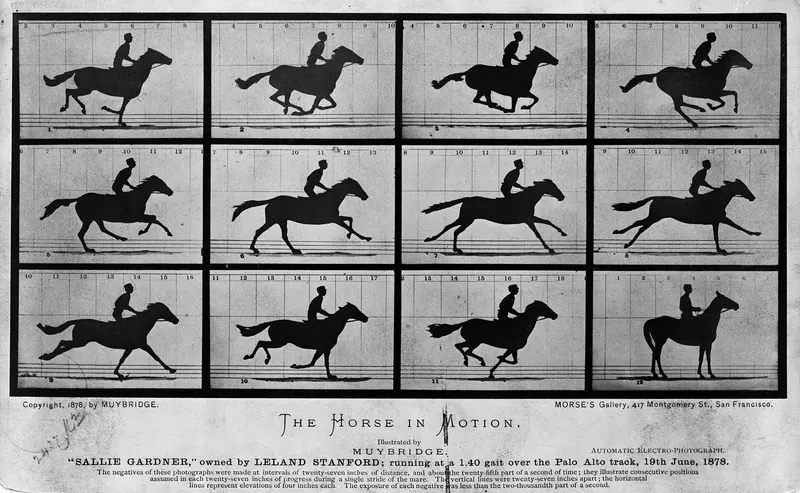
Every few years someone rediscovers the strip of small pictures of a galloping horse. It shows up in film classes, in science museums and in GIFs. Fewer people know the strip was made a short bike ride from downtown Palo Alto, on a dirt training track that is now the western edge of the Stanford campus. The man behind it was Eadweard Muybridge, one of the strangest figures in the history of photography.
Our page on the Palo Alto Stock Farm tells the full story of the horses, the experiments and the barn. This page follows Muybridge himself: where he came from, why he ended up working for Leland Stanford, how the partnership fell apart and where you can see his Palo Alto work today. Sources include Stanford Report, Stanford Libraries' catalog and the state landmark record.
From Kingston to San Francisco
He was born Edward James Muggeridge on April 9, 1830, in Kingston upon Thames, a market town on the river west of London. He changed his name more than once. He became Muygridge and later settled on Eadweard Muybridge, a spelling he linked to the old Saxon kings crowned in Kingston.
He emigrated to the United States as a young man and was working as a bookseller in San Francisco by the 1850s. Around 1860 he was badly hurt in a stagecoach crash in Texas while heading east. Biographers have long asked whether the head injury changed his personality. He spent the next years in England, where he took up photography.
By 1867 he was back in San Francisco and making a name with large views of Yosemite, the city and the Pacific coast. He sold some work under the trade name Helios. His landscapes were admired for their scale and their clouds, which were hard to capture with the slow plates of the day.
Hired by Leland Stanford
Leland Stanford was a railroad president, a former governor and a man obsessed with fast trotting horses. Stanford Report dates the start of the partnership to about 1872. Stanford wanted to know whether a trotting horse ever has all four feet off the ground at once. The human eye could not tell and painters guessed.
The famous story of a big bet on the answer has never been proven. Phillip Prodger, the curator who organized Stanford's 2003 Muybridge exhibition, told Stanford Report, "I personally believe that the story of the bet is apocryphal." What is documented is that Stanford paid for years of trials, first in Sacramento and then on his Palo Alto farm. Our page on the Stanford family explains where that money came from.
The killing at Calistoga
Any honest biography has to stop here. In October 1874 Muybridge learned that his young wife, Flora, had been involved with a drama critic named Harry Larkyns. He traveled to the Yellow Jacket Mine near Calistoga, found Larkyns and shot him dead. His lawyers argued insanity. The jury rejected that plea but acquitted him in 1875 anyway, calling the killing justifiable homicide. Stanford Report's account of the case adds that Muybridge then left on a photographic trip to Central America.
He returned to California in 1876 and went back to work for Stanford. The scandal did not end the partnership. If anything, the next three years were the most productive of his life.
The work on the stock farm
Stanford had begun buying land along San Francisquito Creek in 1876 and turned it into the Palo Alto Stock Farm. Its track was where Muybridge solved the problem. The setup, described in detail on our stock farm page, was simple to describe and hard to build.
- A row of cameras stood in a shed along one side of the track, 12 at first and later 24.
- Threads or wires crossed the track. As the horse or sulky passed, each one tripped a shutter in turn.
- A white backdrop with numbered lines let viewers measure the horse's position in each frame.
- Fast shutters and bright California light made exposures short enough to freeze the legs.
The public demonstration came in June 1878, with invited horsemen and reporters watching. The cards that resulted showed a horse with all four hooves tucked under its body and off the ground. Scientific American put engravings of them on its cover that October. Work continued at Palo Alto into 1879 with more cameras and more animals.

He also photographed the family. The Cantor Arts Center's holdings include an 1879 Muybridge picture of the Stanfords' son on a pony named Gypsy, according to the museum's Wikipedia entry. Our page on Leland Stanford Jr. tells the boy's story.
Credit, a book and a lawsuit
Around 1880 Muybridge showed his zoopraxiscope, a projector that threw images based on his photographs onto a screen in quick order so the animals seemed to move. He took it on lecture tours in the United States and Europe and was celebrated in London and Paris.
Then came the break. In 1882 Stanford sponsored a book called The Horse in Motion, written by his friend and physician J. D. B. Stillman. It reproduced Muybridge's work as drawings but presented him as a hired technician rather than an author. The Royal Society of Arts in London withdrew an offer to publish his paper. Muybridge sued Stanford. The suit was dismissed and the two men never worked together again.
Muybridge found a new sponsor at the University of Pennsylvania. His study Animal Locomotion, published in 1887, held 781 plates of people and animals in motion. At the 1893 World's Columbian Exposition in Chicago he lectured in a hall built for his projections. He spent his last years back in Kingston, where he died on May 8, 1904.
The historical marker
The state honors the Palo Alto work as California Historical Landmark No. 834. The plaque stands on Campus Drive West, across from the Stanford driving range. It says the research took place in 1878 and 1879 using "a battery of 24 cameras fitted with electroshutters." State Parks placed it on April 30, 1983, with the history group E Clampus Vitus. Wikipedia dates the landmark designation itself to 1969, which is why sources give two dates.
Good to know
- The plaque is on a busy campus road with a bike lane. Park legally or come by bike and stay off the roadway when reading it.
- The driving range across the road belongs to the Stanford Golf Course, which is otherwise for members and guests.
- The Red Barn, the farm's old training stable, is a short ride north. See our Red Barn page before visiting a working equestrian center.
Our list of historic landmarks places No. 834 among the other state landmarks in and around Palo Alto.
Muybridge in Stanford's collections
Stanford has kept more of Muybridge than most places. Two collections matter.
- The Cantor Arts Center. Stanford Report describes the museum's Muybridge holdings as extensive. In 2003 the museum used them as the core of Time Stands Still: Muybridge and the Instantaneous Photography Movement, curated by Phillip Prodger, with about 170 works from collections in six countries. A daylong symposium that May carried the pointed title "Eadweard Muybridge, Pioneer But of What?" Writer Rebecca Solnit, whose book River of Shadows is about Muybridge, gave a talk. Our Cantor Arts Center guide covers a visit. Admission is free and the museum is closed Tuesday and Wednesday.
- Special Collections. Stanford Libraries' Eadweard Muybridge photograph collection (PC0006) fills about 9 linear feet. It includes original glass plate negatives and prints from 1872 to 1880, among them views of the Stanfords' houses in Sacramento and San Francisco, plus two printed cards from the 1878 horse series. A set of glass lantern slides was probably assembled by Harry C. Peterson, a former curator of the Stanford Museum. The catalog notes that the negatives need the University Archivist's approval to view. Our Special Collections page explains how to request material.
Many images are also online through Stanford's digital repository, where you can page through individual cards such as the mare Sallie Gardner running.
Why he still matters here
Muybridge's Palo Alto pictures sit at the start of two stories this region likes to tell about itself. One is the movies. The other is the habit of using machines to see what people cannot. A rich patron paid an obsessive technician to answer a narrow question and the answer changed how the world saw motion. Nearly a century later the same land would host labs doing similar things with electronics.
It is also a story with real shadows. Muybridge killed a man and walked free. Stanford took credit that was not fully his. Both facts belong in the picture alongside the horses. For more dates in order, see the Palo Alto timeline.
Frequently asked questions
Who was Eadweard Muybridge?
He was an English-born photographer (1830 to 1904) who worked in San Francisco from the 1850s. He is best known for photographing horses in motion with a row of cameras on Leland Stanford's Palo Alto Stock Farm in 1878. That work is now the Stanford campus.
Where is the Muybridge marker at Stanford?
California Historical Landmark No. 834 stands on Campus Drive West across from the Stanford driving range. State Parks and E Clampus Vitus placed the plaque on April 30, 1983. It honors the motion studies made there in 1878 and 1879.
Did Muybridge invent the movies?
Not on his own. His sequences proved that a camera could break motion into instants and his zoopraxiscope projected moving images from them around 1880. Historians count that as a key step toward cinema, which others later built with film cameras and projectors.
Why did Muybridge sue Leland Stanford?
In 1882 Stanford published The Horse in Motion, written by his friend J. D. B. Stillman. It used Muybridge's photographs without naming him as an author. Muybridge said it hurt his reputation in England and sued, but the case was dismissed.
Does Stanford still have Muybridge's photographs?
Yes. The Cantor Arts Center holds a large Muybridge collection. Stanford's Special Collections keeps original glass plate negatives and prints from 1872 to 1880, including two cards from the 1878 horse series.