On this page
Most Palo Alto neighborhoods are named for a subdivision or a street. This one is named for a building. In the 1930s Lucie Stern paid for a community center on Middlefield Road next to Rinconada Park. Over the next decades the city added a zoo, a library, a children's library and an art center in its old city hall. The result is the densest cluster of public buildings in town, ringed by a small neighborhood of older homes.
This loop walks the whole civic campus with an eye on the architecture, the trees and the public art. It overlaps briefly with our Old Palo Alto walking tour, which passes the community center on its way south. For housing, schools and daily life, see our Community Center neighborhood guide.
Before you go
The loop is about 1.8 miles and takes about 1.25 hours without going indoors. Both are our estimates. Add an hour or more for the zoo or the Art Center galleries. The Palo Alto Caltrain station is about a mile away through Professorville.
- Opening hours: Rinconada Library opens daily at 10 a.m. (noon on Thursdays). The Junior Museum and Zoo is closed Mondays and closes at 4:30 p.m. from November 1, 2026. Check the Art Center's own page for gallery days.
- Parking: City lots surround the buildings. Rinconada Library's lot has about 89 spaces.
- Quiet times: Weekday mornings outside school pickup are calmest.
Coffee and snacks
The civic block has no cafe. The Junior Museum and Zoo allows only water inside. Plan your coffee before or after the loop. Peet's Coffee and Manresa Bread both have cafes at Town & Country Village, about 0.8 mile southwest along Embarcadero Road. Our directory checked the Peet's there on October 30, 2026. Downtown, Palo Alto Creamery at 566 Emerson Street has served diner food and milkshakes since 1923, about a mile away. Rinconada Park has picnic tables if you bring your own food. Our guide to eating near the zoo compares the options.
The route, stop by stop
- Lucie Stern Community Center, 1305 Middlefield Road. Start in the courtyard under red tile roofs. Birge Clark designed the Spanish Mediterranean complex and Wells P. Goodenough built it. It dates to 1934 (some sources say 1932 or 1933) and the Historic Inventory rates it Category 1. It replaced the Hostess House as the city's community center. Inside are the roughly 400-seat Lucie Stern Theatre, used by TheatreWorks Silicon Valley, Palo Alto Players and West Bay Opera, plus the Palo Alto Children's Theatre, founded in 1932.
- Children's Library, 1276 Harriet Street. Walk around the back of the center. Lucie Stern gave $17,000 in 1939 for this small Spanish style library, which opened in 1940. Look for the Secret Garden beside it. The building was refreshed and reopened on June 24, 2025. Our Children's Library history explains its claim to be the oldest freestanding children's library in the country.
- Junior Museum and Zoo, 1451 Middlefield Road. Return to Middlefield and walk south. The museum reopened in a new building in 2021 with a netted zoo and a tree house walk. Entry is by timed ticket.
- Walter Hays School, 1525 Middlefield Road. The school opened in 1923. Its first building, by Charles K. Sumner, was a mission style structure with six classrooms and a tower over the entrance. A bronze plaque near the office honors Walter Hays, the school board president credited with brokering the Palo Alto High School site. The campus borders the Rinconada lawn.
- The Anza marker, Middlefield and Embarcadero roads. At the corner, a 1976 marker from the city's Bicentennial committee records Juan Bautista de Anza's passage in March 1776 while he chose sites for the San Francisco presidio and mission. It is easiest to reach from the end of Coleridge Avenue across the road. Cross Embarcadero only at the signal.
- Rinconada Park's arboretum, Embarcadero Road side. Walk east into the park. The park opened in 1922, the city's second oldest. It covers 19 acres. Many of its heritage trees grow along the Embarcadero edge.
- Rinconada Pool. The city's public pool is open year-round. Even if you do not swim, the sound of lap lanes sets the tone for the park.
- The Magic Forest, Hopkins Avenue side. Cross the park to its northern edge. More than 60 mature redwoods form a grove that children treat as a maze. On a hot afternoon it is noticeably cooler than the lawn. Nearby, the Girl Scout House has its own picnic area. Our Rinconada Park guide covers the 2020s renovation.
- Rinconada Library, 1213 Newell Road. Edward Durell Stone, who also designed the Stanford Medical Center, designed this low, glassy building as the Main Library. It opened in 1958 after voters approved a $700,000 bond in 1956. A renovation by Group 4 Architecture reopened it on February 14, 2015, under its new name. The city lists Hans Wehrli's sculpture Nude in Steel (1976) here.
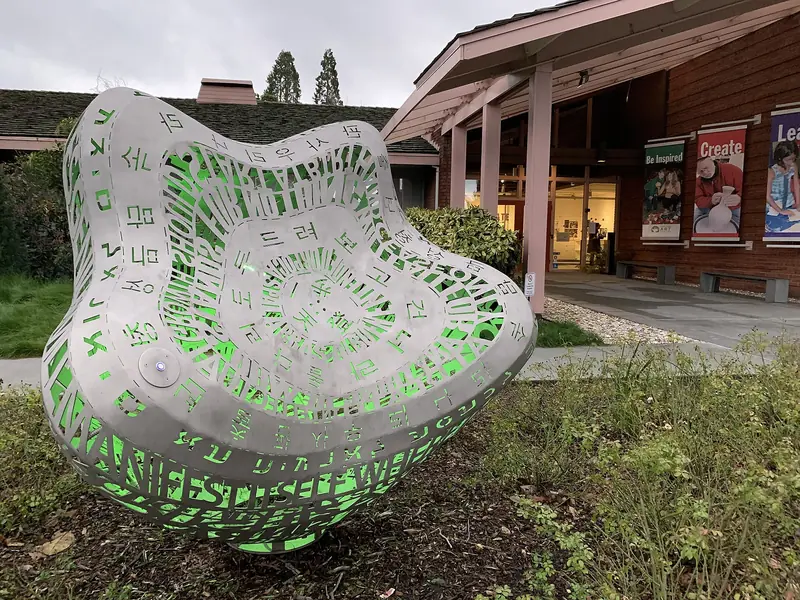
- Brilliance in the library plaza. Between the library and the Art Center stand six interactive pieces by Blessing Hancock and Joe O'Connell, who work as Creative Machines. Each combines words, shapes and light. The words came from meetings with residents who speak 20 languages. They were designed so visitors can press a button to change the LED colors and project messages onto the paving.
- Palo Alto Art Center, 1313 Newell Road. This was Palo Alto's city hall, designed by Leslie Nichols and opened in 1953. After the council moved city hall downtown, residents lobbied for an arts venue and the cultural center opened here on May 1, 1971. A renovation reopened it in 2012. Look for Nathan Oliveira's 8-foot bronze Universal Woman, which his family donated in 2014. Gale Wagner's Albuquerque is also listed at the Art Center. The exhibitions are free.
- Newell Road and Channing Avenue back to Middlefield. Walk north on Newell to Channing, the neighborhood's northern edge. Early in the 20th century some lots here held summer cottages for San Francisco families escaping the fog. Most have been replaced, but 951 Channing is rated Category 2 on the city inventory. Walk west on Channing to Middlefield and back to the start.

Three architects, three decades
The campus is a compact lesson in how Palo Alto's public taste changed. Birge Clark's 1930s community center uses red tile, stucco and courtyards, the Spanish Revival look he also gave downtown. Leslie Nichols's 1953 city hall is a modest modern building of its time. Edward Durell Stone's 1958 library brought a nationally known modernist to the same block. Our Birge Clark page covers the architect who shaped the most of early Palo Alto.
Lucie Stern made the first part possible. Widowed in 1924, she settled in Palo Alto, hired Clark for her own house and then for a string of public gifts. Local writers called her the city's fairy godmother.
Accessibility notes
- The loop is flat. Rinconada Park's renovation added a 12-foot-wide main path with 8-foot connecting paths.
- Restrooms are inside Rinconada Library and the Art Center during open hours. Check on site for current park restrooms.
- Middlefield and Embarcadero roads are busy, especially when Walter Hays and Paly let out. Use the signals.
- The park renovation added new benches and picnic tables.
- For a shorter walk of under a mile, do stops 1 to 3 and then cut through the park to stops 9 to 11.
Sidewalk etiquette
Good to know
- Houses around the civic block are private homes. Stay on the sidewalk.
- Walter Hays is a working school. Do not enter during school hours or photograph students.
- Do not climb on the sculptures. Brilliance invites you to press its buttons, nothing more.
- Keep voices down near the library and theater entrances during events.
Sources
Building histories follow the City of Palo Alto, the library's own history and our attraction pages. Public art details come from the city's collection listings and 2014 local coverage of the library reopening. Inventory ratings come from the city's Historic Inventory list. Distances are our estimates.
Frequently asked questions
What is on the Community Center walking tour?
The loop covers the Lucie Stern Community Center, the Children's Library, the Junior Museum and Zoo, Walter Hays School, Rinconada Park and its redwood grove, Rinconada Library and the Palo Alto Art Center. Most stops are public buildings or city parks.
Who designed the Lucie Stern Community Center?
Birge Clark designed it and Wells P. Goodenough built it. The city dates the complex to 1934, though some sources date the first buildings to 1932 or 1933. Lucie Stern paid for it and for later wings. The city's Historic Inventory rates it Category 1, its top tier.
Where can I get coffee near the Palo Alto Junior Museum and Zoo?
The civic block has no cafe and the zoo allows only water inside. Peet's Coffee and Manresa Bread at Town & Country Village are about 0.8 mile southwest along Embarcadero Road. Palo Alto Creamery at 566 Emerson Street downtown is about a mile away.
What public art is at Rinconada Library and the Art Center?
Look for Brilliance, six light-up pieces by Creative Machines in the plaza between the two buildings. Nathan Oliveira's 8-foot bronze Universal Woman stands at the Art Center. The city lists Hans Wehrli's Nude in Steel at the library and Gale Wagner's Albuquerque at the Art Center.
Is there parking for the Community Center walk?
City lots serve the community center, the zoo and Rinconada Library, which has about 89 spaces. Lots fill on summer weekends, during swim lessons and before evening shows, so arrive early or bike.