On this page
May is when Palo Alto settles into its long dry season. Afternoons reach the low to mid 70s, rain all but disappears and evenings stay light past 8 p.m. The foothills shift from green to gold over a few weeks. Some mornings begin under a low gray ceiling that clears by lunch, the first sign that the ocean fog season has started on the other side of the mountains.
Temperature and rain figures are NOAA's 1991 to 2020 climate normals for the Palo Alto station (USC00046646), which sits on the flats near the bay at about 25 feet. NOAA classes these values as "representative" because the station's record has gaps, so small differences between months are approximate. Sun times are calculated for central Palo Alto for May 2027 and match published tables within a minute. They describe a typical May, not a forecast. Our weather guide has the full year.
May by the numbers
| Measure | May in Palo Alto |
|---|---|
| Average high | 73.3°F |
| Average low | 49.5°F |
| Average rainfall | 0.44 inches |
| Middle half of years | 0.00 to 0.47 inches |
| Days with 0.01 inch of rain or more | 2.5 |
| Days with 0.10 inch or more | 1.5 |
| Days at 90°F or hotter | 1.0 |
| Nights at 32°F or colder | 0.0 |
| Sunrise | 5:50 to 6:14 a.m. |
| Sunset | 7:58 to 8:23 p.m. |
| Daylight | 13 h 45 min to 14 h 34 min |
| Ocean water, San Francisco buoy | 52.4°F |
NOAA's Coastal Water Temperature Guide has no Half Moon Bay station. The ocean figure is its long term average for the buoy west of San Francisco.
Rain: nearly gone
May averages 0.44 inches, but that number is skewed by a few wet years. The median May gets only 0.18 inches. In at least one May out of four the station records essentially nothing. About 2.5 days bring measurable rain and 1.5 bring a tenth of an inch or more. A late spring storm can still surprise, usually early in the month.
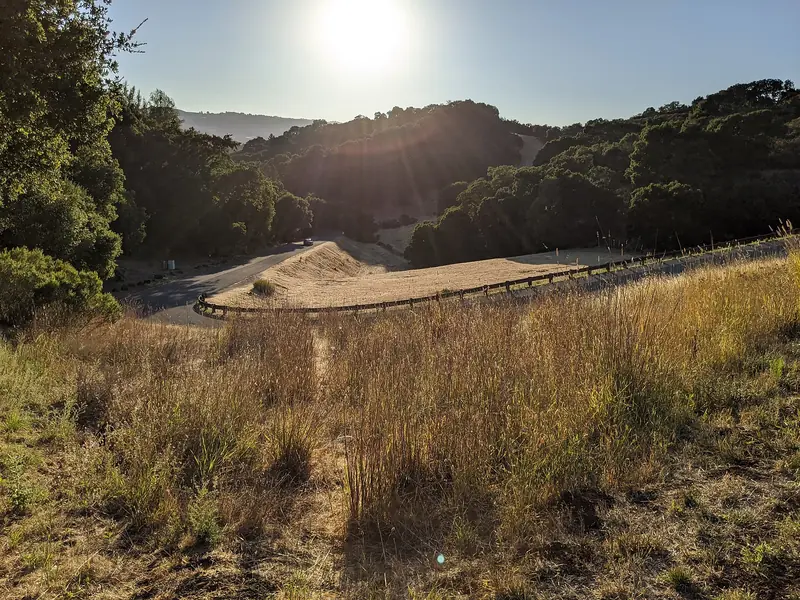
By the end of May the soil is drying fast. Without rain the grasses on the hills cure, turning from green to straw gold. That is beautiful from a distance. It marks the start of grass fire season in the foothills.
Long evenings
May days are long. Sunrise moves from about 6:14 a.m. on May 1 to about 5:50 a.m. by May 31. Sunset moves from about 7:58 p.m. to about 8:23 p.m. Daylight grows from about 13 hours 45 minutes to 14 hours 34 minutes.
That makes May one of the best months for evening plans. Outdoor dining downtown and on California Avenue stays comfortable until sunset. After dark, temperatures drop into the 50s quickly, so bring a layer for the walk home.
May gray, heat and air quality
The marine layer
Late spring is when the ocean off Northern California is coldest. NOAA's buoy west of San Francisco averages 52.4°F in May, the lowest of the year. Warm air sitting over that cold water forms a layer of low stratus clouds, the marine layer. On many nights it pushes through the Golden Gate and gaps in the coastal hills.
In Palo Alto that usually means a gray start a few days a week. The clouds tend to be thin here because the Santa Cruz Mountains block much of the flow. They burn off by 10 or 11 a.m. On the coast and in San Francisco, the same layer can hang on all day. Locals call it May gray.
The first warm spells
May averages about 5.8 days at 80°F or hotter and about one day at 90°F or more. When high pressure builds and the marine layer collapses, the whole Peninsula can warm sharply for a few days. Those are the days the Air District is most likely to call a summer Spare the Air alert for ozone, which forms when sunlight and heat act on vehicle exhaust. Ozone peaks in the afternoon, so plan runs early on hot days.
Fire season begins
Dry grass on the hills can burn from late spring onward. Wildfire smoke is not usually a May problem, but grass fires near trails and roads do happen. Obey any posted closures and never park on dry grass, since a hot exhaust system can start a fire. Our air quality guide explains how to check the AQI.
Microclimates: bay breeze and warm hills
May shows the bay effect clearly. Moffett Field, on the shoreline in Mountain View, averages a high of 71.7°F, about a degree and a half cooler than the Palo Alto station's 73.3°F. Its low is warmer, 52.5°F against 49.5°F. Neighborhoods near the marsh get the afternoon breeze first and keep the damp, mild nights.
The foothills are a different world on a warm day. South-facing grassland at Pearson-Arastradero and along Page Mill Road absorbs sun and can run several degrees warmer than downtown at midday. Then, after sunset, cool air drains downhill and the hills cool off quickly. Hike early or late on warm days.
The ridge along Skyline Boulevard often sits right at the top of the marine layer. On some May mornings you can stand in sun above 2,000 feet and look west over a sea of cloud covering the coast, while the bay side is clear below. Russian Ridge and Windy Hill are good places to see it.

How May compares with San Francisco and San Jose
| May normal | Avg high | Avg low | Rain (in) | Rainy days |
|---|---|---|---|---|
| Palo Alto | 73.3°F | 49.5°F | 0.44 | 2.5 |
| San Francisco downtown | 64.1°F | 51.4°F | 0.70 | 4.0 |
| San Jose | 73.8°F | 52.1°F | 0.39 | 2.7 |
| Moffett Field | 71.7°F | 52.5°F | 0.43 | 2.5 |
The gap with San Francisco widens to about nine degrees. Downtown San Francisco averages a May high of 64.1°F, held down by ocean wind and May gray. Palo Alto averages 73.3°F and San Jose 73.8°F. Nights are closer, with San Francisco at 51.4°F, Palo Alto at 49.5°F and San Jose at 52.1°F.
Rain barely registers anywhere. San Francisco averages 0.70 inches in May, Palo Alto 0.44 and San Jose 0.39. A day trip to the city calls for a real jacket. A trip to San Jose calls for sunscreen.
The coast in May
May is often the windiest and coldest month on the coast. With the open ocean at about 52°F and frequent fog, Half Moon Bay can be in the 50s on a 75°F Palo Alto afternoon. No long term Half Moon Bay sea temperature is published, but the San Francisco buoy average of 52.4°F and the Monterey buoy average of 54.1°F give a good idea. Swimming without a wetsuit is a short, bracing experience.
Inside the bay, the water is a different story. NOAA's Redwood City reading averages 65.1°F in May and keeps warming. Paddlers at the Baylands or Shoreline Lake stay much warmer than surfers on the coast.
What to pack for May
- Short sleeves and light pants for warm afternoons.
- A light jacket or sweater for gray mornings and evenings in the 50s.
- A warm layer and windbreaker for San Francisco or the coast.
- Sun protection. A hat, sunglasses and sunscreen for hikes on exposed trails.
- A water bottle. Many foothill trails have no water and little shade.
What May weather is good for
May is ideal for long days outside before summer heat. Our May trip guide covers the month's events and holidays. Weather-driven ideas:
- Foothill hikes before the heat. Foothills Nature Preserve opens at 8 a.m. and is pleasant until late morning on warm days.
- Sunsets after 8 p.m. Our sunset spots guide lists the best viewpoints.
- Paddling on calm mornings. Bay water is warming and winds are lighter early. See our kayaking and paddling guide.
- A beach town escape. Santa Cruz is often sunnier than Half Moon Bay in late spring. If you want someone else to drive, you can browse coast and redwood tours.
Warm spells come and go. On a hot afternoon, a city pool or a shaded redwood trail is the local move.
Frequently asked questions
How warm is Palo Alto in May?
NOAA's 1991 to 2020 normals give the Palo Alto station an average high of 73.3°F and an average low of 49.5°F in May. About 5.8 days reach 80°F and about one day reaches 90°F in a typical May.
Does it rain in Palo Alto in May?
Rarely. The average is 0.44 inches and the median May gets just 0.18 inches. Only about 2.5 days bring measurable rain. In at least one May out of four, essentially no rain falls at all.
What is May gray?
May gray is the local name for the marine layer of low clouds that forms over the cool ocean in late spring and pushes inland overnight. In Palo Alto it usually shows up as a gray morning that clears to sun by late morning. San Francisco and the coast often stay gray much longer.
Is San Francisco much colder than Palo Alto in May?
Yes. Downtown San Francisco averages a May high of 64.1°F, about nine degrees cooler than Palo Alto's 73.3°F. Bring a jacket for any evening in the city.
When does the sun set in Palo Alto in May?
Sunset moves from about 7:58 p.m. on May 1 to about 8:23 p.m. on May 31. Sunrise moves from about 6:14 a.m. to about 5:50 a.m. Days run from about 13 hours 45 minutes to 14 hours 34 minutes.