On this page
Theranos was a blood testing company that once claimed it could run a wide range of tests on a few drops of blood from a finger prick. It raised more than $700 million and was valued at about $9 billion at its peak in 2013 and 2014. Its claims did not hold up. The company dissolved in 2018 and its founder and former president were later convicted of fraud.
All of this happened in Palo Alto. Theranos ran its headquarters from three buildings in Stanford Research Park, including Facebook's old headquarters and a new building on Page Mill Road. This page sticks to the addresses, the documented timeline and the court outcomes as reported by major news outlets and summarized in public records. For the setting, see our guide to Stanford Research Park.
Founding and early years
Elizabeth Holmes founded the company in 2003, at age 19, after leaving Stanford as an undergraduate. Its first name was Real-Time Cures. She later renamed it Theranos, a blend of "therapy" and "diagnosis." Stanford chemical engineering professor Channing Robertson became an adviser and the company's first board member.
Ramesh "Sunny" Balwani, a software engineer, joined in 2009 as president and chief operating officer. From 2011 the company assembled a high-profile board that included former Secretaries of State George Shultz and Henry Kissinger and former Defense Secretary William Perry. The board was later criticized for consisting mainly of directors with diplomatic or military backgrounds.
The Palo Alto addresses
Theranos moved several times as it grew, staying inside Stanford Research Park each time.
| Address | Years | What happened there |
|---|---|---|
| 3200 Hillview Avenue | Until June 2012 | Earlier offices on Hillview Avenue, per the Silicon Valley Business Journal as cited by Wikipedia. |
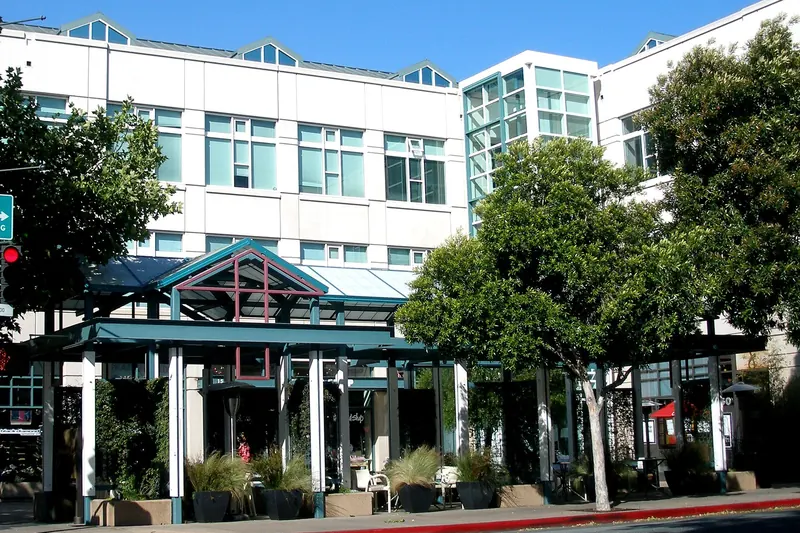
| 1601 S. California Avenue | From June 2012 | The former Facebook headquarters, a former Agilent building. |
| 1701 Page Mill Road | 2015 to 2017 | A new 116,000 square foot headquarters on the old Wall Street Journal printing plant site. |
1601 S. California Avenue
In June 2012 Theranos moved into 1601 S. California Avenue, often written 1601 California Avenue. Facebook had used the building as its headquarters from 2009 until it moved to Menlo Park in 2011. Our Facebook profile covers that earlier chapter. Despite the name, the building is in the research park, southwest of El Camino Real, not on the California Avenue shopping street.

1701 Page Mill Road
The company's final Palo Alto headquarters had a curious history. Fortune reported in October 2015 that the site had been the Wall Street Journal's main facility in Northern California, a printing plant built in 1966 on 8.5 acres. Dow Jones had announced in 2011 that it would close the plant before its lease ran out in 2015. Theranos agreed to take the site, construction began in early 2014 and the company moved in during 2015. That same newspaper's reporting would soon bring the company down.
The two-story building of about 116,000 square feet was built for Stanford's real estate arm and completed in 2014. It won a Gold Nugget Grand Award at the Pacific Coast Builders Conference in 2016.
The 2015 exposé
Theranos's public profile rose fast. In 2013 it partnered with Walgreens to offer blood tests in stores, including a wellness center in Palo Alto. A separate deal with Safeway, which invested $350 million in retrofitting stores with clinics, was terminated in 2015.
In October 2015 John Carreyrou of The Wall Street Journal reported that Theranos ran most of its tests on traditional commercial machines rather than its own Edison devices. It also reported that the Edison might produce inaccurate results. Tyler Shultz, a former employee and grandson of board member George Shultz, was a key source. Theranos called the reporting "factually and scientifically erroneous" and sent lawyers after sources. Carreyrou later told the story in his 2018 book Bad Blood.
Regulators and collapse, 2016 to 2018
Federal regulators soon confirmed serious problems. In January 2016 the Centers for Medicare and Medicaid Services said Theranos's lab in Newark, California, posed "immediate jeopardy to patient health and safety." Walgreens suspended tests from that lab and paused its Palo Alto wellness services. In May 2016 Theranos voided two years of results from its Edison devices. Walgreens ended the partnership in June 2016. In July 2016 regulators revoked the lab's certificate and banned Holmes from owning or operating a lab for two years.
The company shrank quickly. It closed its labs and wellness centers in October 2016 and laid off about 40 percent of its staff, then cut another 41 percent in January 2017. In January 2017 Kilroy Realty bought 1701 Page Mill Road from Stanford, becoming Theranos's landlord. Later that year Theranos left the building and moved its remaining staff into its Newark lab.
In March 2018 the Securities and Exchange Commission charged Theranos, Holmes and Balwani with fraud. Holmes settled with the SEC. She agreed to pay $500,000, forfeit 19 million shares and accept a ten-year bar from leadership roles at public companies. Balwani did not settle. In April 2018 Theranos cut its staff to fewer than 25 people, down from about 800 at its peak. In September 2018 it announced it would dissolve.
The criminal cases
A federal grand jury indicted Holmes and Balwani in June 2018 on wire fraud and conspiracy charges. Both pleaded not guilty and were tried separately in federal court in San Jose before Judge Edward Davila.
- Holmes verdict. On January 3, 2022, the jury found Holmes guilty on four counts related to defrauding investors: three counts of wire fraud and one of conspiracy. It acquitted her on four counts related to patients and could not agree on three more, which were later dismissed.
- Balwani verdict. On July 7, 2022, a separate jury found Balwani guilty on all 12 counts against him.
- Sentences. In November 2022 Holmes was sentenced to 11 years and 3 months. In December 2022 Balwani was sentenced to 12 years and 11 months plus three years of probation. In May 2023 the court ordered the two to pay $452 million in restitution, with responsibility shared.
- Prison. Balwani surrendered on April 20, 2023. Holmes began serving her sentence on May 30, 2023, at Federal Prison Camp, Bryan, in Texas.
- Appeal. In February 2025 the Ninth Circuit Court of Appeals affirmed Holmes's conviction and sentence.
Later developments are still unfolding. Wikipedia reports that Judge Davila reduced Holmes's sentence by 12 months in March 2026 under revised federal sentencing guidelines. It also reports that Balwani petitioned the Supreme Court in June 2026. We have not confirmed these in court records, so treat them as reported rather than settled.
What is there now
None of the Theranos buildings carry any sign of the company today. The Hillview Avenue and California Avenue buildings are ordinary research park offices. Wikipedia, citing a 2020 OneZero report, says Stanford Medicine converted 1701 Page Mill Road into offices and medical labs. Our page on the Stanford School of Medicine explains what visitors can and cannot see of Stanford's medical campus.
The story lives on in media. ABC News released The Dropout podcast in 2019 and Hulu turned it into a 2022 miniseries. In 2026 the documentary You Can See Everything, filmed with Holmes's participation before she reported to prison, opened in theaters on October 16.
Why the story matters locally
Theranos is the most famous failure in Palo Alto's startup history. It attracted big investors and prominent board members without independent proof that its technology worked. The trial verdicts drew a line between investor fraud and ordinary startup failure, which is why founders and investors still cite the case. For the investor side of the valley, see our history of venture capital on the Peninsula.
Good to know
- All three former Theranos addresses are private offices with badge access. There is nothing to visit.
- 1601 California Avenue is in the research park, not on the California Avenue shopping street near the Caltrain station.
- This page reports court outcomes and documented events only. For full legal detail, read the court records and major news coverage.
For other company histories, browse our guide to Palo Alto companies or the famous tech addresses tour.
Frequently asked questions
Where was Theranos located in Palo Alto?
Theranos was at 3200 Hillview Avenue until June 2012, when it moved to 1601 S. California Avenue, Facebook's former headquarters. In 2015 it opened a new headquarters at 1701 Page Mill Road. All three addresses are in Stanford Research Park. It also ran labs in Newark in the East Bay and in Scottsdale, Arizona.
What happened to the Theranos building at 1701 Page Mill Road?
Kilroy Realty bought the building from Stanford in January 2017 while Theranos still occupied it. Theranos left later in 2017 and moved its remaining staff to Newark. Wikipedia, citing a 2020 OneZero report, says Stanford Medicine converted the building into offices and medical labs.
What was Elizabeth Holmes convicted of?
On January 3, 2022, a federal jury in San Jose found Holmes guilty of three counts of wire fraud and one count of conspiracy to commit wire fraud, all related to investors. She was acquitted of four counts related to patients. The jury could not reach a verdict on three other counts, which prosecutors later dismissed.
How long were the Theranos sentences?
In November 2022 Holmes was sentenced to 11 years and 3 months in prison. In December 2022 former Theranos president Ramesh "Sunny" Balwani was sentenced to 12 years and 11 months plus three years of probation. Both were ordered to pay $452 million in restitution.
When did Theranos shut down?
Theranos laid off most of its staff in April 2018 and announced in September 2018 that it would dissolve. The final liquidation left its investors' stakes worthless.