On this page
Cisco Systems makes the routers, switches and security equipment that move data between networks. Most people never see its products, but a large share of the world's internet traffic passes through them. The company is based in San Jose and has been one of the largest technology firms in the country for three decades.
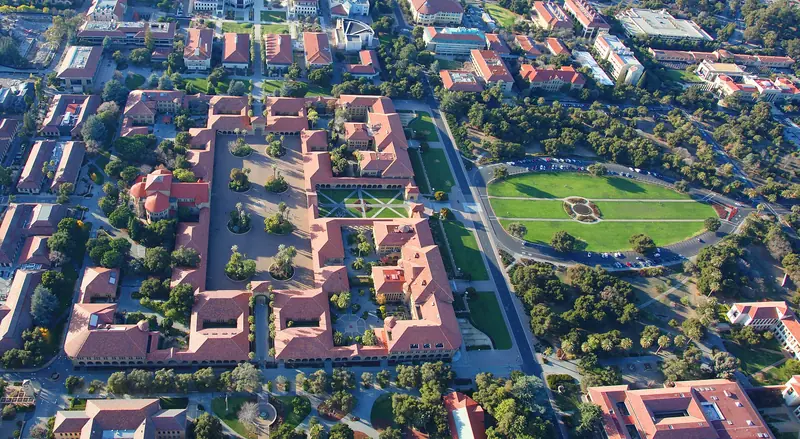
Its story starts at Stanford. Cisco's two founders ran computer facilities on campus in the early 1980s. They helped wire Stanford's scattered computers into a single network, then took the idea off campus and into business. The university was not pleased at first. This profile uses Stanford Engineering's own account, Wikipedia and reputable histories. It flags where sources disagree.
Two campus computer managers
Leonard Bosack and Sandy Lerner met at Stanford and married in 1980. Lerner earned a master's degree in statistics and computer science at Stanford in 1981 and became director of computer facilities for the Graduate School of Business. Bosack, who came to Stanford in 1979 to study computer science, was in charge of the computer science department's machines. Stanford Engineering describes them simply as two people who had worked in Stanford computer operations.
The problem they faced was common in universities of the time. Departments had bought different kinds of computers that could not talk to each other. Bosack worked as a support engineer on a 1981 project to connect Stanford's mainframes, minicomputers, LISP machines and Xerox Altos. Getting the business school network to share data with the computer science lab was part of the same push.
The Blue Box and the campus network
The key device was a multiprotocol router known on campus as the Blue Box. It could pass traffic between networks that used different protocols, which was exactly what Stanford needed. According to Wikipedia, its circuitry came from Andy Bechtolsheim, the Stanford graduate student who designed the SUN workstation board and later co-founded Sun Microsystems. Its software was written by Stanford research engineer William Yeager.
In 1985 Bosack and Stanford employee Kirk Lougheed began a project to formally network the campus. They adapted Yeager's software into what became the basis of Cisco's operating system. Yeager later said he had been denied permission to sell the Blue Box commercially.

Founding the company
Bosack and Lerner founded Cisco in December 1984; Wikipedia gives the date as December 10. Bosack's biography says they first asked Stanford for permission to build and sell routers and were turned down, so they started their own company.
Where exactly it started depends on the source. Wikipedia's article on Bosack says the couple started Cisco in Menlo Park. The company article's summary box lists San Francisco. Lerner has described building routers in the living room and paying for the business with credit cards in the early days. The name came from San Francisco, which is why early engineers insisted on writing it in lowercase. The logo shows the towers of the Golden Gate Bridge.
The early team included Bosack, Lerner, Lougheed, programmer Greg Satz and Richard Troiano in sales. Bill Graves was the first chief executive, from 1987 to 1988.
The dispute with Stanford
Stanford saw the router as university property. On July 11, 1986, Bosack and Lougheed were forced to resign. The university considered criminal complaints over its software and hardware designs. The matter was settled with a deal. In 1987 Stanford licensed the router software and two computer boards to Cisco.
The episode is still cited when people discuss how universities handle inventions made by staff and students. Stanford's Office of Technology Licensing, set up in 1970, now handles that work for faculty, staff and student inventions. Our page on Stanford entrepreneurship programs explains how it operates today.
Venture money, IPO and the founders' exit
Cisco took venture funding from Sequoia Capital, the Menlo Park firm founded by Don Valentine. In 1988 John Morgridge became chief executive. The company went public on Nasdaq on February 16, 1990, with a market value of $224 million.
The founders did not stay long after that. Lerner was fired on August 28, 1990. Bosack resigned in protest. The two sold all their stock for about $170 million and left the company.
Cisco grew fast through the 1990s. Between 1992 and 1994 it bought several Ethernet switching companies, including Kalpana, Grand Junction and Crescendo Communications. John Chambers succeeded Morgridge in 1995 and led the company until 2015.
The internet boom carried Cisco to a peak few companies have reached. In late March 2000 its market value passed $500 billion, briefly making it the most valuable company in the world. When the dot-com bubble burst, it lost most of that value within two years. The business kept growing anyway. In June 2009 Cisco joined the Dow Jones Industrial Average. Chuck Robbins has been chief executive since 2015.
Cisco timeline
| Date | Event |
|---|---|
| 1981 | Stanford project begins to connect campus computers; Bosack is a support engineer. |
| December 1984 | Bosack and Lerner found Cisco. |
| July 11, 1986 | Bosack and Lougheed resign from Stanford. |
| 1987 | Stanford licenses the router software and two boards to Cisco. |
| 1988 | John Morgridge becomes chief executive. |
| February 16, 1990 | Nasdaq listing. |
| August 1990 | Lerner is fired and Bosack resigns. |
| 1995 | John Chambers becomes chief executive. |
| March 2000 | Cisco briefly becomes the world's most valuable company. |
| June 8, 2009 | Added to the Dow Jones Industrial Average. |
| 2015 | Chuck Robbins succeeds Chambers. |
Cisco's place in the local story
Cisco is one of the clearest cases of Stanford infrastructure turning into a company. Its founders were not professors or star students. They were staff who kept the campus computers running. Their product grew from a practical fix for a practical problem.
The timing mattered too. Cisco's routers arrived just as universities, research labs and then businesses began joining their networks to the internet. A box that could translate between different network protocols was suddenly something every organization needed. The skills its founders learned keeping a messy campus network running turned out to be the skills a whole industry needed.
The company also became one of the region's biggest buyers of startups, which ties it to many firms on this site. Kleiner Perkins put money into Cerent, which Cisco later bought. Tae Hea Nahm, a co-founder of Storm Ventures, ran Airespace, a wireless startup Cisco bought, as our Storm Ventures profile notes. Jyoti Bansal sold AppDynamics to Cisco before co-founding Unusual Ventures. For many Peninsula founders, "selling to Cisco" was the exit plan.
Cisco never had a headquarters in Palo Alto that we could confirm. It sits at the south end of the same corridor, in north San Jose. Our San Jose guide covers the city's museums and downtown.
Visiting notes
Good to know
- Stanford displays an early Cisco router, described as "the large white box" that linked Stanford's Ethernets to the internet, on the first floor of the Huang Engineering Center at 475 Via Ortega. Go on a weekday during business hours.
- Cisco's San Jose campus at 170 West Tasman Drive is private. There are no public tours or visitor center.
- Our Engineering Quad guide lists the other historic displays in the same building, including the Yahoo servers and Google's first storage cabinet.
Frequently asked questions
Was Cisco founded at Stanford?
Cisco was founded in December 1984 by Leonard Bosack and Sandy Lerner, who ran computer facilities at Stanford. Its first routers were based on networking work done on campus. The company itself was set up off campus, with early work done in the founders' home.
Where was Cisco founded?
Sources differ. Wikipedia's article on Bosack says the couple started Cisco in Menlo Park, while the company article's summary box lists San Francisco, the city the name comes from. Either way the early company worked on the Peninsula near Stanford before moving to San Jose.
Why did Stanford object to Cisco?
The early routers used software first written at Stanford by research engineer William Yeager. Stanford pushed Bosack and engineer Kirk Lougheed to resign in July 1986 and considered legal action. In 1987 it licensed the router software and two computer boards to Cisco.
Where is Cisco headquartered?
Cisco's headquarters is in San Jose, on West Tasman Drive in the north of the city. It is a private campus with no public tours.
Can I see an early Cisco router?
Yes. Stanford displays a Cisco router that connected the campus Ethernets to the internet in the networking section on the first floor of the Huang Engineering Center at 475 Via Ortega.