On this page
Triple El may be the smallest named neighborhood in Palo Alto. It is three short, curving streets with 68 homes, most of them Eichlers, tucked between North California Avenue and Oregon Expressway. Drivers on Louis Road pass it without a second look. Inside, the streets are quiet, the trees are big and the neighbors know each other well enough to hold a potluck every spring.
This guide covers where Triple El is, how it was built, what its Eichlers and single-story zoning mean for owners and the parks, schools and shops nearby.
Where Triple El is
Palo Alto Weekly locates Triple El between North California Avenue and Oregon Expressway, bounded by Louis Road and Greer Road. Its three streets are Elsinore Drive, Elsinore Court and El Cajon Way. The name matches them neatly, since all three begin with El.
The surroundings are mostly residential. Leland Manor and Garland are just across Louis Road. Midtown begins on the other side of Oregon Expressway, with Greer Park a short walk away. Duveneck/St. Francis lies a few blocks north across Embarcadero Road. US 101 is about a mile east.
Residents describe the street layout as a horseshoe. Because the streets do not serve as shortcuts between the main roads, most of the traffic inside the neighborhood belongs to residents and their visitors.
How it was built
Triple El is a product of the postwar housing boom. Resident John Baum told Palo Alto Weekly how land like this was developed: somebody would buy a piece of farmland, get a permit for a subdivision and build. The Weekly described most of the homes as Eichlers built rapidly in the years after World War II.
Joseph Eichler built about 2,700 homes in Palo Alto, roughly 17 percent of its single-family houses according to the city. Most went up in central and south Palo Alto in the 1950s. Triple El is one of the smaller pockets of his work on the north side of Oregon Expressway, along with tracts such as Green Gables in Duveneck/St. Francis. Our Palo Alto architecture guide explains the Eichler story and the architects who worked with him.

Eichlers and the single-story overlay
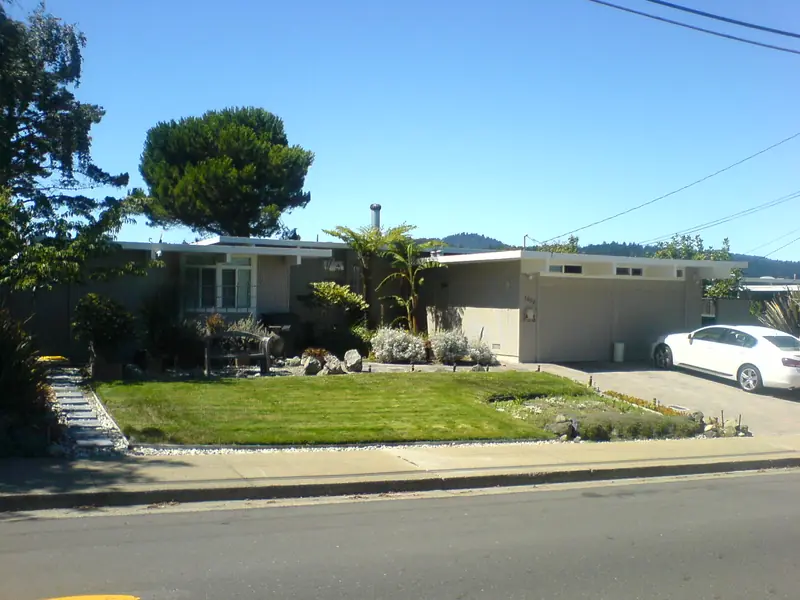
A typical Triple El house follows the Eichler formula. It has a low, flat or gently pitched roof and a mostly closed front facing the street. Floor-to-ceiling glass faces the backyard and post-and-beam construction opens the rooms to the garden. Many Eichler models also have an open-air atrium at the center.
The neighborhood's defining rule is its single-story overlay. Palo Alto Weekly reported that residents gathered a supermajority of about 70 percent to create it and that the rule is a point of pride for most of them. Palo Alto's single-story overlays limit new homes and additions to one floor, with a height cap of about 17 feet. The goal is to protect privacy in houses designed around glass walls and backyards.
What that means in practice:
- Remodels and rebuilds stay on one floor, so backyards are not overlooked by second stories.
- Owners who want more space usually build out rather than up.
- The city's voluntary Eichler design guidelines, adopted in 2018, offer ideas for keeping remodels in character.
Anyone planning work should confirm the current zoning with the City of Palo Alto planning department. For the wider housing market, see our real estate guide.
Owning an Eichler: practical notes
Buyers new to Eichlers should know what they are getting. These houses were built quickly and at modest cost in the postwar years. Decades later most need some care. Typical items to check with an inspector:
- Radiant heating. Many original Eichlers were heated by hot water pipes set in the concrete slab. Old systems can leak and are costly to repair, so many owners have switched to other heating.
- Flat roofs. Low-slope roofs need regular maintenance. Foam roofing is a common upgrade that also adds insulation.
- Glass walls. Original single-pane glass lets in light but also heat and cold. Replacing it with double-pane units is a popular project.
The single-story overlay shapes how far a remodel can go, so plan any work with the zoning in mind.
Street life and traditions
Triple El is known for neighborliness. One resident told Palo Alto Weekly it is a really serious community in terms of people being there for each other. The traditions the Weekly described include:
- A Memorial Day potluck at a corner of the horseshoe.
- A Labor Day ice cream social to close out the summer.
- A New Year's Day Mummers Parade, borrowed from Philadelphia by a resident from that city, with dozens of children taking part.
Residents also described the neighborhood as international, with families from many countries. Sinuous streets lined with Modesto ash and Chinese elm trees give it a leafy feel unusual for a tract this size. Traditions depend on volunteers, so details can change from year to year.
Parks nearby
Greer Park at 1098 Amarillo Avenue, across Oregon Expressway in Midtown, is the closest big park, with sports fields, a playground and a small fenced dog area. Rinconada Park at 777 Embarcadero Road is a short bike ride west. It has the city's public pool and sits next to the Junior Museum and Zoo. The Baylands are a few minutes' drive east along Embarcadero Road.
Schools by attendance area
Palo Alto Weekly neighborhood guides have listed Duveneck Elementary on Alester Avenue, Jordan Middle School and Palo Alto High School for Triple El. Jordan was renamed Frank S. Greene Jr. Middle School in 2018 and sits on North California Avenue, just across Louis Road. Attendance areas follow specific streets and can change, so confirm any home with the PAUSD school finder. Our public schools guide explains the district.
Shops and getting around
For groceries and errands, residents use the Midtown shops on Middlefield Road around Colorado Avenue, where Safeway anchors the center. Edgewood Plaza on Embarcadero Road is another option. See our guide to Midtown and Edgewood Plaza shopping.
Oregon Expressway gives quick access to US 101 and to El Camino Real. VTA buses run on Louis Road and Middlefield Road. Caltrain is a bike ride away at the California Avenue or Palo Alto stations.
Good to know
- Homes are private. Enjoy the architecture from the street and do not walk up driveways.
- Oregon Expressway is loud at rush hour. Homes deeper in the loop are quieter.
- The single-story overlay affects remodel plans. Check zoning before you buy.
Families visiting relatives in Triple El often rent a house nearby for a week or more. You can browse house rentals in Palo Alto or compare Palo Alto hotels.
Frequently asked questions
Where is Triple El in Palo Alto?
Triple El is a small neighborhood in north Palo Alto between North California Avenue and Oregon Expressway, bounded by Louis and Greer roads. It is made up of three streets: Elsinore Drive, Elsinore Court and El Cajon Way.
Why is it called Triple El?
The name matches its three streets, all of which begin with El: Elsinore Drive, Elsinore Court and El Cajon Way. Residents and Palo Alto Weekly use the name for that small cluster of 68 homes.
Are the homes in Triple El Eichlers?
Most of them are. Palo Alto Weekly counted 68 homes, most of them Eichlers built quickly in the years after World War II. Some have been remodeled or replaced, but the single-story overlay keeps new homes to one floor.
Does Triple El have a single-story overlay?
Yes. Palo Alto Weekly reported that residents reached a supermajority of about 70 percent to support a single-story overlay, the zoning rule that limits homes to one story. Palo Alto's overlays generally cap height at about 17 feet. Check with the city's planning department before planning a remodel.
Which schools serve Triple El?
Palo Alto Weekly guides listed Duveneck Elementary, Jordan Middle School (now Frank S. Greene Jr. Middle School) and Palo Alto High School. Confirm any address with the Palo Alto Unified School District school finder, since boundaries can change.