On this page
San Francisco and Palo Alto sit at opposite ends of the same commute. Tens of thousands of people make the trip every weekday in one direction or the other. For a visitor that is good news. The route is well served by trains, two freeways and every ride app in the region. It also means the roads clog at predictable hours, which is the main thing to plan around.
This page covers the trip from San Francisco itself. If you are flying into SFO, our SFO guide covers the airport transfer in detail. For the East Bay or San Jose, see the other guides under getting to Palo Alto.
The options at a glance
| Option | Typical time | Best for |
|---|---|---|
| Caltrain express | About 40 minutes | Weekday trips from SoMa or downtown |
| Caltrain local | About 50 minutes or more | Weekends and stations the express skips |
| BART to Millbrae, then Caltrain | Varies with the transfer | Starting from the Mission or downtown Market Street |
| Driving or rideshare | 40 minutes to well over an hour | Groups, luggage, late nights |
| SamTrans 397 | Long, many stops | Overnight, after the trains stop |
Train times come from Caltrain's weekday timetable as posted in late October 2026. Road times depend almost entirely on when you leave.
Caltrain from San Francisco
Caltrain is the default choice. Its San Francisco terminal sits at Fourth and King streets in SoMa, a short walk from Oracle Park and a Muni Metro stop. The 22nd Street station in Dogpatch is the second San Francisco stop and handy for the Mission side of the city. Both are in Zone 1. Palo Alto is in Zone 3, so the ride counts as three zones.
Which train to take
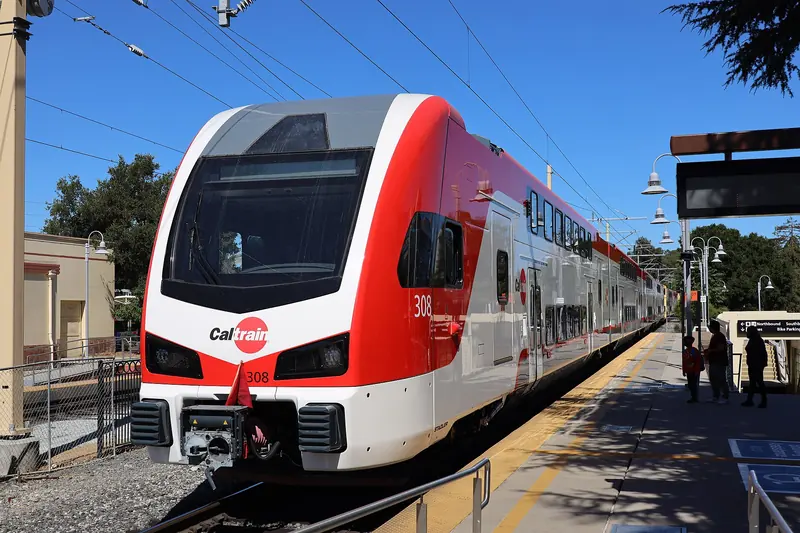
Electric trains have run the whole line since September 2024. Weekdays bring three train types:
- Express trains (500 series) make few stops and reached Palo Alto in about 39 minutes from San Francisco on the late October 2026 timetable.
- Limited trains (400 series) took about 41 minutes southbound and 43 minutes northbound. They also stop at California Avenue.
- Local trains (100 series) stop everywhere and took about 49 minutes, a few runs a little longer.
All three stop at Palo Alto station. Weekend service is local only, with trains about every 30 minutes. Check the official Caltrain schedules before you go, since the timetable is revised several times a year.
Fares and tickets
The adult fare for three zones was $8.50 one way in October 2026, with a day pass at $17.00. Caltrain's fares page lists a rise to $9.00 one way from January 1, 2027. Youth riders pay $1.00 for any distance. Tap a Clipper card, a contactless bank card or a phone wallet on the platform validator before you board and again when you get off. Day passes are sold only from station ticket machines. Our Caltrain guide explains discount fares, bikes on board and the train numbering.
Late trains
The last southbound trains of the night left San Francisco shortly after midnight on the late October 2026 weekday timetable. Plan the return leg of a day in Palo Alto with the same care. Missing the last train means a long bus ride or a pricey car home. Riding this route every workday? Our guide to commuting between Palo Alto and San Francisco compares trains, monthly passes and driving.

BART to Millbrae, then Caltrain
If you are staying near Market Street or in the Mission, walking or riding Muni to Fourth and King can take longer than you expect. BART is the alternative. Ride a train bound for Millbrae, where BART and Caltrain share a station with a cross-platform connection. Then take a southbound Caltrain to Palo Alto.
Millbrae is in Caltrain Zone 2, so the Caltrain leg is a two zone ride. It cost $6.25 for an adult in October 2026. BART charges its own distance-based fare for the first leg; see bart.gov for the amount. On Caltrain's weekday timetable, express trains took about 21 minutes from Millbrae to Palo Alto and locals about 28.
The catch is the connection. BART and Caltrain run on separate patterns. Use the joint Millbrae transfer timetable to pick a pairing that lines up. In the evening Caltrain warns of BART delays while it upgrades its train control system, so leave a margin.
Buses, including the overnight 397
No daytime express bus runs from San Francisco to Palo Alto. Two SamTrans routes matter anyway.
- Route 397 is a limited overnight route that runs from San Francisco through SFO to the Palo Alto Transit Center beside the Caltrain station. It is slow but useful after the trains stop.
- ECR runs the length of El Camino Real between Daly City BART and Palo Alto. It is a local bus with many stops, so it suits short hops more than the whole trip.
SamTrans listed an adult fare of $2.25 in cash or $2.05 on Clipper in October 2026. Check the SamTrans site for overnight times, which are few.
Driving from San Francisco
Two freeways run south. Both take you to Palo Alto in roughly 35 miles.
US 101
The Bayshore Freeway is the direct route along the bay. It passes SFO, San Mateo and Redwood City. Exit at University Avenue for downtown, Embarcadero Road for Stanford Shopping Center and the east side of downtown, or Oregon Expressway for Midtown and California Avenue.
The 101 San Mateo Express Lanes run between the I-380 interchange and the Santa Clara County line. They toll solo drivers Monday to Friday from 5 a.m. to 8 p.m. and need a FasTrak tag during those hours. Carpools of three or more ride free with a FasTrak Flex tag set to 3+. Two-person carpools get half off with the Flex tag set to 2. Prices change with traffic, as explained on the FasTrak express lanes page.
Interstate 280
Interstate 280 follows the hills on the west side of the Peninsula. It is a little longer on the map but often calmer and far prettier, past Crystal Springs Reservoir. Exit at Sand Hill Road for Stanford and Stanford Shopping Center, or at Page Mill Road for Stanford Research Park and California Avenue. Our driving guide goes through every exit.
Parking when you arrive
Downtown Palo Alto has free time-limited parking and several city garages. Our guide to downtown parking garages lists them with the permit rules.
Rideshare, taxis and robotaxis
Uber and Lyft both run trips from San Francisco to Palo Alto. Prices rise with demand, so a weekday evening run usually costs more than a Sunday morning one. Waymo says its Bay Area service covers the Peninsula from San Francisco down to San Jose, Palo Alto included. Open the app to see whether your pickup point and drop-off are inside its current map. Our page on robotaxis and rideshare covers how each works once you are in town.
For a family with bags, a car door to door often beats two train legs plus a walk. For a solo traveler, the express train is cheaper and often faster.
When to travel
Traffic is the variable. Weekday peaks run roughly 7 to 10 a.m. and 3 to 7 p.m. in both directions on both freeways. Friday afternoons are heavy. Sunday mornings are usually the easiest time of the week to drive.
- Weekday mornings: take an express train if you can. They are the fastest way down the Peninsula at that hour.
- Giants home games: Oracle Park sits next to the San Francisco station. Trains and platforms get crowded before and after games.
- Late evenings: plan the trip back before you go out and check the last train on the day.
- Weekends: trains are slower locals, while the roads are usually lighter, so driving gains ground.
Good to know
- Tap on and tap off on every Caltrain ride, whatever card you use.
- Caltrain one-way tickets are valid for four hours in one direction.
- A regional transit funding measure is on the November 3, 2026 ballot. Caltrain has warned of service cuts without new funding, so check the timetable after the election.
- Every electric train has two bike cars, so you can bring a bike for riding around Palo Alto.
Arriving in Palo Alto
Trains and the overnight bus all end at or pass through Palo Alto station, at the foot of University Avenue. Downtown restaurants and hotels are a few minutes away on foot. Free Stanford Marguerite shuttles leave from the transit center on weekdays. If you still need a room close to the platform, read about staying downtown or compare hotels near Palo Alto station. Heading the other way for a day? Our San Francisco day trip works in reverse.
Frequently asked questions
How long is the train from San Francisco to Palo Alto?
In the weekday timetable Caltrain posted in late October 2026, express trains took about 39 minutes from San Francisco to Palo Alto. Limited trains took about 41 minutes southbound and 43 northbound. Locals took about 49. Weekend trains are all locals, so allow close to an hour.
How much is Caltrain from San Francisco to Palo Alto?
It is a three zone trip. The adult one-way fare was $8.50 in October 2026 and a day pass was $17.00. Caltrain lists a rise to $9.00 one way from January 1, 2027.
Is it faster to drive or take Caltrain from San Francisco?
Outside rush hour, driving and the express train take about the same time. On weekday mornings and late afternoons the express train usually wins, because US 101 and Interstate 280 slow down near the city and through the mid-Peninsula. Driving makes more sense for groups, heavy bags or late night trips.
What is the last train from San Francisco to Palo Alto?
On the weekday timetable we checked in late October 2026, the last southbound trains left San Francisco shortly after midnight. Timetables change, so confirm the final departure on caltrain.com on the day you travel. After the last train, the overnight SamTrans 397 bus or a ride service are the options.
Which Palo Alto station should I get off at?
Use Palo Alto station at 95 University Avenue for downtown, Stanford and the transit center, since every train stops there. California Avenue station suits Midtown and the California Avenue district, but express trains do not stop there.